
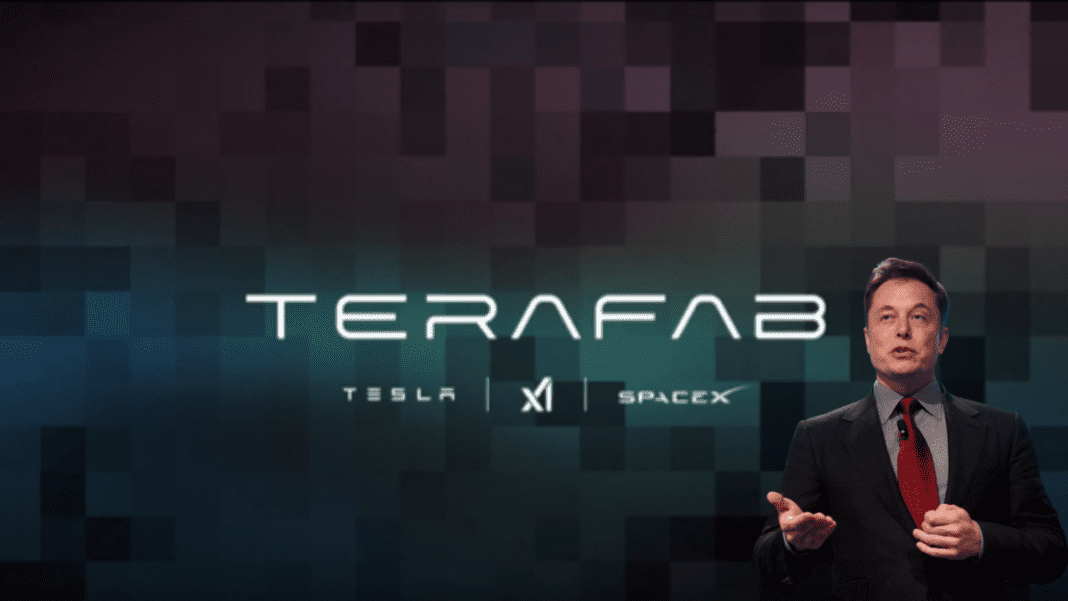

Elon Musk has unveiled “Terafab,” a major chip manufacturing project involving Tesla, SpaceX, and xAI. The initiative aims to tackle rising demand for advanced semiconductors by creating an integrated facility that brings chip production under one roof, reducing reliance on external suppliers.
A Massive Chip Project Takes Shape in Texas
Elon Musk, CEO of Tesla, has unveiled an ambitious semiconductor project called “Terafab,” planned for Austin, Texas. The facility aims to bring together chip design, manufacturing, memory production, and packaging under one roof, which is uncommon in the industry. This integrated approach is expected to improve efficiency and give Musk greater control over supply chains.
The project involves Tesla along with SpaceX and xAI, as all three companies face rising demand for advanced chips used in artificial intelligence systems. Initial costs are estimated between $20 billion and $25 billion, while analysts at Morgan Stanley suggest the total investment could increase to $35 billion to $45 billion over time.
SpaceX schedules Falcon 9 launch from Cape Canaveral following unusual southeast trajectory
Terafab will be built at Tesla’s Giga Texas North Campus and could surpass the size of its existing factory. SpaceX described it as a step toward a “galactic civilization,” highlighting its link to AI and space technology.
Why Musk Wants to Build His Own Chips
Elon Musk said the idea behind Terafab comes from a growing global shortage of advanced chips. His companies depend heavily on powerful semiconductors, but supply has struggled to keep up with rising demand. At present, most cutting-edge chips are produced by TSMC and Samsung, which remain industry leaders but expand their production capacity at a controlled pace.
Musk believes this rate of expansion is too slow for companies focused on artificial intelligence. He has highlighted that global AI computing capacity is still only a small portion of what will be required in the coming years. Without enough chips, key projects across Tesla, SpaceX, and xAI could face serious delays or limitations.
Elon Musk’s Bold Vision for Robotaxis Faces Uber’s Race to Saudi Arabia
The demand is increasing rapidly, especially because of Tesla’s growing focus on robotics and self-driving systems. These technologies rely on chips as their core processing units, often described as the “brains” that power decision-making and automation. A limited chip supply could slow down innovation and large-scale deployment.
Terafab aims to address this by producing two main categories of chips. These include edge processors for self-driving cars, Robotaxi fleets, and Optimus robots, as well as radiation-hardened chips designed for space environments. These advanced chips will support satellites and potential orbital data centers, linking AI growth with space-based infrastructure.
Huge Demand Driven by Robotics and AI
A major driver behind Terafab is the expected surge in robot production. Tesla is rapidly expanding its focus on humanoid robots, which depend on advanced chips to process data, make decisions, and interact with the real world. Analyst Andrew Percoco estimates that a single facility in Texas could support production of up to 10 million robots annually. To power these machines, around 20 million chips would be needed each year, a figure significantly higher than Tesla’s current chip requirements for its electric vehicles.
Elon Musk has outlined an even more ambitious long-term vision. He aims to scale robot production to 100 million units per year. If achieved, this would drive demand for over 200 million chips annually. This projection highlights the massive scale at which Terafab is being planned, positioning it as a critical part of Tesla’s robotics and artificial intelligence ecosystem.
SpaceX pivots from Mars as Elon Musk backs fast-track plan for self-growing city on the Moon
The facility is expected to focus on 2-nanometer chip manufacturing, one of the most advanced and efficient technologies in the semiconductor industry. These chips are designed to deliver higher performance while consuming less power. Musk has also set a target of generating more than one terawatt of AI computing capacity annually, with a significant portion expected to support space-based systems connected to SpaceX.
However, experts caution that building such a facility will be highly complex and expensive. Percoco describes Terafab as a high-risk, capital-intensive project that requires developing advanced expertise from scratch. While SpaceX is reportedly exploring an IPO, Terafab could serve as a key indicator of long-term growth, though production may not begin before mid-2028.