
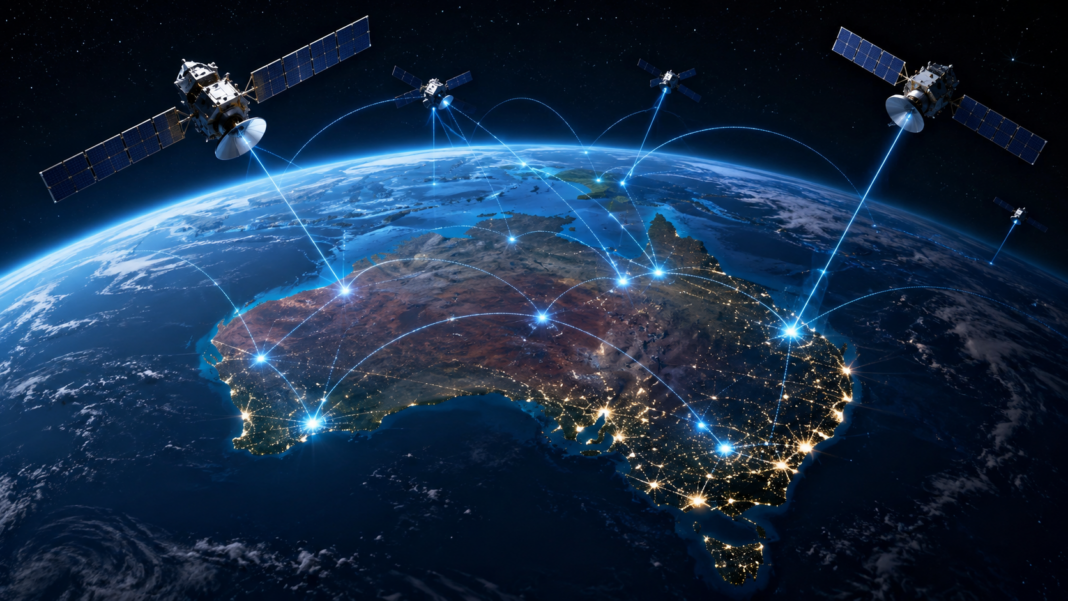

Australia’s modern economy is deeply connected to satellites that orbit far above Earth. These satellites help power everyday life, from navigation on mobile phones to weather forecasting, banking systems, farming, and emergency response. But a growing concern highlighted in recent analysis is that Australia depends heavily on satellites it does not own or fully control, raising questions about how secure and stable this reliance really is.
Australia’s Hidden Dependence on Foreign Satellites
Many Australians do not realize how often satellites support daily life. Services like phone navigation, digital payments, and parcel tracking all depend on satellite systems working in the background.
Most of these satellites are not owned by Australia. They are operated by other countries or global companies, meaning Australia relies on outside systems for GPS, internet in remote areas, weather forecasts, and disaster monitoring.
Satellites are also important for farming and emergency services. Farmers use them to study soil, rainfall, and crops, while rescue teams depend on them during floods, bushfires, and cyclones. Despite this, Australia has limited ownership of its own satellites, increasing its dependence on international providers.
Space as a Critical Infrastructure Backbone
Satellite systems are now treated as critical infrastructure because they support essential national functions. If disrupted, they could affect transport, banking, power grids, communication networks, and even national security.
A key function is Positioning, Navigation, and Timing (PNT), including GPS, which is used in aviation routes, logistics, and financial transactions. Even a short GPS outage could disrupt many industries at once. Earth observation satellites also provide important data for weather tracking, disaster response, environmental monitoring, and defence planning.
Most of these satellites are owned by foreign governments or global companies, so Australia depends on external access. The country also spends large amounts each year buying satellite data from providers in nations like the United States, Japan, and Europe. Experts warn that this reliance carries risks, as access to critical satellite information may not always be guaranteed during technical failures or global tensions.
Economic and Strategic Risks of Relying on External Space Systems
Australia’s economy is closely tied to satellite services, even if it is not always visible. Key industries such as mining, agriculture, logistics, banking, and telecommunications all depend on space-based data to function smoothly.
Ozone Layer at Risk: Starlink Satellites Pose New Threat
Satellite signals help financial systems process transactions, guide delivery routes, and support weather forecasting used in farming, aviation, and tourism. Because of this reliance, even small disruptions or delays in satellite data can create major economic and operational issues.
At present, Australia depends heavily on satellites owned and operated by other countries for communication, navigation, and Earth observation. Many of these services are provided through commercial agreements that can change based on pricing or availability. This limits Australia’s control over critical data. With increasing global competition in space and more reliance on a few major providers, Australia’s economy remains strongly connected to systems managed outside its borders.
Growing Reliance on Global Satellite Networks
Australia is increasingly using satellite systems from international companies to improve internet access in remote and rural areas. These systems help connect isolated communities, support emergency services, and assist industries operating far from major cities.
How invisible dual-use satellites are blurring the dangerous lines between peace and war in space
Most of these satellite services, including low Earth orbit internet networks, are owned and operated by foreign organisations. As a result, Australia relies on external infrastructure to maintain wide communication coverage. In several cases, government agencies have also signed agreements with global providers to replace older domestic systems, improving connectivity but increasing dependence.
Australia continues to purchase large amounts of satellite data instead of producing it locally, which strengthens efficiency but deepens reliance on outside systems. Satellite technology is also now widely used in defence, including communication, surveillance, and navigation. This shows that satellites have become essential infrastructure for both the economy and daily life, even without full national control.