

Blue Origin has moved closer to launching its Blue Moon MK1 cargo lander after completing major environmental testing at Nasa’s Johnson Space Center. The successful tests simulated the harsh conditions of space and marked an important step for future Moon missions under the Artemis programme.
Blue Origin’s Blue Moon MK1 completes critical testing inside giant Nasa vacuum chamber
Blue Origin has moved closer to launching its Blue Moon Mark 1 (MK1) cargo lander after completing major environmental testing at Nasa’s Johnson Space Center in the United States. The spacecraft, also called “Endurance,” was tested inside Thermal Vacuum Chamber A, one of the world’s largest facilities designed to recreate the harsh conditions of space.
Engineers exposed the lander to freezing temperatures, extremely low pressure, and near-airless conditions similar to those expected during its journey to the Moon. The goal was to confirm that MK1’s thermal systems, electronics, structure, and overall performance could operate safely in space.
Blue Origin achieves New Glenn landing milestone as regulatory tensions with SpaceX continue
The testing marks an important milestone for Blue Origin’s lunar programme and supports broader Artemis Moon mission goals. Conducted under a Space Act Agreement between Nasa and Blue Origin, the project highlights growing cooperation between government space agencies and private companies in developing lunar transportation and cargo systems for future Moon exploration missions.
What Blue Moon MK1 will do during its Moon mission
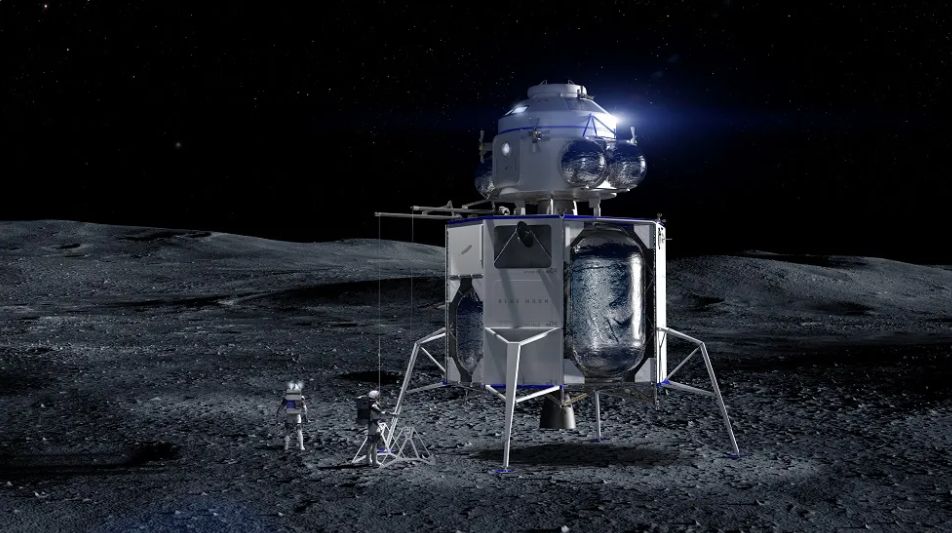
Blue Moon MK1 is an unmanned cargo lander designed to transport equipment, scientific payloads, and mission supplies to the Moon’s surface. Unlike future lunar vehicles built for astronauts, MK1 will focus on testing important technologies needed for safe lunar operations.
Its first mission will demonstrate precision landing systems, autonomous navigation, and advanced cryogenic propellant management. Cryogenic propellants are super-cold fuels used in modern spacecraft, and engineers want to confirm they can function properly during a real Moon mission.
The lander will also test autonomous guidance and control systems, allowing it to make landing adjustments without direct human control from Earth. Accurate landing is critical because the Moon’s surface contains craters, rocks, and uneven terrain that could damage spacecraft during descent.
Empowering Space industries: Power Players
Blue Moon MK1 is expected to land near the Moon’s south pole, a region believed to contain water ice inside permanently shadowed craters. Scientists consider this ice important because it could support future missions by providing water, oxygen, and even rocket fuel.
The lander will carry scientific instruments, including cameras that study how engine plumes interact with lunar dust during landing, along with a Laser Retroreflective Array used for highly accurate measurements of the Moon’s position and movement.
Testing results help advance future Moon landing systems
Although Blue Moon MK1 is designed for cargo delivery, the mission is also helping develop future lunar transportation systems. Technologies tested on MK1 are expected to support the larger Blue Moon Mark 2 lander, which is being designed to carry astronauts between lunar orbit and the Moon’s surface.
Engineers are using lessons from MK1 to improve spacecraft reliability, safety systems, and mission planning for future crewed lunar missions. Data collected during environmental testing helps teams understand how spacecraft materials and onboard systems behave under space-like conditions, reducing risks during real Moon operations.
Precision in orbit! Blue Origin’s 320-foot New Glenn rocket aces launch and historic sea landing
The thermal vacuum testing also allows engineers to detect technical problems before launch. Identifying issues on Earth is safer and less expensive than dealing with failures during a lunar mission.
Nasa’s Thermal Vacuum Chamber A continues to play an important role in supporting commercial spacecraft development. Access to such advanced facilities helps private companies test and improve their systems for future space missions.
The Blue Moon MK1 testing campaign also highlights growing cooperation between Nasa and private aerospace firms as lunar exploration expands. With environmental testing now completed, the cargo lander has moved another step closer to supporting future Moon missions and lunar surface operations.