

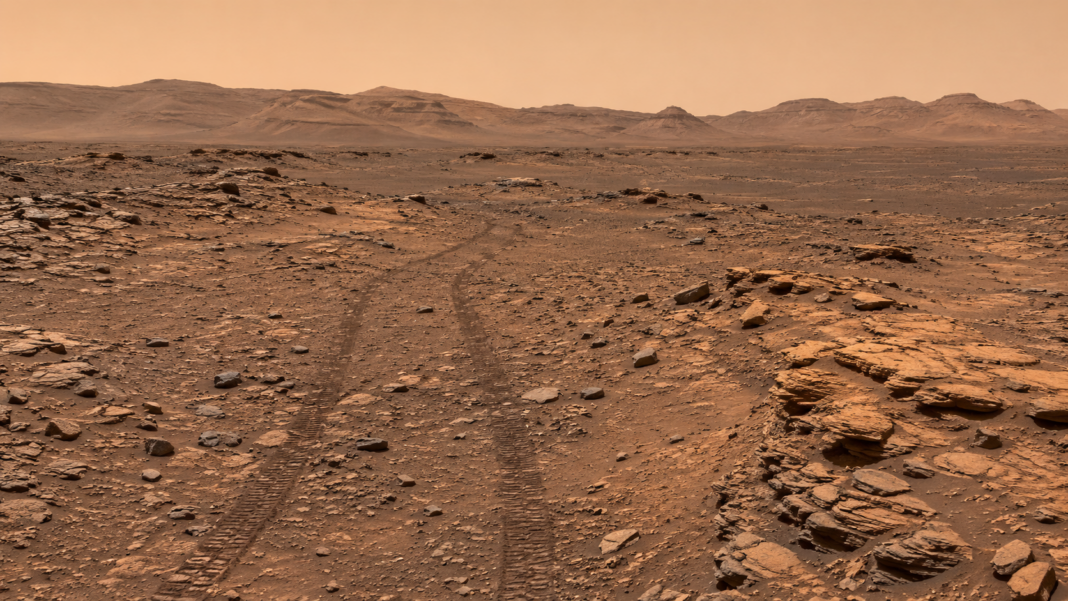

NASA’s Perseverance rover has captured a stunning 360-degree panorama of a mysterious Martian region called “Crocodile Bridge,” revealing ancient rocky terrain near Jezero Crater. Scientists believe the area may hold clues about Mars’ early history, atmosphere and long-lost water-rich past.
Ancient Martian Rocks Could Hold Secrets of Mars’ Early History
The Crocodile Bridge region lies along the rim of Jezero Crater, one of the most important exploration sites on Mars. Scientists selected Jezero Crater for the Perseverance mission because evidence suggests it once contained a large lake and river delta billions of years ago. Earlier observations also found minerals that usually form in water-rich environments, making the area important in the search for signs of ancient microbial life.
Researchers believe the rocks in Crocodile Bridge are among the oldest ever studied on Mars and may date back to the early formation of the solar system. Unlike Earth, Mars does not have active plate tectonics constantly reshaping its surface. This has allowed ancient landscapes and rocky terrain to remain preserved for billions of years.
Exceptional results from lithium thruster testing boost potential for future Mars exploration
The panorama also reveals the nearby “Lac de Charmes” region, another major area of scientific interest for the Perseverance mission. NASA released enhanced-colour and 3D versions of the images to help scientists study rock layers, textures and geological details more clearly across the Martian landscape.
Why NASA Calls the Region ‘Crocodile Bridge’
The unusual nickname “Crocodile Bridge” has attracted curiosity from many people following the mission. However, the name does not mean there are crocodiles or actual bridges on Mars.
NASA has not officially explained where the nickname came from. The title appears to be an informal operational name used by mission teams to identify a specific route or landscape feature during rover operations.
Mars missions often use unofficial names for rocks, cliffs, hills and exploration zones to make navigation and scientific discussions easier. These names help teams quickly identify important areas while working on the mission.
Empowering Space industries: Power Players
In this case, Crocodile Bridge refers to a transition zone leading toward the Lac de Charmes region. Some observers believe the terrain may resemble the shape or texture of a crocodile from certain angles, though NASA has not confirmed the exact inspiration behind the name.
The nickname has added an extra layer of fascination to an already remarkable discovery. The rocky landscape shown in the panorama appears wild, ancient and untouched, giving viewers a glimpse into a world far different from Earth.
The image also highlights how isolated and harsh the Martian environment is. Dust-covered rocks stretch across the plain under a pale sky, while rugged ridges rise in the distance. The rover’s wheel tracks provide one of the few visible signs of human exploration on the planet.
Perseverance Rover Continues Its Mission Across Jezero Crater
Since landing on Mars in February 2021, NASA’s Perseverance rover has been exploring Jezero Crater in search of signs that microbial life may once have existed on the Red Planet. The rover has already studied ancient river channels, sediment deposits and volcanic rocks during its mission.
One of Perseverance’s most important tasks is collecting rock and soil samples from the Martian surface. These carefully selected samples are being stored for a possible future mission that could return them to Earth for detailed scientific analysis.
NASA builds on the success of the Mars helicopter to launch a powerful drone mission to Titan
The newly released Crocodile Bridge panorama was captured using Mastcam-Z, an advanced stereo camera system mounted on the rover’s mast. The camera can zoom in on distant objects, create 3D imagery and capture highly detailed views of the Martian landscape, helping scientists closely examine geological formations.
Researchers say the high-resolution panorama provides another valuable opportunity to study one of the oldest preserved landscapes on Mars. The rocky terrain, dusty plains and ancient ridges seen in the images may hold clues about Mars’ early crust, atmosphere and long-lost watery past.