
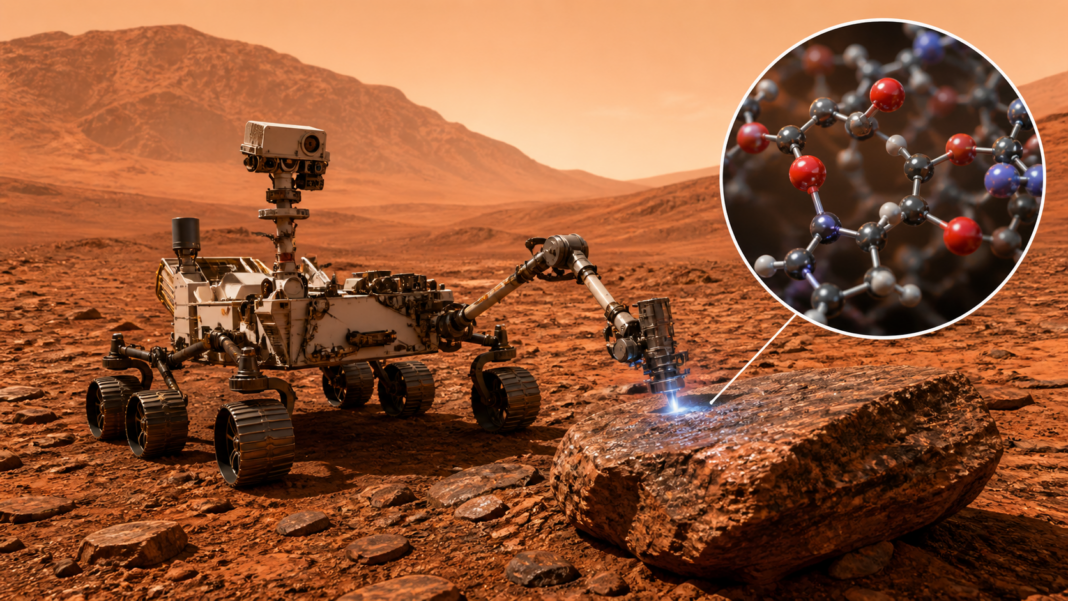

A major discovery on Mars has revealed the richest collection of organic molecules ever found on the planet. Detected by NASA’s Curiosity rover in an ancient lakebed rock, the finding offers new clues about Mars’ past and its ability to preserve key ingredients for life.
A Remarkable Find Inside an Ancient Martian Lakebed
A major scientific discovery on Mars has revealed the richest collection of organic molecules ever found on the planet. NASA’s Curiosity rover detected these compounds in a rock sample taken from an ancient lakebed, offering valuable clues about Mars’ distant past and its chemical history.
The sample was collected in 2020 from a site called Mary Anning 3, located in the Glen Torridon region on Mount Sharp inside Gale Crater. Billions of years ago, this area was filled with water, including lakes, streams, and muddy shorelines. The rock, estimated to be around 3.5 billion years old, formed from sediments that settled in this ancient lake and later hardened over time.
Exceptional results from lithium thruster testing boost potential for future Mars exploration
Scientists identified 21 organic molecules in the sample, including seven never before found on Mars. These carbon-based molecules are essential building blocks for life on Earth, but they can also form through natural chemical reactions and geological processes without the presence of life.
Why Organic Molecules Matter on Mars
The presence of organic molecules on Mars is not entirely new, as earlier missions, including NASA’s Curiosity rover, have already detected simpler compounds in Martian rocks. However, this latest discovery stands out because of the greater variety and complexity of the molecules found, making it the most diverse collection identified on the planet so far.
Mars is a harsh environment with constant exposure to strong radiation from space. This is mainly because the planet lacks a thick atmosphere and a protective magnetic field. Over time, such radiation can break down complex molecules, making their survival over billions of years extremely difficult.
The Glen Torridon region, where the sample was collected, is rich in clay minerals. These minerals are known for their ability to trap and preserve organic material. This natural protection likely helped shield the molecules from harsh surface conditions, allowing them to remain intact for such a long time.
Although these carbon-based molecules are essential for life on Earth, they can also form through natural chemical and geological processes. They may be created through interactions between water and rocks or delivered by meteorites and space dust. Their presence shows that important ingredients for life-related chemistry existed and were preserved on Mars.
Building on Previous Discoveries in Gale Crater
Gale Crater has been a key site for studying Mars since the Curiosity rover landed there. Over time, the rover has gathered strong evidence that this region once had long-lasting lakes and streams, suggesting a very different environment in the planet’s past.
Earlier discoveries revealed mudstones and sediment layers that typically form in calm water. These findings showed that Mars was once much wetter and may have had conditions more suitable for life. Curiosity also previously detected simple organic molecules in the crater, confirming that carbon-based chemistry existed on Mars billions of years ago.
NASA builds on the success of the Mars helicopter to launch a powerful drone mission to Titan
In 2025, scientists reported finding larger and more complex organic molecules, including long-chain hydrocarbons like decane, undecane, and dodecane. While these are often linked to biological processes on Earth, they can also form through non-living chemical reactions.
The latest discovery adds to this growing evidence by identifying a wider variety of organic compounds in a single sample. It highlights the importance of ancient, water-rich environments, especially clay-rich regions, in preserving chemical records and shows that valuable molecular evidence can survive for billions of years on Mars.