

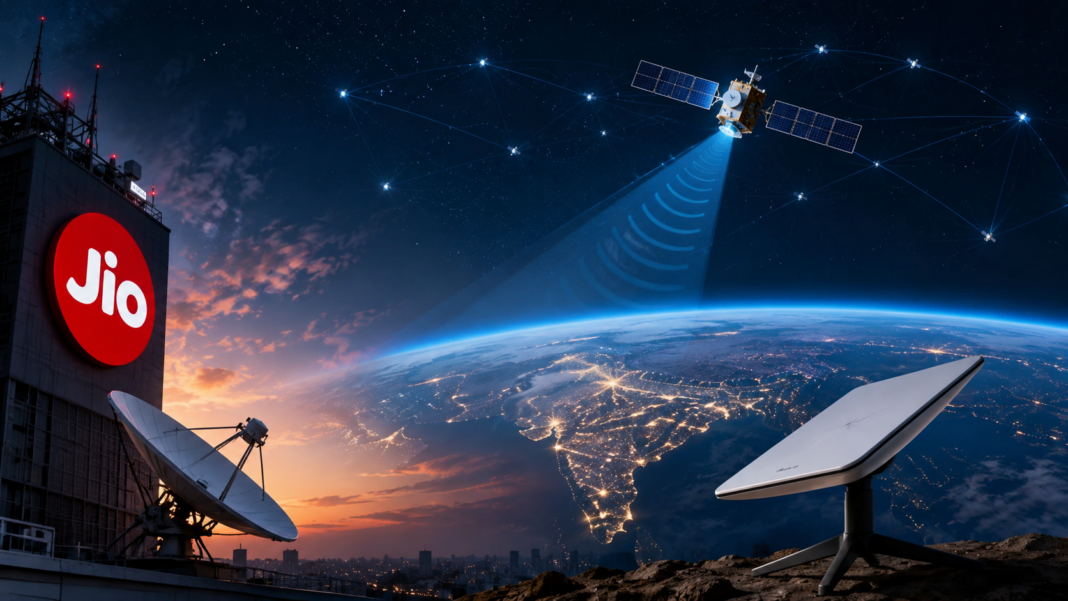

India’s satellite internet market could soon see major competition as Mukesh Ambani’s Reliance Industries reportedly plans a big push into low Earth orbit (LEO) satellite communications through Jio Platforms. The move may position Jio as a direct rival to Starlink as companies compete for India’s fast-growing broadband and space market.
Jio Plans Major Push Into Low Earth Orbit Satellite Internet
Mukesh Ambani’s Reliance Industries is reportedly planning a major entry into the low Earth orbit (LEO) satellite internet market through Jio Platforms. According to The Economic Times, the company is exploring a multi-billion dollar project that may include building satellites, launch systems, payloads, and internet terminals for users across India.
Reliance is also discussing orbital slot access with Indian authorities and is evaluating possible acquisitions of existing satellite operators, although no deal or investment amount has been confirmed.
Innovative OptoSAR technology allows India’s newest satellite to see through thick clouds
Jio already operates a satellite joint venture with Luxembourg-based SES, called Orbit Connect India, which uses geostationary and medium Earth orbit satellites. However, commercial services have not launched yet because the company is still waiting for final security clearances from India’s Department of Telecommunications.
The planned LEO constellation would allow Jio to compete more directly with Starlink in India’s growing satellite broadband market.
Why Jio Wants LEO Satellites Instead of MEO Systems
Reliance is interested in low Earth orbit (LEO) satellites mainly because they offer faster internet with lower latency. Latency is the delay between sending and receiving data. Medium Earth orbit (MEO) satellites operate much farther from Earth, causing slower response times compared to LEO satellites.
LEO satellites orbit at around 500 to 1,200 kilometres above Earth, allowing internet services to perform closer to traditional broadband networks. For example, Starlink users typically experience latency of 20 to 40 milliseconds. Jio’s current satellite partnership with SES relies on only six MEO satellites, which cannot match the real-time performance of LEO systems.
Ambani Clashes with Musk Over Satellite Spectrum in A Fierce Showdown
The global LEO satellite market is growing rapidly. Grand View Research estimates the sector could expand from $12.64 billion in 2024 to $41.31 billion by 2033. India is considered a major opportunity because many remote regions still lack reliable high-speed internet despite the country having nearly 950 million internet users.
India’s space economy could reach $44 billion by 2033, according to IN-SPACe. Reliance has also announced ₹10 lakh crore investments in AI infrastructure, data centres, and digital systems, showing the scale of its broader technology ambitions.
India’s Satellite Internet Battle and Starlink’s Position
Reliance Industries has rapidly changed its strategy toward satellite internet, making it one of the biggest developments in India’s telecom sector. In late 2024, the company pushed for satellite spectrum to be auctioned instead of allocated administratively. Such a system could have increased entry costs for foreign companies like Starlink. However, the Indian government rejected the proposal and accepted TRAI’s recommendation for administrative allocation instead.
Only a few months later, Reliance changed its approach completely. On March 12, 2025, Jio signed a partnership with SpaceX to distribute Starlink hardware in India. Under the agreement, Jio stores and online platforms would sell Starlink equipment and help customers with installation and activation services across the country.
India’s approach to Starlink reflects a growing focus on sovereign control over satellite networks
The agreement mirrored a similar partnership signed by Airtel. At the time, Jio said the collaboration would improve broadband connectivity and expand internet access in underserved areas. However, new reports now suggest Reliance could eventually become a direct competitor to Starlink by building or acquiring its own low Earth orbit, or LEO, satellite network.
Starlink has already received approval from IN-SPACe to operate its Gen 1 LEO satellite constellation in India until July 2030. However, commercial operations have still not started because final security clearances and spectrum allocation rules under India’s Telecommunications Act 2023 are still pending approval from Indian authorities.