

NASA’s Curiosity rover recently encountered a rare problem on Mars after a massive rock became stuck to its robotic drill arm during a routine mission in Gale Crater. The incident halted operations for nearly six days as engineers worked carefully to free the rock without damaging the rover’s critical drill system.
Massive Martian Rock Creates Rare Problem for Curiosity Rover
NASA’s Curiosity rover recently faced an unusual problem on Mars after a massive rock became stuck to its robotic drill arm for nearly six days, temporarily halting scientific operations. The incident happened on April 25 during a routine drilling mission inside Gale Crater, where the rover was collecting rock samples from a target named “Atacama.”
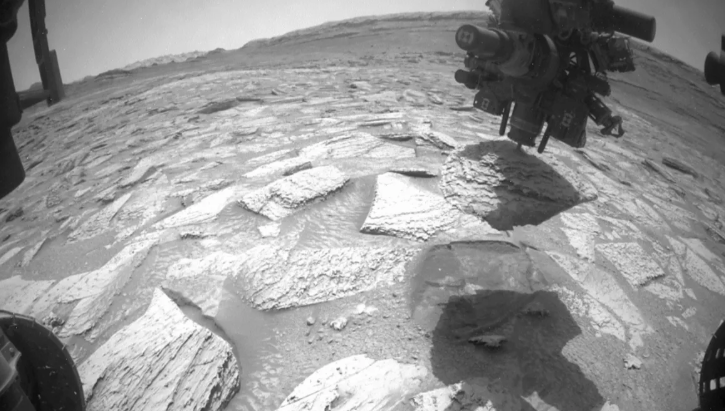
After completing the drilling process, Curiosity attempted to pull back its robotic arm, but the entire rock slab unexpectedly lifted from the Martian surface and stayed attached to the drill sleeve. NASA estimated the rock weighed around 29 pounds (13 kilograms) and measured about 1.5 feet across.
Why NASA is exploring the extraordinary Crocodile Bridge, a region of Mars frozen in time
The situation raised concerns because Curiosity’s drill is one of its most important scientific tools, used to study ancient Martian rocks that may hold clues about past microbial life on Mars. Engineers later worked carefully to free the rock without damaging the rover’s robotic arm or drill system during the rare incident.
NASA Engineers Spend Days Trying to Free the Rock
After discovering the problem, NASA engineers began trying to safely free the massive rock without damaging Curiosity’s robotic drill arm. Their first solution involved vibrating the drill mechanism, hoping the shaking would loosen the slab and allow it to fall back onto the Martian surface naturally.
However, the plan failed. Even after multiple vibration attempts, the rock remained firmly attached to the drill sleeve. Images sent back from Mars showed the heavy slab still hanging from the rover’s arm days later.
Because signals between Earth and Mars take time to travel, every command sent to Curiosity had to be carefully planned and tested before execution. Engineers could not respond instantly as they would with machinery on Earth.
Space Radiation: Confronting Risks with Vigor
Over the following days, teams tried several methods, including repositioning the robotic arm and triggering additional drill vibrations. Some Martian dust and sand eventually fell away from the rock, suggesting it was loosening slightly, but the slab still would not detach.
NASA described the incident as one of the most unusual mechanical problems ever faced during Curiosity’s mission, forcing engineers to pause scientific operations and focus entirely on protecting the rover’s critical drill system.
Aggressive Maneuver Finally Breaks the Rock Free
After nearly a week of failed attempts, NASA engineers finally freed the massive rock from Curiosity’s drill arm on May 1 using a more aggressive maneuver. The rover simultaneously tilted and rotated its robotic arm while vibrating and spinning the drill mechanism.
The strategy worked almost instantly. The large rock detached from the drill sleeve, fell back onto the Martian surface, and shattered into pieces on impact. Cameras onboard Curiosity captured the dramatic sequence, and NASA later released animated images showing the moment the rock finally broke free after being stuck for days.
NASA builds on the success of the Mars helicopter to launch a powerful drone mission to Titan
The success allowed Curiosity to resume normal scientific operations after nearly six days of disruption. Fortunately, engineers reported no lasting damage to the rover’s robotic arm or drill system, though the equipment continued to be monitored carefully afterward.
Curiosity has been exploring Gale Crater since landing on Mars in 2012. Over the years, the rover has studied ancient rocks, lakebeds, and mineral deposits that suggest Mars once had rivers and lakes billions of years ago.
The unusual drilling incident highlighted the challenges of operating robotic explorers on Mars, where even routine missions can quickly become unexpected engineering problems millions of miles from Earth.