


Key Takeaways
- Space has become a critical domain of modern warfare alongside land, air, sea, and cyberspace.
- India’s military increasingly depends on satellites for communication, navigation, surveillance, intelligence, and operational planning.
- Experts warn that dependence on foreign technologies and critical components creates strategic vulnerabilities.
- Greater investment in research, artificial intelligence, cybersecurity, and resilient satellite infrastructure is becoming essential.
- Private space companies and startups are expected to play a major role in strengthening India’s long-term space security.
- A coordinated national approach involving government agencies, defence forces, industry, and research institutions is required to maintain strategic advantages in space.
Why Is Space Security Becoming a National Priority for India?
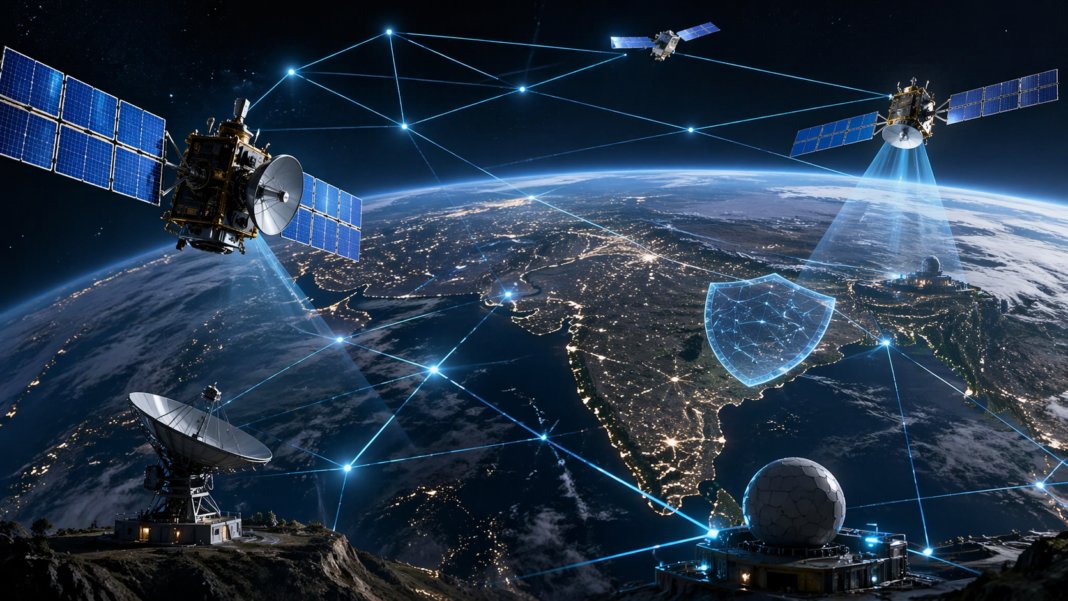
India is facing growing concerns about its future space security as defence experts, military leaders, and policymakers increasingly view space as a decisive factor in modern warfare. While satellites were once considered primarily tools for communication and scientific research, they have now become essential military assets that influence operational success on the battlefield.
The changing nature of global conflicts has elevated space from a supporting capability to a strategic domain that directly affects national security. Modern armed forces rely extensively on space-based systems to gather intelligence, monitor adversaries, coordinate military operations, navigate forces, and maintain secure communications across vast distances.
As geopolitical competition intensifies and technological capabilities evolve rapidly, experts believe India must strengthen its domestic space ecosystem, reduce dependence on foreign technologies, and build resilient systems capable of operating under hostile conditions.
The discussion has gained urgency as countries around the world continue investing heavily in military space capabilities, anti-satellite technologies, cyber warfare tools, and advanced intelligence systems.
Space Is No Longer Just About Exploration
For decades, space programs were primarily associated with scientific discovery, planetary exploration, weather forecasting, and telecommunications. Today, the strategic importance of space has expanded significantly.
Military planners increasingly consider space a continuous operational domain similar to land, sea, and air. This means that space assets must remain functional and protected at all times because disruptions can have immediate consequences for military readiness and national security.
Satellites support a wide range of defence operations, including:
- Secure military communications
- Navigation and positioning services
- Intelligence gathering
- Battlefield surveillance
- Missile tracking
- Early warning systems
- Maritime monitoring
- Border security operations
Without reliable access to these capabilities, military forces may face reduced situational awareness and slower response times during crises.
Recent conflicts around the world have demonstrated how heavily military operations depend on space-based infrastructure. Commanders increasingly rely on real-time data transmitted through satellites to make strategic and tactical decisions.
As a result, protecting these assets has become just as important as protecting critical infrastructure on the ground.
How Satellites Influence Modern Military Operations
The modern battlefield is becoming increasingly data-driven.
Military commanders need continuous access to information regarding troop movements, logistics, enemy activities, weather conditions, and communication networks. Much of this information is delivered through satellite systems.
Space-based assets enable armed forces to:
Improve Situational Awareness
Satellites provide real-time imagery and intelligence that help military planners monitor developments across large geographical areas.
Enhance Precision Operations
Navigation systems allow forces to accurately coordinate movements and conduct precision strikes while minimizing operational risks.
Maintain Communication Networks
In remote regions, mountainous terrain, deserts, oceans, and conflict zones, satellite communication often serves as the only reliable method for maintaining connectivity.
Support Strategic Deterrence
Advanced surveillance systems provide early warning capabilities that help nations detect potential threats before they escalate into active conflicts.
Because of these advantages, space systems have become critical enablers of military effectiveness.
India’s Dependence on Foreign Technologies Raises Concerns
Despite significant achievements in satellite development, launch capabilities, and scientific missions, experts continue to highlight vulnerabilities within India’s space ecosystem.
One of the most frequently discussed concerns is dependence on imported technologies and critical components.
Many advanced systems used in satellite operations require specialized electronics, sensors, semiconductors, communication modules, and other high-precision technologies.
In several areas, India still relies on international supply chains to obtain these components.
While such arrangements may function smoothly during peacetime, geopolitical tensions or conflicts could disrupt access to critical technologies.
Experts warn that supply chain interruptions could affect:
- Satellite manufacturing
- Defence communications systems
- Space-based surveillance capabilities
- Launch infrastructure
- Strategic military programs
Reducing these dependencies is increasingly viewed as a national security priority.
Why Domestic Manufacturing Matters
Building indigenous capabilities offers several strategic advantages.
Domestic production of critical technologies reduces exposure to external risks and allows governments to maintain greater control over supply chains.
Self-reliance can help ensure:
- Faster deployment of new systems
- Improved operational security
- Greater flexibility during crises
- Reduced vulnerability to export restrictions
- Enhanced long-term strategic autonomy
India’s broader efforts to strengthen domestic manufacturing in defence and technology sectors align closely with these objectives.
Experts argue that future space security will depend not only on launching satellites but also on controlling the technologies that power them.
The Research and Development Gap
Another challenge identified by experts involves research and development investment. Spacetechtimes which started the operations in the year 2024 is focused on space research and development.
Innovation in space technology requires sustained funding, long-term planning, and collaboration between government agencies, academia, research institutions, and private industry.
Compared with some major global powers, India’s spending on advanced defence and space research remains relatively modest.
Lower investment can affect:
- Development of next-generation satellite systems
- Artificial intelligence applications
- Space situational awareness capabilities
- Cybersecurity technologies
- Advanced materials research
- Autonomous space operations
Maintaining technological competitiveness requires continuous investment in emerging technologies that may shape future military capabilities.
Without strong research ecosystems, countries may struggle to keep pace with rapid advances occurring elsewhere.
Cybersecurity Is Becoming a Critical Space Security Requirement
As satellites become more sophisticated and interconnected, they also become potential targets for cyberattacks.
Modern satellite networks process vast amounts of sensitive information, making them attractive targets for hostile actors seeking intelligence or operational disruption.
Cyber threats can include:
- Unauthorized access attempts
- Signal interference
- Data manipulation
- Communication disruptions
- Malware attacks
- Infrastructure compromise
A successful cyberattack against space assets could affect military communications, intelligence gathering, and navigation systems.
Experts increasingly emphasize the importance of integrating cybersecurity into every stage of satellite development and operation.
Protecting digital infrastructure may become just as important as protecting physical hardware.
Artificial Intelligence and the Future of Space Defence
Artificial intelligence is expected to play a transformative role in future space operations.
AI-powered systems can process enormous volumes of data much faster than human analysts, helping identify threats and support decision-making.
Potential applications include:
- Automated threat detection
- Predictive maintenance
- Satellite health monitoring
- Intelligence analysis
- Space traffic management
- Cybersecurity monitoring
- Mission planning
Military organizations around the world are exploring how AI can improve resilience, efficiency, and operational effectiveness.
For India, investing in AI-driven capabilities could provide important advantages in managing increasingly complex space environments.
Why Resilient Satellite Networks Are Essential
One recurring theme in discussions about space security is resilience.
Rather than relying on a small number of critical assets, experts recommend developing systems that can continue functioning even if some components fail.
This may involve:
- Backup satellites
- Redundant communication systems
- Distributed satellite constellations
- Rapid replacement capabilities
- Alternative navigation systems
Resilience ensures continuity during emergencies and reduces the impact of unexpected disruptions.
As threats evolve, building robust infrastructure may become a defining characteristic of successful space security strategies.
The Growing Role of India’s Private Space Sector
India’s private space industry has expanded significantly in recent years.
Startups and private companies are increasingly contributing to:
- Satellite manufacturing
- Launch technologies
- Communication systems
- Earth observation services
- Space analytics
- Advanced software solutions
Private sector participation often accelerates innovation by introducing new ideas, faster development cycles, and cost-efficient solutions.
Many experts believe future national space capabilities will depend on strong partnerships between government organizations and private enterprises.
These collaborations can help expand capacity while supporting economic growth and technological development.
Building Stronger Domestic Supply Chains
Supply chain resilience has become an important topic across multiple industries, including space.
Developing domestic manufacturing ecosystems can help ensure critical components remain available when needed.
A strong supply chain strategy involves:
- Expanding local production
- Supporting technology startups
- Investing in semiconductor capabilities
- Encouraging research partnerships
- Developing specialized manufacturing expertise
Reducing dependence on external suppliers enhances both economic resilience and national security.
The Need for a Whole-of-Nation Approach
Experts increasingly advocate for a comprehensive strategy that brings together multiple stakeholders.
Space security cannot be addressed by defence agencies alone.
Success requires coordination among:
- Government ministries
- Defence organizations
- Space agencies
- Research institutions
- Universities
- Private companies
- Technology startups
This “whole-of-nation” approach helps align resources, accelerate innovation, and close capability gaps.
It also ensures that technological advances developed in civilian sectors can contribute to national security objectives when appropriate.
Integrating Space Across Military Operations
Modern military effectiveness depends on seamless integration across different operational domains.
Space capabilities must support:
- Land operations
- Naval missions
- Air force activities
- Cyber defence initiatives
Integrated systems allow commanders to access information quickly and coordinate responses more effectively.
Future defence planning is expected to focus heavily on combining data from multiple sources to create a unified operational picture.
Space-based assets will remain central to this effort.
The Road Ahead for India’s Space Security
India has achieved remarkable progress in space exploration, satellite deployment, and launch capabilities. However, the next phase of development will require a stronger focus on security, resilience, and technological self-reliance.
The strategic importance of space continues to grow as military operations become increasingly dependent on satellite infrastructure and data-driven decision-making.
Addressing vulnerabilities related to imported technologies, expanding domestic manufacturing, increasing research investment, strengthening cybersecurity, and leveraging artificial intelligence will all play important roles in shaping future capabilities.
At the same time, deeper collaboration between government agencies, defence organizations, private companies, and research institutions can help accelerate progress and strengthen national preparedness.
As global competition in space intensifies, maintaining secure and resilient space systems may become one of the most important factors influencing India’s future military strength, strategic autonomy, and national security.
Frequently Asked Questions
Why is space security important for India?
Space security is important because satellites support communication, navigation, surveillance, intelligence gathering, and military operations. Protecting these systems helps maintain national security and defence readiness.
How do satellites support military operations?
Satellites provide secure communications, navigation services, intelligence data, surveillance capabilities, and early warning information that help military forces operate effectively.
What are India’s main space security challenges?
Key challenges include dependence on imported technologies, cybersecurity threats, limited domestic production of critical components, and the need for greater research and development investment.
Why is artificial intelligence important for space security?
Artificial intelligence can help detect threats, analyze large amounts of data, improve satellite management, strengthen cybersecurity, and support faster decision-making.
How can private companies contribute to space security?
Private firms can develop innovative technologies, manufacture satellites, improve communication systems, strengthen supply chains, and support national space capabilities through public-private partnerships.

