
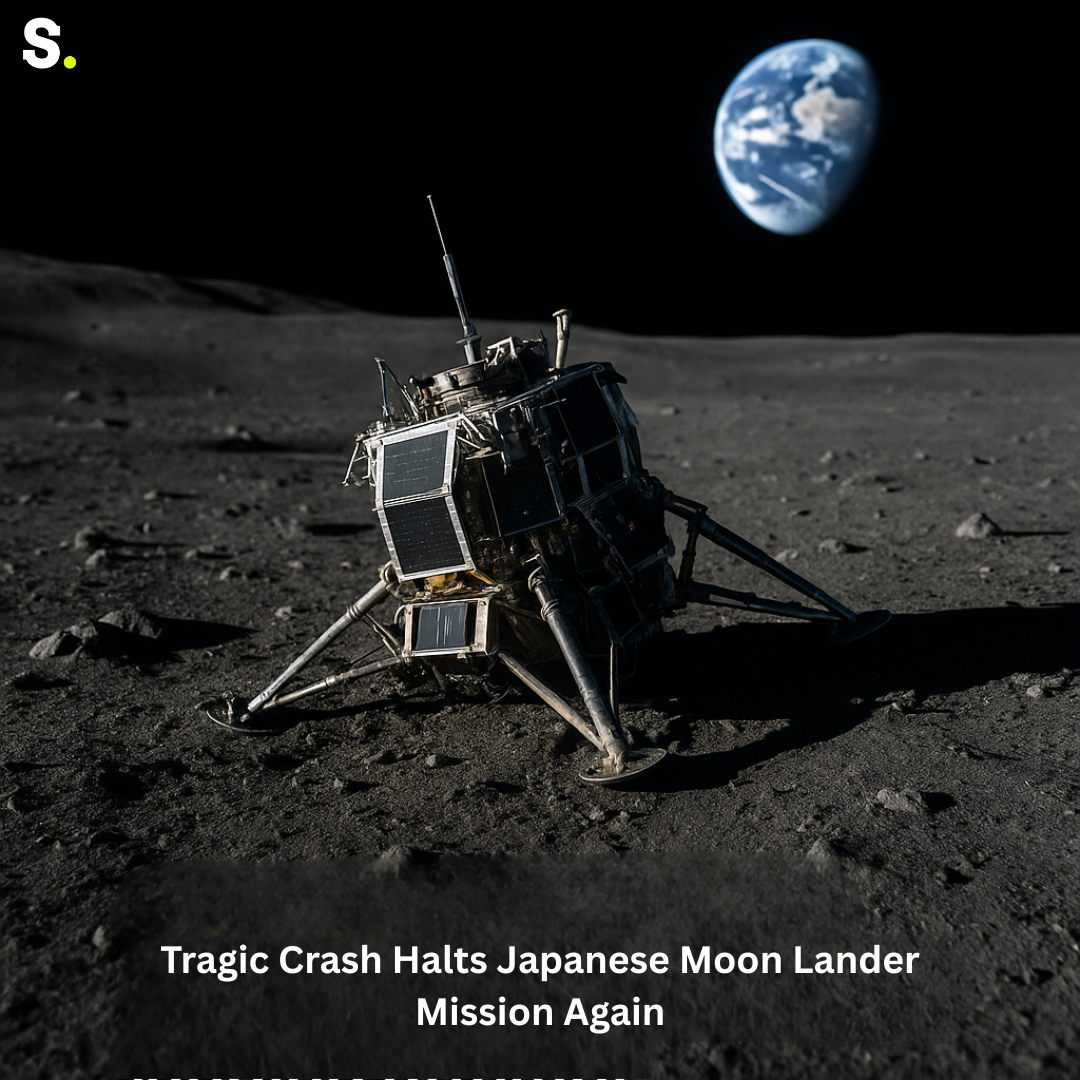

A Japanese-built moon lander called Resilience has crashed during its attempt to softly land on the lunar surface. This was Japan’s second try at reaching the moon with a private spacecraft, and unfortunately, it ended in failure just like the first one.
Second Attempt Ends in Disaster
The mission began four and a half months ago when the Japanese spacecraft Resilience launched aboard a SpaceX Falcon 9 rocket. After traveling through space for months, the lander reached the moon’s orbit. From there, it started a carefully timed descent toward the moon’s surface. The goal was to land in a flat area called Mare Frigoris or “Sea of Cold,” located in the moon’s northern region.
Everything appeared to go smoothly for most of the trip. However, things went awry in the last few seconds of landing. The Japanese lander began to descend faster than it should have. Data showed it was falling too quickly just before it was supposed to touch down. Then, communication with the lander was suddenly lost.
Japanese flight controllers on Earth tried several ways to reconnect with the spacecraft. They even sent commands to restart the lander’s computer system, hoping it was still alive. But sadly, there was no reply.
Japan’s 2024 Mega Earthquake Sent Shockwaves into Space—Shocking New Satellite Data Revealed
Key Equipment Failed to Work in Time
After losing contact, Japanese engineers closely studied the data they had received. They discovered that a special tool on the lander, called a laser rangefinder, wasn’t working properly. The spacecraft’s distance from the lunar surface is determined by this instrument.
The rangefinder had trouble collecting correct distance data in time. Because of this, the Japanese lander didn’t slow down enough during its final approach. Without accurate information on how close it was to the surface, the lander couldn’t reduce its speed properly. This caused it to crash instead of landing softly.
The lander was designed to carry cameras, science instruments, a small rover named Tenacious, and even a tiny red-and-white model house built as an art project. Unfortunately, none of these payloads could be used as planned due to the crash.
The failure was officially announced hours after the landing attempt. Japanese mission teams said they are still reviewing all the information to better understand exactly what happened. Their main focus now is to study the problem thoroughly.
Not an Isolated Incident
The failure of this lander model was not the first time. Resilience’s parent corporation has previously attempted a lunar landing in 2023. When the spaceship ran out of fuel shortly before it touched down, that mission likewise ended in disaster. It fell from the sky and hit the moon hard.
From Space to Trade Deals: Trump’s Missile Shield Pitch to Japan May Change Everything
And Japan is not alone in these setbacks. In early 2024, another company from the U.S. launched a spacecraft called Peregrine, but it never reached the moon due to a fuel leak.
Issues persisted even after several landers made it to the moon. One U.S. company managed to land two of its spacecraft, but both of them tipped over when they touched down. Although they survived, they couldn’t complete everything they were supposed to do.
So far, only one lander in this wave of commercial lunar missions has fully succeeded. The spacecraft was named Blue Ghost, and it was launched on the same rocket as Resilience. It landed safely on the moon back in March 2025 and worked properly during its mission.
Unlike Blue Ghost, the Japanese lander took a longer and more energy-efficient route to reach the moon. It used the moon’s gravity to adjust its path before entering its final orbit. The final orbit was about 62 miles above the moon, from where it started its descent. However, the strategy ultimately did not work out as expected.
Despite all the planning and preparations, landing on the moon remains very difficult. There are many steps involved, and even one small failure—like a delayed sensor reading—can lead to mission failure.
While the spacecraft itself is lost, engineers are working hard to analyze the data that was received before the crash. This information could help avoid similar problems in the future. But for now, the mission is considered over.
The dream of a successful Japanese commercial moon landing has once again been delayed after this second hard landing. The goal of providing private, low-cost transportation to the moon remains a difficult challenge.