
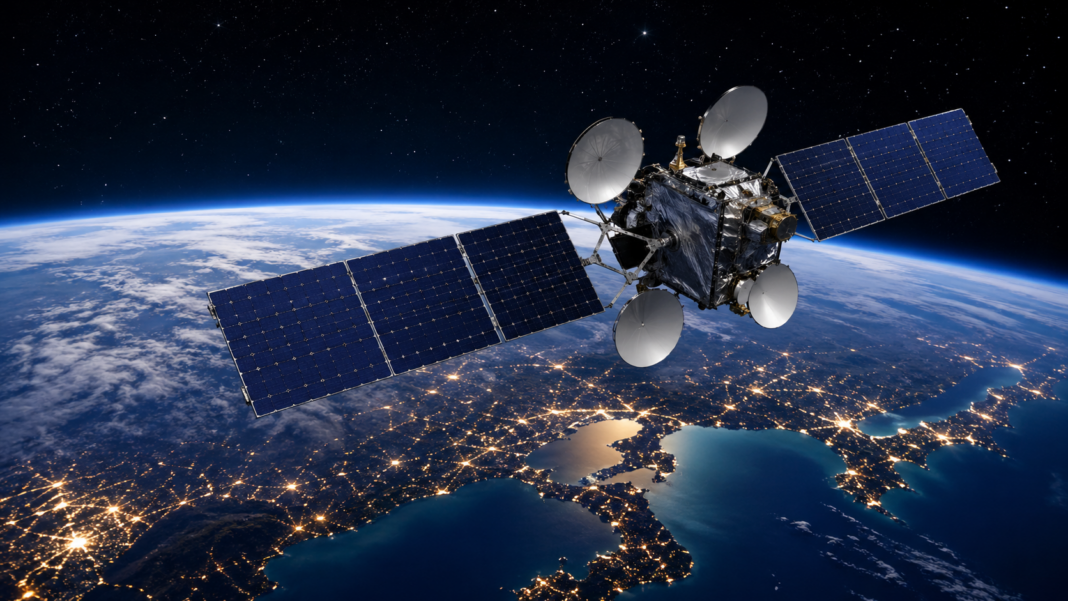

As the need for fast and reliable internet continues to rise, especially in remote and underserved areas, Viasat Inc. has launched its latest high-capacity satellite, ViaSat-3 F3. The new satellite aims to enhance connectivity across the Asia-Pacific region by delivering improved performance, wider coverage, and more dependable communication services.
A Major Boost for Connectivity Across Asia-Pacific
Global satellite communications company Viasat Inc. has successfully launched its latest satellite, ViaSat-3 Flight 3 (F3), marking an important step in expanding internet and communication services across the Asia-Pacific (APAC) region.
This new satellite is designed to deliver extremely high data capacity, making it one of the most advanced communication satellites in operation today. With the ability to provide more than 1 Terabit per second (Tbps) of throughput, it can support a large number of users and devices at the same time.
In simple terms, this means faster internet speeds, more reliable connections, and better service for people and industries that depend on satellite communication. This includes areas where traditional internet infrastructure like fiber cables or mobile towers is limited or unavailable.
The satellite has already completed its launch and initial signal acquisition, which is the first step in confirming that it is working properly in space. It is expected to begin full operations later in 2026, after further testing and calibration.
Advanced Technology Designed for Smarter Connectivity
ViaSat-3 F3 uses cutting-edge technology to improve how satellite internet works. One of its key features is advanced beam-forming capability. This allows the satellite to direct its signal precisely to areas where demand is highest.
Instead of spreading internet capacity evenly across a large region, the satellite can focus more bandwidth on busy areas such as cities, flight paths, or shipping routes. This helps improve performance where it is needed most.
Another important feature is its flexible payload system. This system allows the satellite to adjust how it uses its resources in real time. For example, if there is a sudden increase in demand in one region, the satellite can quickly shift its capacity to support that area.
Countering Space Espionage: USA Deploys New Jammers to Counter China’s Spy Satellite Threats
This kind of flexibility is especially useful for industries like aviation and maritime services. Aircraft flying over oceans and ships traveling across remote waters rely heavily on satellite connectivity. With ViaSat-3 F3, these services can expect stronger and more stable connections.
The satellite is also designed to support government operations, including secure communications and emergency response systems. Its ability to deliver reliable connectivity in difficult or remote environments makes it a valuable tool for disaster management and national security.
Completing a Next-Generation Satellite Network
The launch of ViaSat-3 F3 is part of a broader plan by Viasat Inc. to build a global satellite network known as the ViaSat-3 constellation. This network includes three advanced satellites designed to cover different regions of the world.
The first satellite, ViaSat-3 F1, has been operational since 2024, while ViaSat-3 F2 is still undergoing testing in orbit. With the successful addition of F3, the constellation is now complete, enabling wider global coverage with high-capacity and reliable connectivity.
ViaSat-3 F3 is expected to strengthen communication services across India and the Asia-Pacific region. Viasat has been active in India for years, supporting key services such as disaster response systems, tsunami early warning networks, and vessel tracking. It also provides connectivity solutions for aviation and government operations.
In 2026, Viasat partnered with Bharat Sanchar Nigam Limited (BSNL) to enhance satellite communications for naval operations using advanced Ka-band technology.
The new satellite increases network capacity and resilience, allowing services to continue smoothly during high demand or disruptions. Its ability to shift bandwidth dynamically makes it especially useful for remote areas, busy transport routes, and emergency situations.