

Astronomers have discovered a nearly invisible galaxy called CDG-2, which blends into the cosmic background and is made up of 99% dark matter. Unlike bright galaxies like the Milky Way, CDG-2 barely glows and contains only a few stars. Scientists detected it by spotting globular clusters, tiny dense star groups that serve as markers for hidden galaxies.
How Astronomers Unearthed the Ghost Galaxy
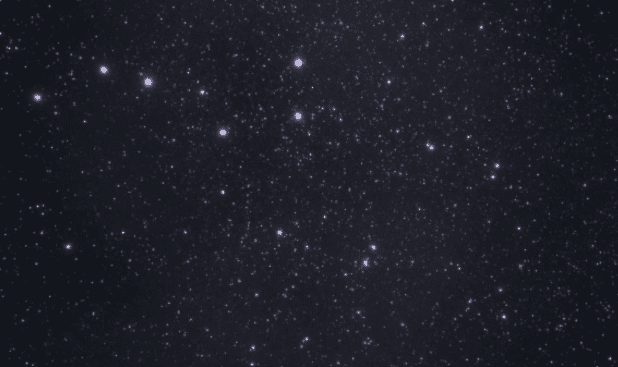
Finding a galaxy this faint is an enormous challenge. Instead of searching for the galaxy’s weak starlight, astronomers relied on clever statistical techniques to look for tight groupings of stars known as globular clusters. These clusters are dense, spherical collections of stars that usually orbit galaxies, and they are far easier to detect than the galaxies themselves when the galaxies are extremely faint.
In the case of CDG-2, four globular clusters were spotted within the Perseus galaxy cluster, located around 300 million light-years from Earth. By focusing on these clusters, astronomers realized that something mysterious was hiding nearby.
The Stunning, Most Distant Galaxy Found by Webb — Just 280 Million Years After the Big Bang
To confirm their findings, scientists used a combination of some of the world’s most powerful telescopes. NASA’s Hubble Space Telescope, ESA’s Euclid space observatory, and the Subaru Telescope in Hawaii all provided high-resolution images of the area. Hubble’s data revealed the clusters in stunning detail, while Euclid and Subaru helped detect a faint, diffuse glow surrounding them. This subtle halo of light provided strong evidence that a galaxy existed, even though it was almost invisible to normal observation.
“This is the first galaxy detected solely through its globular cluster population,” scientists noted. They also found that, under conservative assumptions, the four clusters probably make up the entire population of globular clusters in CDG-2.
A Galaxy Dominated by Dark Matter
CDG-2 is not just faint; it is extraordinarily unusual. Early measurements show that it shines with the light of roughly six million stars like our Sun, a tiny number compared to the billions found in most galaxies. Intriguingly, the four globular clusters themselves contribute 16% of all the visible light in the galaxy.
The truly mind-blowing fact is that nearly all of CDG-2’s mass—around 99%—consists of dark matter. This invisible material is a mysterious substance that dominates the universe, yet cannot be seen directly. In CDG-2, the stars we can observe make up only a tiny fraction of what’s actually there.
China’s Jilin-I Satellite: A Game Changer in Asteroid Tracking and Disaster Prevention
Astronomers believe that much of the gas normally needed to form stars was likely stripped away due to gravitational interactions with other galaxies in the crowded Perseus cluster. The result is a galaxy almost entirely made of dark matter, with only a handful of stars sprinkled across it.
Globular clusters play a crucial role in finding such ghostly galaxies. Their dense, tightly bound stars make them resistant to being torn apart by gravitational forces. Because of this, these clusters can act as reliable tracers, helping scientists locate galaxies that would otherwise remain hidden in the cosmic darkness.
Mapping the Invisible Universe
The discovery of CDG-2 marks a remarkable achievement in astronomy. It demonstrates how advanced tools and smart observational strategies can uncover galaxies that were previously invisible to even the most powerful telescopes. By combining space-based and ground-based observations, researchers can detect the faintest glimmers of starlight and pinpoint where hidden galaxies reside.
Astronomers spotted a star dying in real time, and it happened far faster than expected
NASA’s Hubble Space Telescope, which has been operational for over 30 years, continues to play a central role in uncovering these cosmic mysteries. Managed jointly by NASA and ESA, Hubble’s data helps scientists map the universe and explore phenomena that are invisible to the naked eye.
As astronomers continue to study globular clusters and faint galaxies, discoveries like CDG-2 reveal that the universe is far stranger and more mysterious than we ever imagined. While most galaxies shine brightly, this ghost galaxy hides in plain sight, almost entirely made of dark matter, and reminds us of the invisible threads that bind the cosmos together.