

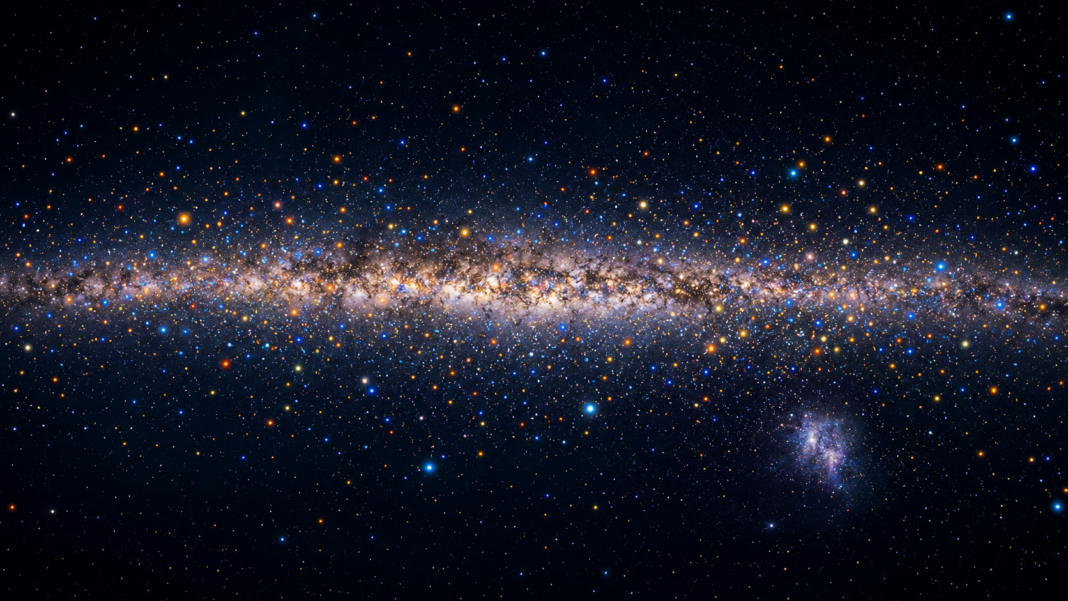

A new image released by NASA has revealed nearly 6,000 alien worlds scattered across the Milky Way galaxy. Created using data from NASA’s Transiting Exoplanet Survey Satellite (TESS), the stunning all-sky mosaic highlights confirmed and candidate exoplanets discovered over several years of observations, showing how vast and crowded the universe may truly be.
NASA’s TESS mission maps thousands of distant planets across the galaxy
A stunning new image released by NASA has revealed nearly 6,000 alien worlds scattered across the Milky Way galaxy. The image was created using data collected by NASA’s Transiting Exoplanet Survey Satellite, or TESS, which has been searching for planets beyond our Solar System since its launch in 2018.
The all-sky mosaic shows thousands of colored dots spread across the glowing plane of the Milky Way. Blue dots represent confirmed exoplanets, while orange and yellow dots mark candidate planets still awaiting verification. The image combines observations captured between April 2018 and September 2025.
TESS detects planets using the transit method, which measures tiny dips in a star’s brightness when a planet passes in front of it. The image also highlights the Large Magellanic Cloud, a nearby satellite galaxy orbiting the Milky Way.
Thousands of strange and mysterious worlds appear in the giant cosmic mosaic
The latest image released from NASA’s Transiting Exoplanet Survey Satellite (TESS) reveals nearly 700 confirmed exoplanets along with more than 5,000 candidate worlds still being studied by scientists. Some of these distant worlds are rocky planets similar to Earth, while others are giant gas planets even larger than Jupiter. TESS has helped scientists discover many of these planets by tracking tiny dips in starlight.
Several of these planets orbit extremely close to their stars, exposing them to intense heat and radiation. Scientists believe some may have molten lava oceans, violent volcanic eruptions, and temperatures hot enough to melt rock. In some cases, nearby stars may slowly destroy parts of the planets over time. TESS continues scanning huge regions of the sky to uncover more unusual worlds.
NASA uncovers long-running phishing plot aimed at sensitive defense technology
Among the most fascinating discoveries are planets orbiting two stars instead of one, meaning two suns could appear in their skies. These discoveries by TESS are helping scientists better understand how diverse planetary systems across the universe can be.
Researchers have also identified planets located inside the “habitable zone,” where temperatures may allow liquid water to exist on the surface. TESS detects these planets by monitoring tiny dips in starlight when a planet passes in front of its star, helping scientists build one of the largest exoplanet databases ever created.
The giant Milky Way image reveals how crowded the universe may really be
The release of the giant exoplanet map from NASA shows how dramatically our understanding of space has changed in just a few decades. What once seemed like science fiction is now a major area of scientific discovery, with thousands of alien worlds already identified beyond our Solar System.
The image was created using data from NASA’s Transiting Exoplanet Survey Satellite and combines observations from 96 different sectors of the sky collected over seven years. Together, these sections form a detailed panorama of the Milky Way galaxy filled with nearly 6,000 confirmed and candidate exoplanets.
Why NASA is exploring the extraordinary Crocodile Bridge, a region of Mars frozen in time
Many of the colored dots appear near the Milky Way’s galactic plane because this region contains huge numbers of stars. Since planets form around stars, areas with more stars are also likely to contain more planetary systems.
Besides searching for exoplanets, TESS has also tracked asteroids near Earth, observed young stars, and monitored changing activity across the galaxy. The spacecraft recently captured observations of comet 3I/ATLAS as well.
The image has drawn worldwide attention because it visually displays thousands of distant worlds together, offering a striking reminder that Earth is only one planet in a vast and crowded galaxy.