
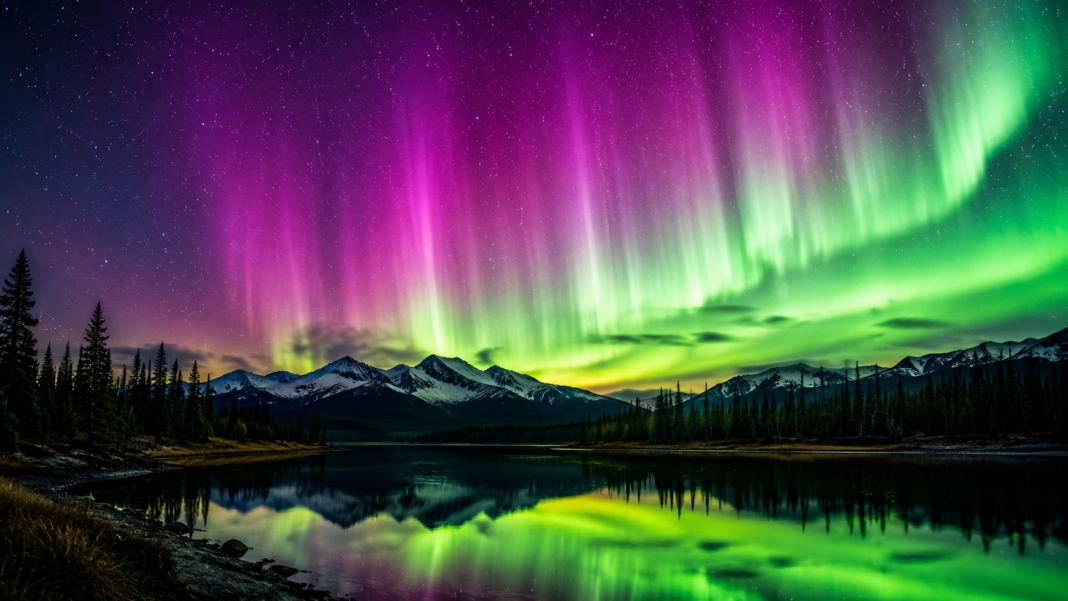

A G2-level solar storm could make the northern lights visible across nearly 20 U.S. states tonight as charged particles from the sun interact with Earth’s atmosphere. The rare event may create glowing green and purple auroras, with darker pre-new moon skies expected to improve visibility.
How Solar Storms Create the Northern Lights
The northern lights, also known as the aurora borealis, form when charged particles from the sun travel through space and collide with gases in Earth’s upper atmosphere. Earth’s magnetic field pulls these particles toward the North and South Poles, creating glowing waves of green, red, and purple light in the night sky. Green is the most common aurora color and is mainly produced by energized oxygen molecules.
The latest aurora event began after scientists detected a coronal mass ejection, or CME, moving toward Earth. A CME is a massive burst of solar material released from the sun during periods of intense solar activity. At the same time, strong solar wind escaping from a coronal hole on the sun added to the storm’s strength.
Meta looks to space based solar energy to help power its AI operations around the clock
These combined solar events created a G2-level geomagnetic storm, which is considered moderate but powerful enough to push aurora visibility farther south than normal. Besides producing colorful skies, geomagnetic storms can also briefly affect satellite communications, GPS systems, and radio signals in some regions.
States That Could See the Aurora Tonight
Forecast maps suggest that the northern lights could become visible across a large part of the United States if the ongoing geomagnetic storm remains active overnight. States with the highest chances of seeing the aurora include Washington, Idaho, Montana, North Dakota, South Dakota, Minnesota, Wisconsin, Michigan, and Maine, where aurora activity is more common during periods of strong solar activity.
The viewing zone may also stretch much farther south into states such as Oregon, Wyoming, Nebraska, Iowa, Illinois, Indiana, Ohio, New York, Vermont, and New Hampshire. In many of these areas, the aurora may appear low along the northern horizon instead of directly overhead, depending on storm strength and local viewing conditions.
Weather conditions are expected to play a major role in visibility. Experts say clear skies and low light pollution will provide the best opportunity to spot the glowing lights, while clouds, rain, or bright city lights may reduce visibility. The approaching new moon may improve viewing conditions further because darker skies make faint auroras easier to detect.
Scientists expect the strongest aurora activity between around 10 p.m. Thursday and 1 a.m. Friday Eastern Time. However, aurora intensity can change quickly as solar particles interact with Earth’s magnetic field. Experts also note that smartphone cameras may capture the colorful lights more clearly than the human eye in some locations.
How People Can Watch the Northern Lights
Skywatchers hoping to catch the northern lights are being advised to move away from bright city areas and find dark, open spaces with a clear view toward the northern horizon. Rural locations are expected to provide the best viewing conditions because artificial lights from cities and streets can make faint auroras difficult to see. Experts say darker skies can significantly improve the chances of spotting the colorful display.
Astronomy experts also recommend allowing eyes to adjust to the darkness for at least 20 to 30 minutes before searching the sky. Avoiding bright phone screens, flashlights, and headlights can help improve visibility. Even if the aurora appears weak or faint at first, the display may suddenly become brighter as solar activity changes and charged particles continue interacting with Earth’s atmosphere.
Many people are expected to use smartphones and cameras to capture the rare event. Modern phone cameras with night mode or long-exposure settings can often reveal stronger shades of green, pink, and purple than what is visible to the naked eye. In some cases, the aurora may appear as pale streaks in person but look much brighter in photographs.0
Real-time aurora tracking apps and forecast maps are also helping skywatchers follow changing geomagnetic conditions throughout the night. Scientists say the current storm follows a period of rising solar activity, increasing excitement among stargazers across the country.