
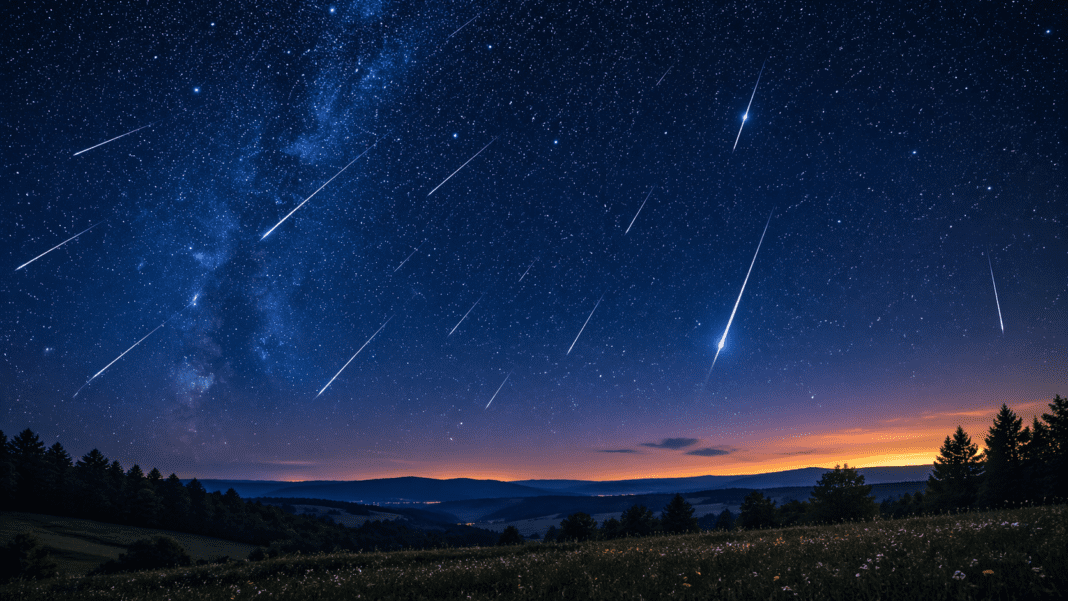

April 2026 brings the Lyrid meteor shower, peaking around April 22, when several shooting stars may be visible each hour. Running from April 16 to 25, this sky event can be enjoyed easily with the naked eye.
What Is the Lyrid Meteor Shower?
The Lyrid meteor shower is formed from tiny particles left behind by the comet C/1861 G1 Thatcher as it travels around the Sun. Over time, the comet sheds dust and small rocky fragments, creating a trail in space. Every year in April, Earth passes through this trail, and these particles enter our atmosphere at very high speeds, often faster than 40 kilometers per second.
As these particles hit the atmosphere, they collide with air molecules, creating intense heat due to friction. This heat causes them to glow brightly, producing the quick streaks of light known as “shooting stars.” Most of these particles are extremely small, often no larger than grains of sand, which is why they usually burn up completely before reaching the ground.
The meteor shower gets its name from the constellation Lyra, as the meteors appear to originate from this area of the sky. This point is called the radiant and is located near the bright star Vega, though meteors can be seen across the sky.
When and Where to Watch in the UK
For people in the UK, the best time to watch the Lyrid meteor shower is during the late-night hours, especially after midnight. The peak is expected around April 22, when the number of visible meteors is likely to be highest.
Clear skies are very important. Clouds can block the view completely, so checking the weather forecast before heading out is a good idea.
The best places to watch are areas with little or no light pollution. City lights can make it harder to see faint meteors. Locations like countryside fields, beaches, and hilltops offer better viewing conditions. Open spaces with a wide view of the sky are ideal.
It is also helpful to allow your eyes time to adjust to the darkness. This usually takes about 20 to 30 minutes. During this time, it is best to avoid looking at phones or bright lights, as they can reduce your ability to see faint objects in the sky.
Unlike the “planet parade,” which may be harder to spot in the northern hemisphere, the Lyrid meteor shower is easier to view from places like the UK. This makes it one of the best sky events of the month for local stargazers.
How to Get the Best Viewing Experience
Watching the Lyrid meteor shower is simple and does not require telescopes or binoculars. In fact, these tools can restrict your view because they focus on a small section of the sky. The best way to enjoy the Lyrid display is by lying back and looking up at a wide, open sky. Choosing a dark location away from city lights, such as a field or hilltop, can greatly improve your chances of seeing more meteors.
Comfort is also important for a good viewing experience. April nights can still feel cold, so wearing warm clothes and carrying a blanket, sleeping bag, or reclining chair can help you stay relaxed while watching. It is also recommended to let your eyes adjust to the darkness for about 20 to 30 minutes, as this makes it easier to spot faint meteors during the Lyrid meteor shower.
Astronomers say Ursids may be subtle, but the year’s last meteor shower is worth watching
Patience plays a key role during a meteor shower. Meteors do not appear continuously, and there may be quiet moments followed by sudden bursts of activity. Spending at least an hour outdoors increases your chances of seeing more shooting stars across different parts of the sky.
For better visibility, look slightly away from the radiant in the constellation Lyra, near the bright star Vega. Meteors seen farther from this point often appear brighter and leave longer glowing trails.