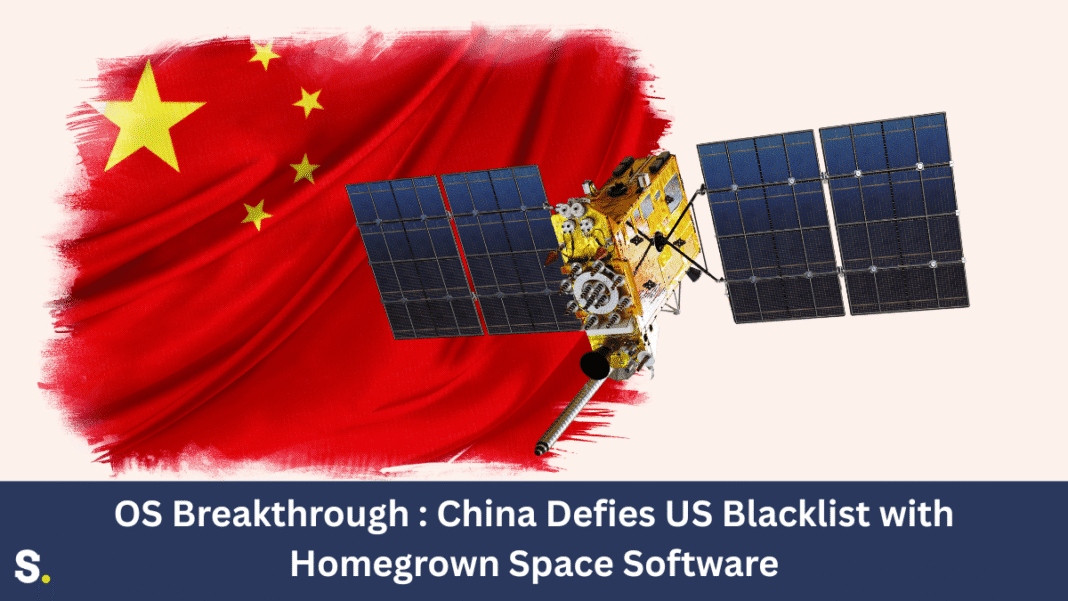



In a major development for global communications, China has shocked the world by demonstrating a satellite technology that outpaces current systems like Starlink—despite using a laser as weak as a nightlight.
Unbelievable Speed From the Edge of Space
What makes this breakthrough even more impressive is its distance from Earth. The Chinese satellite is stationed 36,000 kilometers above the ground—more than 60 times higher than Starlink’s network—and still manages to beat its speed.
This remarkable feat involves a 2-watt laser, about the same strength as a candle or a small bulb. Yet, it was able to deliver data at a speed of 1 gigabit per second (Gbps). In comparison, Starlink typically operates at lower speeds of a few hundred megabits per second and from a much closer altitude of about 550 kilometers. Despite its vast satellite network, Starlink relies on low-Earth orbit to reduce latency, but it still struggles to match the speed demonstrated by this single Chinese satellite.
The weak laser from the satellite pierced through Earth’s thick and constantly changing atmosphere without losing its signal strength. This is a massive challenge in space communication, as Earth’s atmosphere often bends, shakes, or scatters the light signals, making data transfer unstable. But the Chinese satellite handled this perfectly—even over a distance where Starlink’s approach would typically be considered more effective.
The Science That Made It Possible
One of the biggest problems in using lasers for satellite communication is the atmosphere. As laser beams pass through different air layers, they can scatter or blur, especially when the weather is unstable or air pressure changes quickly. These disruptions, known as atmospheric turbulence, have made it difficult for scientists to use lasers from space effectively.
What’s Really Going On in Orbit? China’s Satellite Moves Shock Analysts
Earlier methods to solve this issue tried to fix the laser’s shape using Adaptive Optics (AO) or collect better signal pieces using Mode Diversity Reception (MDR). However, using these methods one at a time did not work well when the turbulence was strong.
What changed this time was the use of both techniques together in a combined method known as AO-MDR synergy. The satellite first uses AO to fix the shape of the laser beam in real time, making it sharper and more focused. At the same time, MDR collects multiple versions of the signal that may be scattered in the air and reconstructs them into a single strong signal. This teamwork between the two methods helps to maintain a smooth and stable data transfer—even if the laser is very weak.
Thanks to this smart setup, the satellite was able to send data with clarity and speed that shocked many experts in the field. Even more surprising is the fact that this was done without relying on large, complex systems on the ground. The signal traveled directly from the satellite to Earth, beating many modern communication networks in terms of both speed and stability.
Crushing Starlink’s Performance With Simplicity
What makes this story more powerful is the simplicity of the system used. The laser used by the Chinese satellite is not powerful in energy terms—it’s just 2 watts. But its efficiency and accuracy are so advanced that it managed to send huge amounts of data across the globe faster than satellite systems that use much more power.
Stop Weaponizing the Stars! China Warns U.S. Against Triggering Space Arms Race
Starlink, which uses thousands of satellites at a lower orbit, generally offers internet speeds suitable for common users. But this new test shows that a single satellite with a smart laser system can beat Starlink’s overall performance—even from a far higher location in space.
Moreover, operating from 36,000 kilometers away gives the satellite some serious advantages. From this height, a single satellite can cover a much wider area of Earth compared to low-Earth orbit satellites. This means fewer satellites are needed to provide global coverage. Add to that the speed and stability of laser transmission, and this becomes a major game-changer in the field of space communication.
The successful laser test also shows that with the right technology, long-distance space communication does not need massive energy or complex tools. Smart engineering and precise methods can overcome even the most difficult problems—like turbulence in Earth’s atmosphere.
This stunning demonstration not only sets a new record in satellite communications but also marks a critical moment in global technology rivalry. With such developments, the use of laser-based satellites for high-speed data could soon challenge the need for larger, power-hungry systems. The performance of this 2-watt laser from deep space clearly proves that the race for the fastest and most reliable satellite communication is entering a new era.