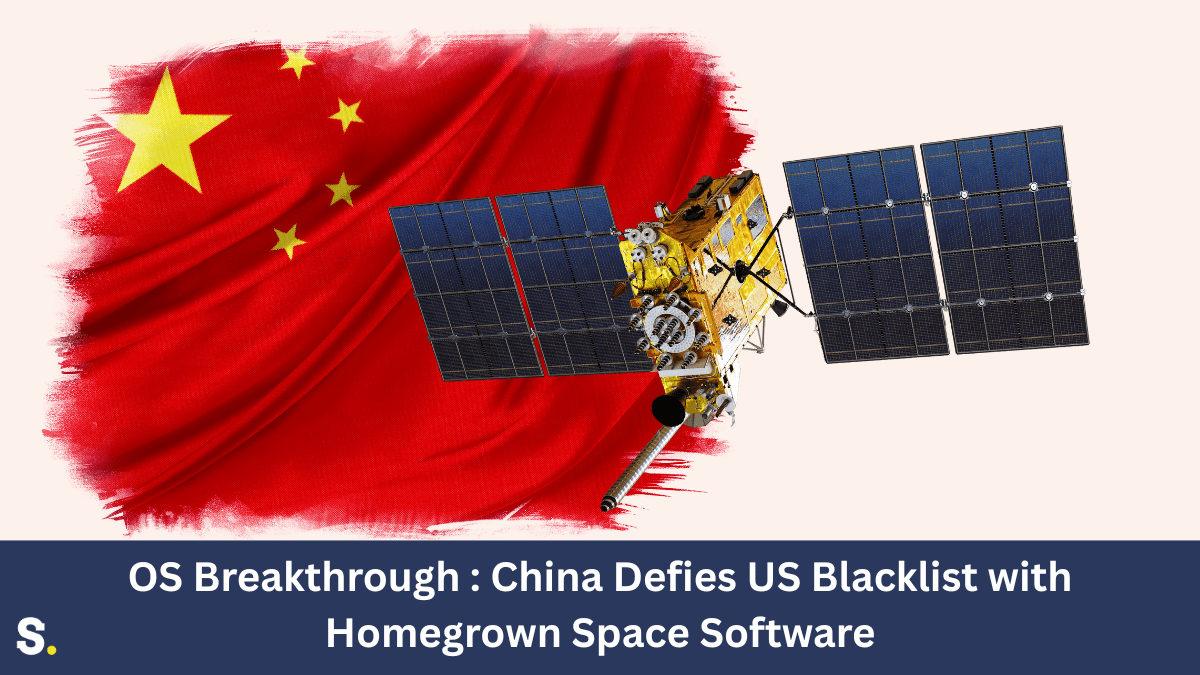
In a major milestone for China’s space and technology sector, the country has successfully tested its own OS (operating system) in orbit.
China Runs Homegrown OS in Space for the First Time
This achievement follows years of rising tensions and trade restrictions with the United States, especially those targeting Chinese tech giant Huawei. The breakthrough is part of a larger push by China to reduce its reliance on foreign-made software and hardware in critical national sectors like aerospace.
The tiny, light-weight CubeSat, Dalian-1 Lianli, was launched into orbit from China’s Tiangong space station and was utilized in the test. The fact that the satellite ran on OpenHarmony, a real-time operating system created in China, is what made this mission historic. This software is a streamlined version of Huawei’s HarmonyOS, which was first created as an alternative to Google’s Android after Huawei was cut off from U.S. technology in 2019.
OpenHarmony was developed for use in devices that need fast responses and high stability, which are essential for space missions. The satellite was equipped with the operating system and tested for more than 1,000 hours in space. According to Chinese researchers, the results were very positive. They reported that the satellite showed noticeable improvements in speed, reliability, and overall performance.
The mission was led by Professor Yu Xiaozhou of the Dalian University of Technology. He stated that the new operating system made the satellite’s operations faster and more dependable compared to earlier satellites using foreign software. Traditional firmware and other foreign-based operating systems that were frequently utilized in China’s space program were replaced with the OpenHarmony system.
Orbit at Breaking Point! China’s Satellite Expansion Threatens Global Space Stability
OpenHarmony Replaces Foreign Tech to Boost Self-Reliance
Before this project, many of China’s small satellites ran on open-source foreign systems such as FreeRTOS, which, despite being useful, came with limitations. These systems were not built for the unique challenges of space and often required extra adaptation. Also, because of U.S. export laws and trade restrictions, China’s continued use of such software became a growing concern.
To solve this issue, Chinese developers worked on creating a complete homegrown solution—not only building their own software but also using chips manufactured within China. This means the entire system, both the software and hardware, was developed without depending on foreign components.
Researchers called it a “fully indigenous software-hardware solution.” In simple terms, this means everything needed for the satellite to work came from within China. This is a big deal in space technology, where countries usually rely on parts and software from multiple international suppliers.
The OpenHarmony system also helped run important tools on the satellite such as the magnetometer, sun sensor, and orientation unit. These devices need to operate very quickly, and with OpenHarmony, they responded within microseconds—that’s a millionth of a second. This allowed the satellite to send back highly detailed and frequent data, improving the mission’s success rate.
What’s Really Going On in Orbit? China’s Satellite Moves Shock Analysts
Even more impressive is how the satellite system held up before its launch. The CubeSat was stored outside the Tiangong space station for 253 days before deployment. Despite being exposed to space conditions for that long, the satellite and its operating system started working smoothly once activated.
Satellite Produces High-Resolution Earth Images
Along with testing the software, the Dalian-1 Lianli CubeSat also had a camera on board. After launch, it successfully captured sub-meter resolution images of Earth. This level of image clarity is good enough to detect objects less than one meter wide on the ground. These images are now being used for urban planning and coastal development projects, especially in cities like Dalian.
The accomplishment of this mission contributes to China’s larger plan to increase its independence in vital technologies. Since Huawei was placed on the U.S. trade blacklist in 2019, Chinese companies and researchers have stepped up their efforts to build independent technology platforms. OpenHarmony is now maintained by the OpenAtom Foundation, and it’s being used not just in space, but also in embedded systems, electronics, and industrial applications.
By using OpenHarmony in orbit, China has shown that it is possible to manage high-level space missions without using foreign software. This move marks a turning point in China’s space program and highlights the growing strength of its domestic tech industry.