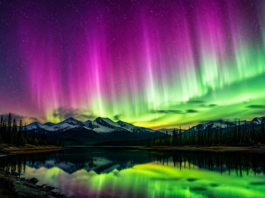

This week, skywatchers across the northern United States have a special treat waiting for them. The magical northern lights — also called aurora borealis — might be visible across 15 states, stretching from Alaska in the west to Maine in the east.
Widespread Viewing Opportunity Across 15 States
The U.S. National Oceanic and Atmospheric Administration’s (NOAA) Space Weather Prediction Center has released maps that show where the lights may appear in the night sky on Tuesday and Wednesday.
The most favorable locations for viewing the Northern Lights are in northern regions, where the skies are often clearer and farther from the glow of city lights. Residents in Alaska have the highest chance to witness these colorful displays. Other states with strong possibilities include most of Washington, Montana, North Dakota, South Dakota, Minnesota, Wisconsin, Michigan, and Maine.
In addition, some northern parts of Idaho, Wyoming, Iowa, New York, Vermont, and New Hampshire might also experience the Northern Lights. These areas are farther south than the lights usually travel, making this week a rare chance for many to see this stunning phenomenon.
Once-in-a-Decade Alert: Rare Northern Lights to Stun the U.S. for 3 Nights Straight
The forecast suggests that the Northern Lights may appear after dark, particularly in places with little to no cloud cover. Those in more rural areas, far from streetlights and buildings, will likely have better visibility. Weather and light pollution are two main factors that can affect the viewing experience.
What Causes the Northern Lights?
The northern lights occur due to a fascinating natural process. Space-borne high-energy particles collide with gases in the upper atmosphere of the Earth. These particles are highly energetic and originate from solar activity. They collide with airborne atoms and molecules as they enter the atmosphere.
Glowy light is produced by these impacts. The type of gas struck and the altitude at which the contact occurs determine the color of the aurora. For instance, the most prevalent aurora hue, green light, is frequently produced when particles collide with oxygen high in the atmosphere. Lower down, they might create red or even pinkish-purple colors.
While the northern lights are seen near the North Pole, their counterpart, the southern lights (aurora australis), happen near the South Pole. Both are caused by the same space weather activity.
Misleading Marvels: The Peril of Deepfake Targeting Elon Musk During SpaceX Launch
Though the lights are usually limited to areas near the Arctic and Antarctic Circles, strong solar storms can push them farther away from the poles, making them visible to people living in lower latitudes — such as the northern parts of the continental United States.
Best Spots and Viewing Tips for This Week
Here’s a breakdown of U.S. states where the aurora may be seen this week:
- Alaska: Offers the highest chance for clear, vibrant views.
- Washington, Montana, North Dakota, South Dakota, Minnesota, Wisconsin, Michigan, and Maine: Entire or most parts of these states are included in the forecast zone for northern lights.
- Northern parts of Idaho, Wyoming, and Iowa: Those living in the upper regions of these states may catch a glimpse if the skies are clear.
Northern parts of New York, Vermont, and New Hampshire: These areas are on the edge of the visibility zone, but viewing is still possible under the right conditions.
To have the best chance of spotting the northern lights:
- Try to find a location far from city lights, such as rural fields, lakesides, or open parks.
- Look toward the northern horizon, as that’s where the auroras usually appear.
- Avoid areas with too much cloud cover, if possible.
- Check the forecast around sunset to know the best time to look up.
While it’s not guaranteed that everyone in these areas will see the aurora, the chances are higher this week than usual. The combination of recent solar activity and clear nighttime skies has created a perfect opportunity.
Auroras can appear anytime after nightfall and are often active for several hours. They can be quick, appearing and fading within minutes, or stretch across the sky in long, glowing bands. A natural light show can be produced by the light shifting and moving in patterns.
Both space weather researchers and nature enthusiasts are taking notice of this unique opportunity to witness the aurora borealis in so many U.S. states. With the right conditions and a bit of patience, skywatchers in these 15 states may find themselves under a glowing, dancing sky of green, purple, or pink lights.