

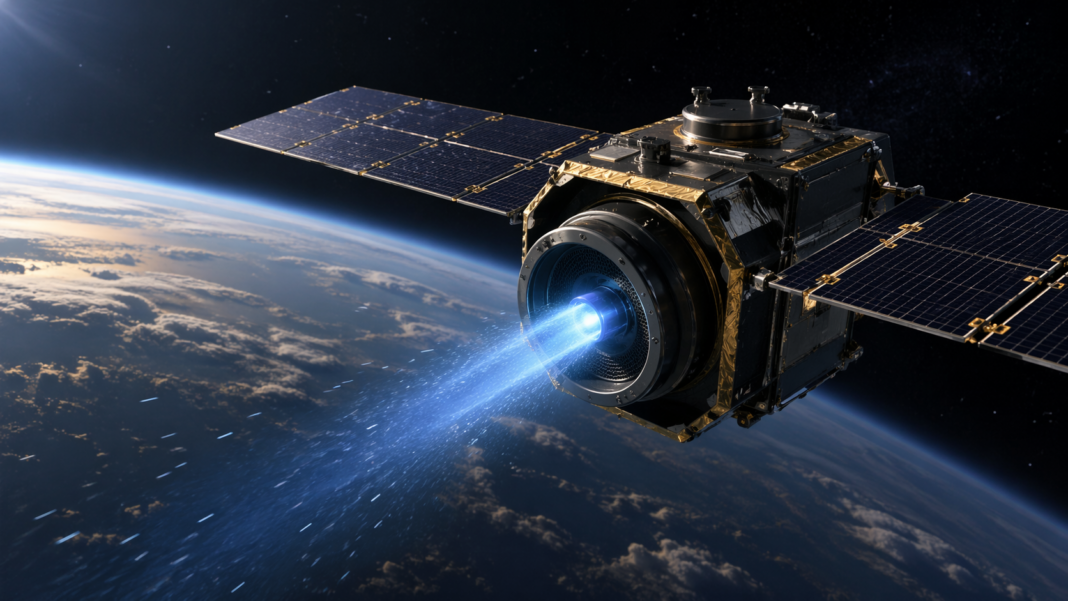

Kreios Space, a startup from Vigo, Spain, is gaining attention for its new Air-Breathing Electric Propulsion (ABEP) engine. This innovative system allows satellites to generate thrust using particles from the upper atmosphere instead of traditional fuel, offering a new way to improve satellite operations in low Earth orbit.
What Is Kreios Space and Its New ABEP Engine?
Kreios Space, a startup based in Vigo, Spain, has introduced a new Air-Breathing Electric Propulsion (ABEP) engine that could change how satellites operate. Founded in 2021, the company focuses on building advanced space technologies. Unlike traditional systems, most satellites carry onboard fuel, which limits how long they can stay in orbit before eventually falling back to Earth.
The ABEP engine works in a completely different way. Instead of using stored fuel, it collects tiny air particles from the upper atmosphere. These particles are then converted into plasma using solar energy, creating thrust that helps the satellite stay in motion and maintain its orbit.
NASA launches new NASA Force hiring portal to recruit engineers for space exploration
This technology is especially useful for satellites in Very Low Earth Orbit (VLEO), where atmospheric drag slows them down. By using the surrounding air as fuel, the ABEP engine removes the need for heavy fuel tanks, allowing satellites to operate longer and more efficiently at lower altitudes.
Testing, Investment, and Development Progress
Kreios Space has already completed important steps in developing the ABEP engine. The company built and tested prototypes on the ground to ensure the system works as expected. These tests were carried out in Galicia, a region in Spain known for its growing space technology sector.
To support this work, Kreios expanded its facilities in Nigrán. The company added a cleanroom and a vacuum chamber. These are special environments where engineers can test space equipment under conditions similar to outer space. A vacuum chamber removes air to simulate the near-empty conditions satellites experience in orbit.
One major milestone for Kreios Space came in 2026. The ABEP engine reached certification and completed ground testing. This achievement showed that the technology is ready for the next phase.
NASA Clarifies No Emergency on ISS
Following this progress, NATO’s Innovation Fund led an investment round to support the company. This funding highlights the importance of the technology for both commercial and strategic uses. It also gives Kreios Space the resources needed to move toward testing the engine in space.
The company is now preparing two test satellites. One of these satellites will carry the ABEP engine for an in-orbit demonstration. This step is important because it will show how the engine performs in real space conditions, where factors like temperature, radiation, and microgravity come into play.
Why VLEO Satellites Matter for Everyday Life
Satellites operating in Very Low Earth Orbit can offer several benefits that directly impact people on Earth. Because they are closer to the planet, they can capture higher-resolution images. This is useful for applications like weather monitoring, disaster management, agriculture, and mapping.
Another advantage is lower communication delay, also known as latency. This is important for services like internet connectivity, video calls, and real-time data sharing. VLEO satellites can make these services faster and more reliable.
The ABEP engine also helps reduce space debris over time. Since satellites in VLEO are closer to Earth, they naturally fall back and burn up in the atmosphere if they stop working. This reduces the risk of long-term space junk, which can be dangerous for other satellites.
Cygnus XL carrying 11000 pounds of supplies to ISS delayed by main engine problem
For satellite operators, the ability to stay in orbit without carrying fuel can lower costs and improve efficiency. Instead of launching heavier satellites with large fuel tanks, companies can use lighter designs that rely on the ABEP system.
Kreios Space’s work shows how new ideas in propulsion can change the way satellites are designed and used. By combining solar power with air-breathing technology, the company is exploring a method that uses resources already available in space.
The upcoming in-orbit demonstration will be a key step in understanding how this system performs outside of testing environments.

