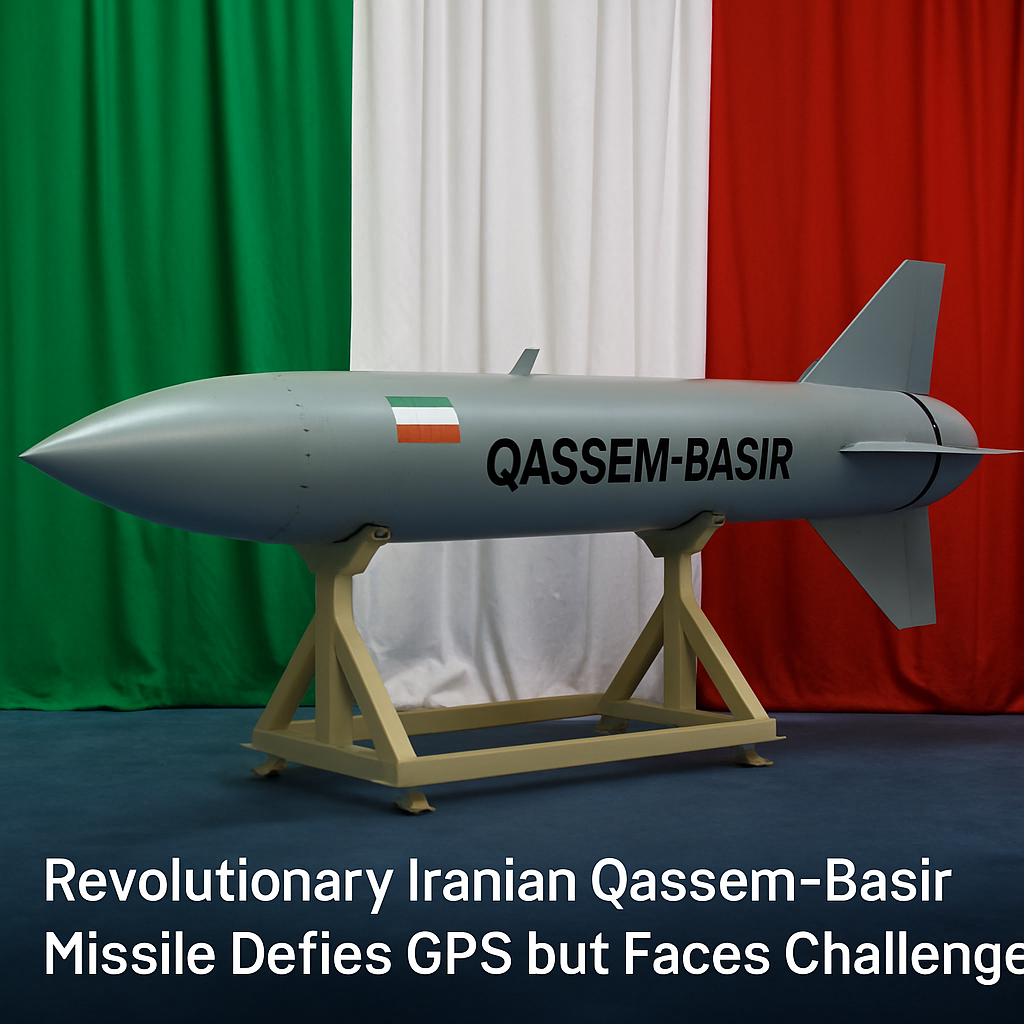

Iran recently introduced a new missile named the Qassem-Basir, which is considered a major step forward in its military technology. What makes this missile special is that it does not rely on GPS, the satellite navigation system commonly used worldwide for guidance.
Iran Unveils Advanced Qassem-Basir Missile
Instead, the Qassem-Basir uses a technology called the Inertial Navigation System, or INS for short. This system allows the missile to find its target accurately, even when GPS signals are jammed or blocked.
This is very important because many modern military weapons depend on GPS to reach their targets. If GPS signals are cut off, these weapons can lose their way and fail. The Qassem-Basir missile avoids this problem by using sensors and internal calculations to keep track of its position during flight. This ability gives Iran an advantage, especially in situations where enemies try to block satellite signals to stop attacks.
Iran’s military officials have praised the Qassem-Basir as a breakthrough in self-reliant and cyber-resistant weapons. This means the missile works well even in electronic warfare, where enemies try to disrupt technology by hacking or jamming signals. The missile’s design shows Iran’s growing ability to build advanced weapons at home without relying on other countries.
How the Qassem-Basir Missile Works Without GPS
The key to the Qassem-Basir missile’s success is the Inertial Navigation System. Unlike GPS, which uses satellites to tell a missile its exact location, INS uses a set of sensors inside the missile to track its movement. These sensors measure changes in speed and direction as the missile flies through the air.
By constantly calculating its position based on these measurements, the missile can “know” where it is and adjust its path to hit the target accurately. This method is not affected by outside interference like satellite jamming or cyber attacks, which can confuse GPS-guided weapons.
INS has been used in other types of military equipment before, but combining it with a powerful missile like the Qassem-Basir is a significant achievement for Iran. It allows the missile to operate in a more secure and reliable way, making it harder for enemies to defend against.
Iran Thwarted: Brilliant GPS Spoofing by Israel Outsmarts Missile Strike
Iran claims that the Qassem-Basir missile is fully developed within the country. This means all the design, engineering, and production took place in Iran, without foreign help. This is important for Iran because international sanctions often make it hard for the country to buy military technology from other nations.
Strategic Importance and Iran’s Military Growth
The introduction of the Qassem-Basir missile is part of Iran’s broader effort to improve its military power. In recent years, Iran has focused on developing new weapons, including drones, naval equipment, and missiles. The country wants to be able to defend itself and project power without relying on imports from outside.
One of the main reasons Iran developed this missile is to counter threats from countries like the United States and Israel. These countries have advanced defense systems and often try to stop missile attacks by jamming GPS signals or using other electronic warfare tactics.
With the Qassem-Basir missile’s INS guidance, Iran can bypass some of these defenses. The missile is harder to detect, track, or intercept because it does not depend on satellites. Military experts say this kind of technology is harder to block and can improve Iran’s ability to hit targets in complex battle situations.
GPS Breakthrough : How Space Tech is Enhancing Global Positioning Systems
Officials have highlighted that the Qassem-Basir represents a move toward more cyber-resilient weapons. This means the missile is designed to continue working even when faced with modern cyber and electronic threats. Iran’s emphasis on homegrown technology also shows its determination to become more independent in military capabilities.