Wednesday, November 25, 2026
2.4 C
Chicago

Space and Sky Events in 2027: The Total Solar Eclipse, Meteor Showers and More

Last updated: November 23, 2026.

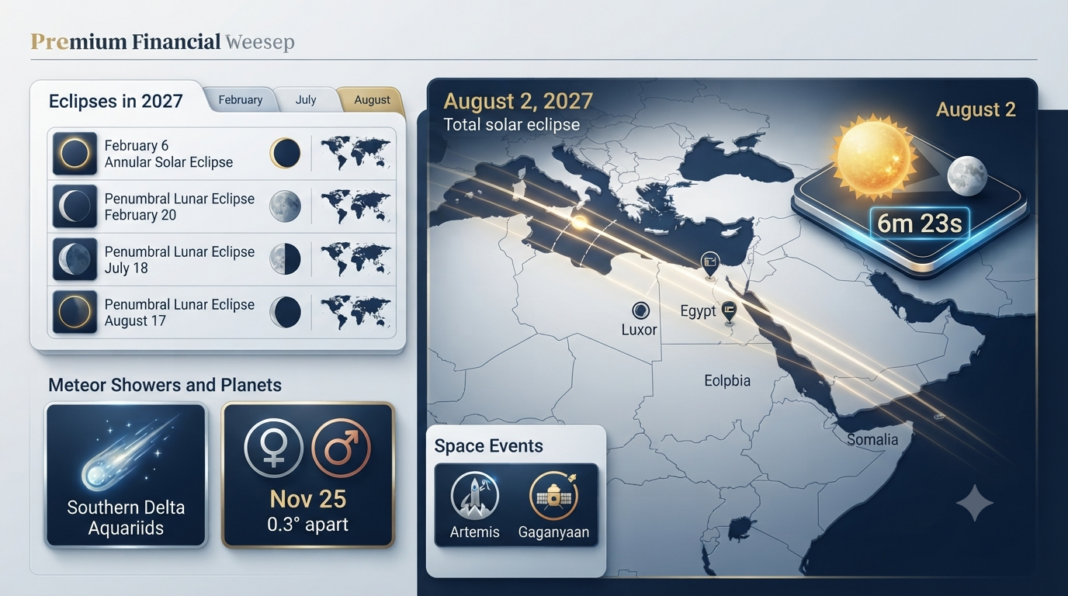
Short answer: The headline event of 2027 is the total solar eclipse on August 2, with totality lasting up to 6 minutes 23 seconds near Luxor, Egypt. The year also has an annular solar eclipse on February 6, three penumbral lunar eclipses and the usual meteor showers.

Eclipses in 2027

Date Event Where
— — —
February 6 Annular solar eclipse Chile, Argentina, Uruguay and West Africa
February 20 Penumbral lunar eclipse Visible where the Moon is above the horizon
July 18 Penumbral lunar eclipse Visible where the Moon is above the horizon
August 2 Total solar eclipse Southern Europe, North Africa, the Middle East and Somalia
August 17 Penumbral lunar eclipse Visible where the Moon is above the horizon

Penumbral lunar eclipses are subtle, because the Moon only dims slightly. They are a smaller event than the solar eclipses.

The August 2 total solar eclipse

The longest totality on the path is 6 minutes 23 seconds, near Luxor in Egypt, according to eclipse calculations. The path crosses Morocco, southern Spain (including Gibraltar), Algeria, Tunisia, Libya, Egypt, Saudi Arabia, Yemen and Somalia. Greatest eclipse occurs at about 10:07 UTC. It is widely described as one of the longest total solar eclipses of the century.

Planning tips:

  • Choose your spot early. Hotels and tours along the path in Spain, Morocco and Egypt are likely to book up.
  • Check the weather record. Southern Europe and North Africa tend to have clearer skies in early August than many regions, but clouds can still interfere.
  • Use proper eye protection. Never look at the Sun without eclipse glasses that meet the ISO 12312-2 standard, except during the brief total phase.

Meteor showers and planets

  • Southern Delta Aquariids: peak around July 31, with up to about 25 meteors an hour, and the Moon only about 6% lit, so skies are dark.
  • Venus and Mars: a close pairing in the evening sky on November 25, about 0.3 degrees apart, close enough to share a telescope view.
  • Planet and meteor shower timings depend on your latitude and local weather, so check a local calendar nearer the date.

Space events to follow on Earth

2027 is also expected to bring the next Artemis flight and, in India, Gaganyaan’s crewed mission. See what NASA does next after Artemis II and where Gaganyaan stands. For terms like penumbral and annular, see our space glossary, and for stargazing basics, our Milky Way stargazing guide.

Frequently asked questions

When is the next total solar eclipse after 2026?

August 2, 2027, crossing southern Europe, North Africa, the Middle East and Somalia.

How long will the August 2, 2027 eclipse last?

Totality lasts up to 6 minutes 23 seconds at the point of greatest duration, near Luxor, Egypt.

What is an annular solar eclipse?

An eclipse in which the Moon is too far from Earth to cover the Sun completely, leaving a bright ring around it. One occurs on February 6, 2027.

Is it safe to look at a solar eclipse?

Only with certified eclipse glasses or solar filters meeting the ISO 12312-2 standard. The brief total phase of a total eclipse is the only time it is safe to look without protection.

Which lunar eclipses happen in 2027?

Penumbral lunar eclipses on February 20, July 18 and August 17, 2027.
Official and primary sources

News reporting and analysis used

Hot this week

Astronauts, Rocket Founders and Agency Chiefs: Meet LinkedIn’s 25 Biggest Space Voices

A curated guide to 15 space leaders, astronauts, founders and investors worth following on LinkedIn, each with a public profile and more than 10,000 followers.

German Startup NeuralSat Raises €2.9 Million for a 72-Satellite Data-Relay Network

NeuralSat GmbH raised €2.9 million in pre-seed funding co-led by Capnamic and Bayern Kapital to build a planned 72-satellite network for data relay and processing in orbit.

CesiumAstro Raises $730 Million at a Valuation Above $4.5 Billion

Austin-based CesiumAstro closed a $730 million Series D led by Janus Henderson on November 5, 2026, and plans a 737-satellite constellation and a large Austin manufacturing campus.

Hyderabad’s Cosmoserve Space Raises $6 Million to Build Satellite-Servicing Spacecraft

Cosmoserve Space, founded by a former ISRO engineer, raised a $6 million seed round led by Japan’s Rebright Partners to develop spacecraft that capture and refuel satellites and clear debris.

NASA’s Swift Observatory Re-enters Earth’s Atmosphere After 22 Years

NASA’s Neil Gehrels Swift Observatory re-entered over Indonesia on November 4, 2026, nearly 22 years after launch, after a private rescue attempt failed to lift it to a higher orbit.

Topics

Astronauts, Rocket Founders and Agency Chiefs: Meet LinkedIn’s 25 Biggest Space Voices

A curated guide to 15 space leaders, astronauts, founders and investors worth following on LinkedIn, each with a public profile and more than 10,000 followers.

German Startup NeuralSat Raises €2.9 Million for a 72-Satellite Data-Relay Network

NeuralSat GmbH raised €2.9 million in pre-seed funding co-led by Capnamic and Bayern Kapital to build a planned 72-satellite network for data relay and processing in orbit.

CesiumAstro Raises $730 Million at a Valuation Above $4.5 Billion

Austin-based CesiumAstro closed a $730 million Series D led by Janus Henderson on November 5, 2026, and plans a 737-satellite constellation and a large Austin manufacturing campus.

Hyderabad’s Cosmoserve Space Raises $6 Million to Build Satellite-Servicing Spacecraft

Cosmoserve Space, founded by a former ISRO engineer, raised a $6 million seed round led by Japan’s Rebright Partners to develop spacecraft that capture and refuel satellites and clear debris.

NASA’s Swift Observatory Re-enters Earth’s Atmosphere After 22 Years

NASA’s Neil Gehrels Swift Observatory re-entered over Indonesia on November 4, 2026, nearly 22 years after launch, after a private rescue attempt failed to lift it to a higher orbit.

NASA’s Twin ESCAPADE Probes Slingshot Past Earth and Head for Mars

NASA’s two ESCAPADE spacecraft completed powered Earth flybys on November 7 and 9, 2026, and are now on a roughly 10-month cruise to Mars, with orbit insertion planned for September 2027.

SpaceX’s IPO Explained: The Numbers, the Structure and What It Means for the Space Industry

SpaceX listed on Nasdaq on June 12, 2026 in the largest IPO ever. The pricing, first-day trading, share structure and what the listing means for the space sector.

India’s Spacetech Funding in 2026: How Much Startups Have Raised and Who Leads

Indian spacetech startups have raised about $871 million across 241 rounds through July 2026, with Skyroot, Pixxel, Agnikul and Digantara leading. The numbers and why sources differ.
spot_img

Related Articles

Popular Categories