Wednesday, November 25, 2026
2.3 C
Chicago

NASA’s Twin ESCAPADE Probes Slingshot Past Earth and Head for Mars

Published November 23, 2026.

In short: NASA’s two ESCAPADE spacecraft each completed a powered flyby of Earth on November 7 and 9, 2026. The manoeuvres set them on course for Mars, where orbit insertion burns are planned for September 7 and 9, 2027.

What happened

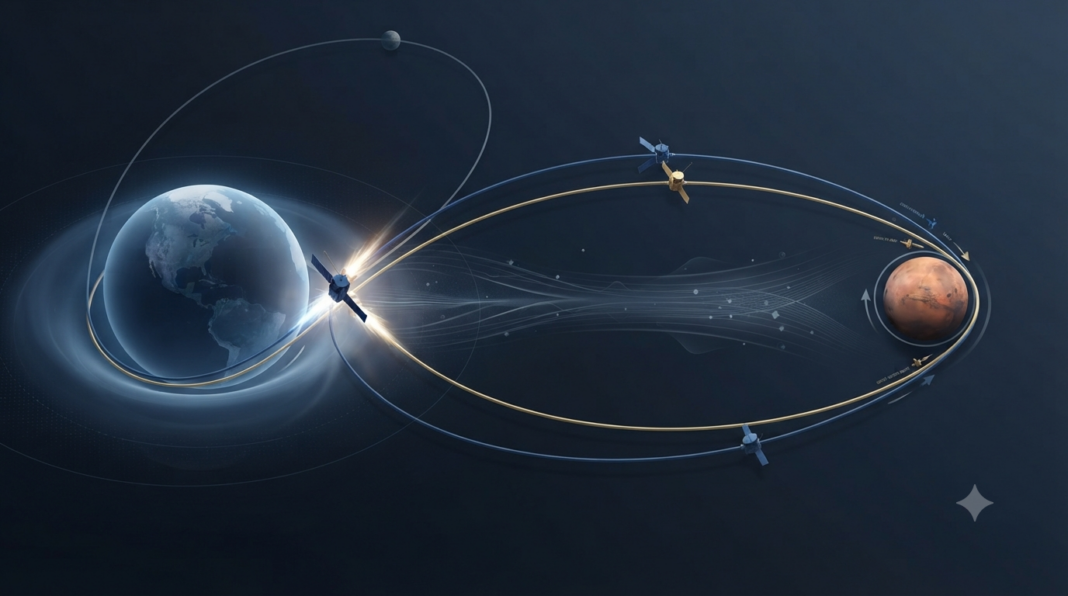
Each of the twin spacecraft, known as Blue and Gold, used Earth’s gravity together with an engine burn of about nine minutes to speed up and bend its path toward Mars. NASA confirmed on November 9 that both had completed the manoeuvre. Blue passed roughly 1,000 miles above Earth on November 7, and Gold passed about 650 miles above Earth two days later.

Why the detour

ESCAPADE launched on Blue Origin’s New Glenn rocket on November 13, 2025, when Earth and Mars were on opposite sides of the Sun. The original plan was a departure in October 2024, but delays to New Glenn pushed it past that window. Mission planners instead parked the probes on a loop around the Earth–Sun L2 region, about a million miles from Earth, and brought them back past Earth when the planets’ positions suited a Mars transfer.

Reports describe this as the first time NASA has used a powered Earth flyby to send spacecraft toward Mars. If the approach works, it could let future missions launch without waiting for the usual two-year alignment of Earth and Mars.

What comes next

  • A cruise of about 10 months to Mars.
  • Orbit insertion burns planned for September 7 and 9, 2027, which are still plans, not completed events.
  • Science observations on the way, including the behaviour of the solar wind between Earth and Mars.

ESCAPADE is designed to study how the solar wind strips gas from the Martian atmosphere. For more on the agencies behind missions like this one, see our guide to the world’s space agencies and the NASA section.

Sources

Primary and official:

News reporting:

Hot this week

Astronauts, Rocket Founders and Agency Chiefs: Meet LinkedIn’s 25 Biggest Space Voices

A curated guide to 15 space leaders, astronauts, founders and investors worth following on LinkedIn, each with a public profile and more than 10,000 followers.

German Startup NeuralSat Raises €2.9 Million for a 72-Satellite Data-Relay Network

NeuralSat GmbH raised €2.9 million in pre-seed funding co-led by Capnamic and Bayern Kapital to build a planned 72-satellite network for data relay and processing in orbit.

CesiumAstro Raises $730 Million at a Valuation Above $4.5 Billion

Austin-based CesiumAstro closed a $730 million Series D led by Janus Henderson on November 5, 2026, and plans a 737-satellite constellation and a large Austin manufacturing campus.

Hyderabad’s Cosmoserve Space Raises $6 Million to Build Satellite-Servicing Spacecraft

Cosmoserve Space, founded by a former ISRO engineer, raised a $6 million seed round led by Japan’s Rebright Partners to develop spacecraft that capture and refuel satellites and clear debris.

NASA’s Swift Observatory Re-enters Earth’s Atmosphere After 22 Years

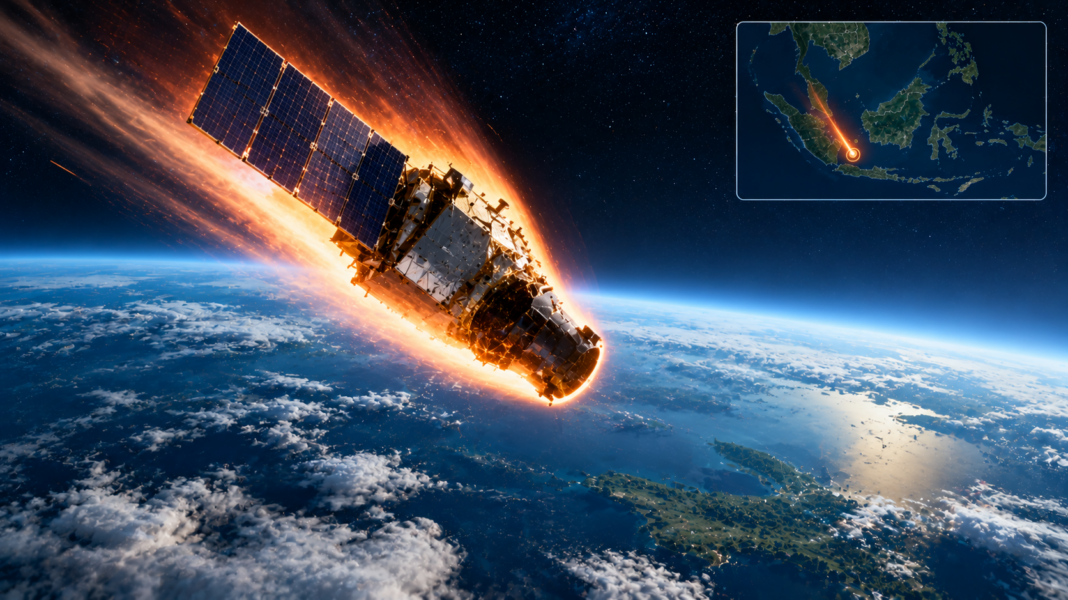
NASA’s Neil Gehrels Swift Observatory re-entered over Indonesia on November 4, 2026, nearly 22 years after launch, after a private rescue attempt failed to lift it to a higher orbit.

Topics

Astronauts, Rocket Founders and Agency Chiefs: Meet LinkedIn’s 25 Biggest Space Voices

A curated guide to 15 space leaders, astronauts, founders and investors worth following on LinkedIn, each with a public profile and more than 10,000 followers.

German Startup NeuralSat Raises €2.9 Million for a 72-Satellite Data-Relay Network

NeuralSat GmbH raised €2.9 million in pre-seed funding co-led by Capnamic and Bayern Kapital to build a planned 72-satellite network for data relay and processing in orbit.

CesiumAstro Raises $730 Million at a Valuation Above $4.5 Billion

Austin-based CesiumAstro closed a $730 million Series D led by Janus Henderson on November 5, 2026, and plans a 737-satellite constellation and a large Austin manufacturing campus.

Hyderabad’s Cosmoserve Space Raises $6 Million to Build Satellite-Servicing Spacecraft

Cosmoserve Space, founded by a former ISRO engineer, raised a $6 million seed round led by Japan’s Rebright Partners to develop spacecraft that capture and refuel satellites and clear debris.

NASA’s Swift Observatory Re-enters Earth’s Atmosphere After 22 Years

NASA’s Neil Gehrels Swift Observatory re-entered over Indonesia on November 4, 2026, nearly 22 years after launch, after a private rescue attempt failed to lift it to a higher orbit.

SpaceX’s IPO Explained: The Numbers, the Structure and What It Means for the Space Industry

SpaceX listed on Nasdaq on June 12, 2026 in the largest IPO ever. The pricing, first-day trading, share structure and what the listing means for the space sector.

India’s Spacetech Funding in 2026: How Much Startups Have Raised and Who Leads

Indian spacetech startups have raised about $871 million across 241 rounds through July 2026, with Skyroot, Pixxel, Agnikul and Digantara leading. The numbers and why sources differ.

Space and Sky Events in 2027: The Total Solar Eclipse, Meteor Showers and More

A guide to 2027’s biggest sky events: the August 2 total solar eclipse (6 minutes 23 seconds), the February annular eclipse, lunar eclipses and meteor showers.
spot_img

Related Articles

Popular Categories