
Last updated: November 23, 2026.
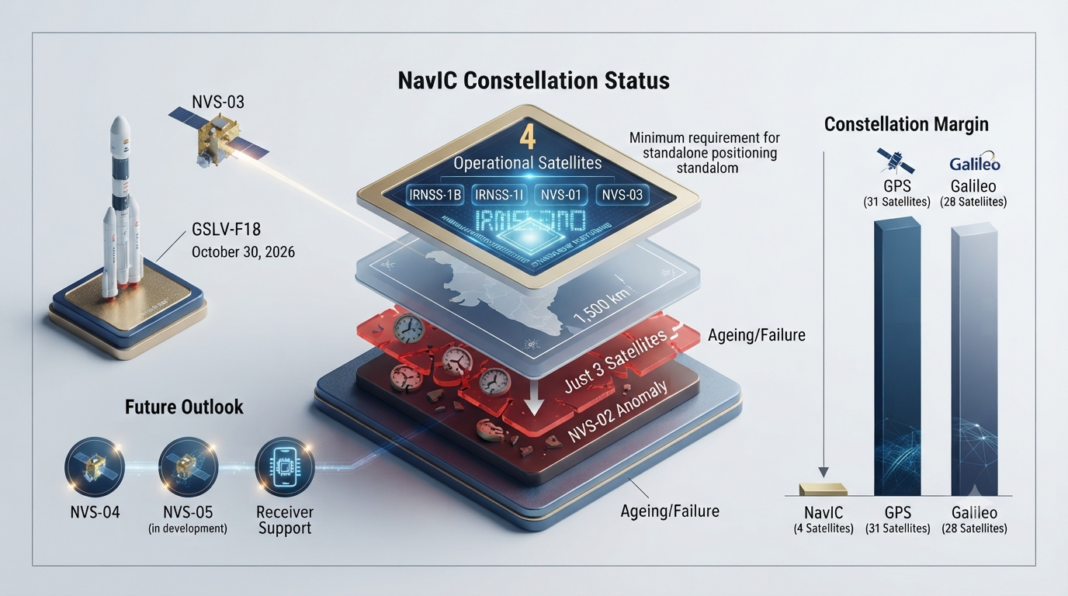
Short answer: NavIC, India’s regional navigation system, had fallen below the four satellites needed to compute a position on its own. ISRO launched the NVS-03 satellite on a GSLV rocket on October 30, 2026, and ISRO’s chairman said the launch restored NavIC’s positioning, navigation and timing services. Analysts note the system is still thin, with little margin for further failures.
What NavIC is
NavIC (Navigation with Indian Constellation) is India’s regional satellite navigation system, designed to cover India and about 1,500 km around it. Receivers need signals from at least four visible satellites to calculate latitude, longitude, altitude and time. For how it compares with GPS and other systems, see our GNSS constellations guide.
What went wrong
- Ageing first-generation satellites. Several IRNSS satellites lost their atomic clocks, which are essential for accurate timing. Indian coverage in 2026 reported that only a handful of the 11 satellites launched were providing service.
- NVS-02 failure. NVS-02, launched in January 2025 as a replacement, did not reach its intended orbit. Reports blamed an oxidiser valve problem, and the satellite was stranded in transfer orbit.
- A third satellite lost. One report said IRNSS-1F’s clock stopped in March 2026, leaving only three satellites providing service.
- Government acknowledgement. In July 2026, the government acknowledged that the operational constellation relied on just IRNSS-1B, IRNSS-1I and NVS-01, below the minimum for standalone positioning, while saying users faced no security or operational vulnerabilities.
What NVS-03 changes
NVS-03 is the third satellite in the second-generation NVS series. The Space Minister told Parliament that corrective measures from the NVS-02 anomaly were incorporated before launch. ISRO’s GSLV-F18 placed the satellite in its intended geosynchronous transfer orbit on the night of October 30, 2026.
With NVS-03 working, commentators count four NavIC satellites able to provide navigation and timing: IRNSS-1B, IRNSS-1I, NVS-01 and NVS-03. That is the minimum, not a comfortable margin, and analysts point out that some of those are first-generation satellites with limited remaining life.
What is still needed
- NVS-04 and NVS-05, which the government said are in advanced stages of realisation, plus another navigation satellite planned after them.
- Receiver support. NavIC’s value to the public depends on phones and chips supporting its signals.
- Reliability. Further launches need to succeed so the constellation can survive the loss of any one satellite.
Why it matters
Independent navigation matters for defence, aviation, disaster management and timing services, and it provides an alternative when other systems are jammed or spoofed. India’s sector is also expanding quickly on the private side. See our Indian space sector guide.
Frequently asked questions
What is NavIC?
NavIC is India’s regional satellite navigation system, built by ISRO to cover India and the surrounding region up to about 1,500 km.
Why was NavIC in trouble?
Atomic clocks failed on ageing satellites, and the NVS-02 replacement satellite failed to reach its operational orbit in 2025, leaving too few working satellites for standalone positioning.
Has NVS-03 fixed NavIC?
ISRO launched NVS-03 on October 30, 2026 and said it restored positioning, navigation and timing services. The constellation still has little margin, and more satellites are planned.
How many satellites does NavIC need?
At least four visible satellites are needed to calculate position and time. The full system was designed with more than that for resilience.
Does GPS work in India if NavIC is down?
Yes. GPS and other GNSS signals work in India regardless of NavIC’s status, and most phones use them.