
Last updated: November 23, 2026.
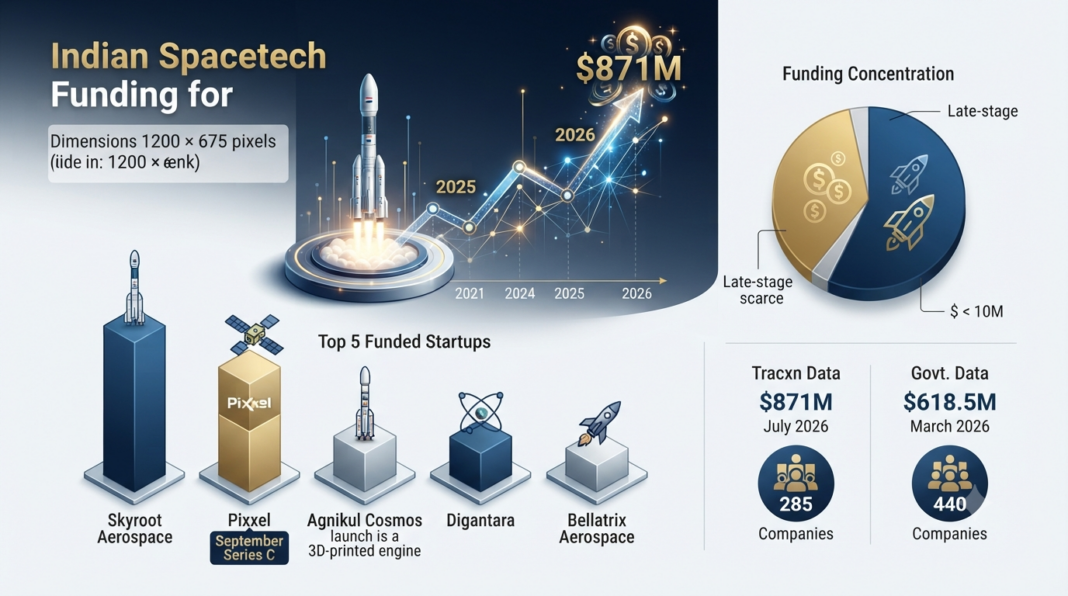
Short answer: Indian private space startups have raised about $871 million across 241 funding rounds as of July 2026, according to Tracxn. Skyroot Aerospace leads with about $150 million. Pixxel then announced a $100 million Series C in September, the largest single round by an Indian spacetech company.
The headline numbers
- Total funding: about $871 million across 241 rounds and 285 companies, per Tracxn data as of July 2026. Of those companies, 72 have raised institutional equity funding.
- Yearly growth: funding rose from $43 million in 2021 to more than $200 million in 2025, and startups had raised another $113 million across 24 rounds in 2026 by the end of July.
- Concentration: five rounds by Skyroot, Digantara, EtherealX, Bellatrix Aerospace and Agnikul together accounted for about $158 million, more than half of capital deployed across 2025 and 2026 at that point.
The top-funded startups
| Company | Total raised (Tracxn, July 2026) | What it does |
|---|---|---|
| — | — | — |
| Skyroot Aerospace | About $150 million | Launch vehicles (Vikram series) |
| Pixxel | About $96 million, then $195 million total after its September Series C | Hyperspectral Earth observation |
| Agnikul Cosmos | About $76 million | Launch vehicles with 3D-printed engines |
| Digantara | About $67 million | Space situational awareness |
| Bellatrix Aerospace | About $34 million | Propulsion |
Skyroot became India’s first spacetech unicorn in May 2026 after raising $60 million. Its Vikram-1 reached orbit in July. See our report on Vikram-1’s launch. Pixxel’s $100 million Series C in September 2026 was co-led by Temasek and Seraphim and took its total to $195 million. Digantara raised $50 million in late 2025.
Why the numbers differ
Tracxn counts $871 million through July 2026. India’s Department of Space told Parliament in August that cumulative investment in Indian space startups reached about $618.5 million as of March 31, 2026, and that around 440 space technology startups are registered on the Startup India portal. The gap reflects different dates, different definitions of what counts as a space startup, and different ways of counting rounds. Always check the date and source before quoting a total.
Why investors are interested, and cautious
Policy reforms since 2020, the Indian Space Policy 2023 and IN-SPACe’s support have opened the market. IN-SPACe announced its first group of companies selected for funding under its Technology Adoption Fund in June 2026. Even so, the funding is concentrated. A Business Today analysis found that the top three companies account for more than half of the private capital raised, while most startups operate with under $10 million, and late-stage capital remains scarce.
What to watch
Whether more startups can reach later funding stages, how quickly Skyroot and Agnikul fly again, and whether Earth observation and space-data companies can build recurring revenue. Our earlier list, Top 10 Indian spacetech startups, and our Indian space sector guide give background.
Frequently asked questions
How much have Indian spacetech startups raised?
About $871 million across 241 funding rounds through July 2026, according to Tracxn. The government cited about $618.5 million as of March 31, 2026, using a different measure.
Which Indian space startup has raised the most?
Skyroot Aerospace, with about $150 million, according to Tracxn. It became India’s first spacetech unicorn in May 2026.
What was Pixxel’s funding round?
A $100 million Series C announced in September 2026, co-led by Temasek and Seraphim, taking its total funding to $195 million.
How many space startups are there in India?
Around 440 are registered on the Startup India portal, according to the government. Tracxn counts 285 companies in its spacetech dataset.
Why do funding totals differ between sources?
They use different dates, definitions of a space startup, and ways of counting funding rounds.
Official and primary sources
- Press Information Bureau: Parliament question on space startups (August 12, 2026), via GlobalSecurity
- Indian Space Policy 2023 (ISRO)
News reporting and analysis used
- Entrepreneur India: India’s spacetech attracts $871 million (Tracxn report)
- IANS: India’s private spacetech sector raises $871 million through July
- YourStory: Pixxel raises $100M
- Business Today: Can India’s $13 billion spacetech sector scale?
- Gujarat Samachar: IN-SPACe selects startups for funding (June 2026)