Wednesday, November 25, 2026
2.3 C
Chicago

Skyroot’s Vikram-1 Reaches Orbit: How India’s First Private Orbital Rocket Made It

Last updated: November 23, 2026.

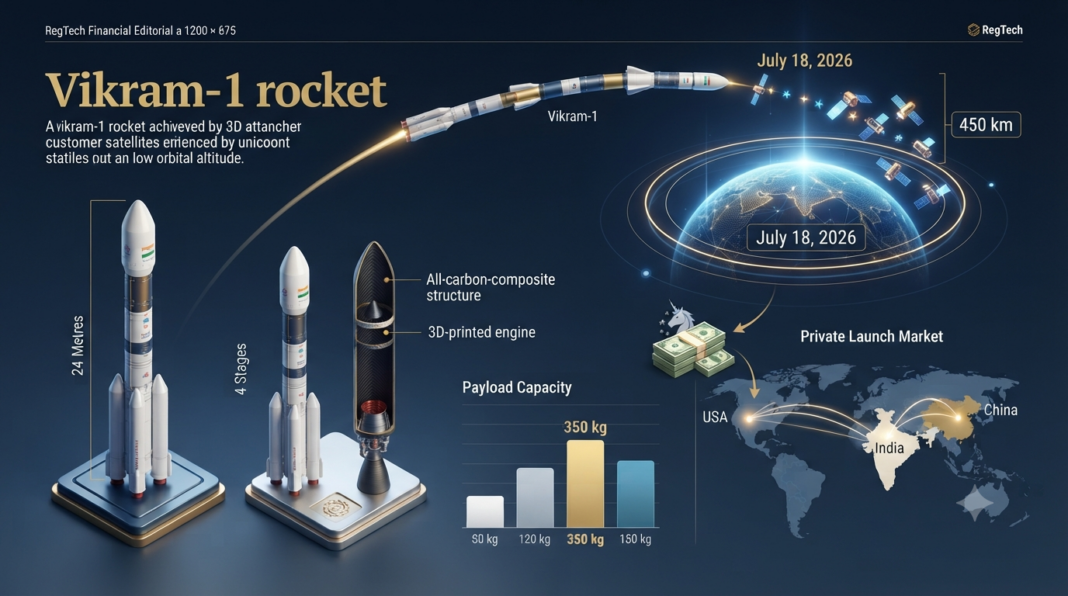
Short answer: Skyroot Aerospace’s Vikram-1 reached low Earth orbit on its first attempt on July 18, 2026, from the Satish Dhawan Space Centre in Sriharikota. It is India’s first privately developed orbital-class rocket, and the mission was called Mission Aagaman, meaning “arrival”.

What happened

Vikram-1 lifted off on the morning of July 18 and placed multiple customer payloads and technology demonstrations into a roughly 450 km orbit at about 60 degrees inclination. Reports say it completed all planned stages, including stage separations and the firing of its Orbital Adjustment Module. Indian officials and Skyroot described the flight as a success, and the Indian government’s science and technology portal reported that the vehicle reached orbit.

Several outlets reported that this makes India the third country, after the United States and China, to have a private company launch an orbital rocket successfully. That ranking comes from press reports rather than an official registry, so treat it as the media’s framing.

About the rocket

  • Size: about 24 metres tall, with four stages.
  • Payload: designed to lift about 350 kg to low Earth orbit.
  • Technology: an all-carbon-composite structure and in-house propulsion, including 3D-printed engines and solid-fuel motors.
  • Role: a small-satellite launcher, aimed at the growing market for dedicated launches of small satellites.

Why this matters

India’s private launch story began with Skyroot’s Vikram-S, a suborbital rocket flown in November 2022. Vikram-1 is the step from that test to orbit. It follows the 2020 reforms and the Indian Space Policy 2023, which opened launch and satellite manufacturing to private companies, with IN-SPACe providing authorisation and ISRO supporting with range and facilities. See our guide to India’s space sector for how those pieces fit together.

It also helped Skyroot’s funding story. The company became India’s first spacetech unicorn in May 2026 after raising $60 million, and Indian coverage tied the launch to rising investor interest. For the funding picture, see India’s spacetech funding in 2026.

What comes next

This was Vikram-1’s first test flight, so the next questions are about repeatability: how quickly Skyroot can fly again, how many launches it can do per year, and how it competes with ISRO’s small launcher and with global rideshare options. Companies such as Agnikul are also working towards orbital flight. See our report on Agnikul’s milestone.

Frequently asked questions

When did Vikram-1 launch?

July 18, 2026, from the Satish Dhawan Space Centre in Sriharikota, India.

What was Mission Aagaman?

The name of Vikram-1’s first orbital test flight. Aagaman means arrival.

Who built Vikram-1?

Skyroot Aerospace, a Hyderabad-based company.

How much can Vikram-1 carry?

It is designed to carry about 350 kg to low Earth orbit.

Is Vikram-1 India’s first private rocket?

It is India’s first privately developed rocket to reach orbit. Skyroot’s earlier Vikram-S was a suborbital rocket flown in 2022.

Official and primary sources

News reporting and analysis used

Hot this week

Astronauts, Rocket Founders and Agency Chiefs: Meet LinkedIn’s 25 Biggest Space Voices

A curated guide to 15 space leaders, astronauts, founders and investors worth following on LinkedIn, each with a public profile and more than 10,000 followers.

German Startup NeuralSat Raises €2.9 Million for a 72-Satellite Data-Relay Network

NeuralSat GmbH raised €2.9 million in pre-seed funding co-led by Capnamic and Bayern Kapital to build a planned 72-satellite network for data relay and processing in orbit.

CesiumAstro Raises $730 Million at a Valuation Above $4.5 Billion

Austin-based CesiumAstro closed a $730 million Series D led by Janus Henderson on November 5, 2026, and plans a 737-satellite constellation and a large Austin manufacturing campus.

Hyderabad’s Cosmoserve Space Raises $6 Million to Build Satellite-Servicing Spacecraft

Cosmoserve Space, founded by a former ISRO engineer, raised a $6 million seed round led by Japan’s Rebright Partners to develop spacecraft that capture and refuel satellites and clear debris.

NASA’s Swift Observatory Re-enters Earth’s Atmosphere After 22 Years

NASA’s Neil Gehrels Swift Observatory re-entered over Indonesia on November 4, 2026, nearly 22 years after launch, after a private rescue attempt failed to lift it to a higher orbit.

Topics

Astronauts, Rocket Founders and Agency Chiefs: Meet LinkedIn’s 25 Biggest Space Voices

A curated guide to 15 space leaders, astronauts, founders and investors worth following on LinkedIn, each with a public profile and more than 10,000 followers.

German Startup NeuralSat Raises €2.9 Million for a 72-Satellite Data-Relay Network

NeuralSat GmbH raised €2.9 million in pre-seed funding co-led by Capnamic and Bayern Kapital to build a planned 72-satellite network for data relay and processing in orbit.

CesiumAstro Raises $730 Million at a Valuation Above $4.5 Billion

Austin-based CesiumAstro closed a $730 million Series D led by Janus Henderson on November 5, 2026, and plans a 737-satellite constellation and a large Austin manufacturing campus.

Hyderabad’s Cosmoserve Space Raises $6 Million to Build Satellite-Servicing Spacecraft

Cosmoserve Space, founded by a former ISRO engineer, raised a $6 million seed round led by Japan’s Rebright Partners to develop spacecraft that capture and refuel satellites and clear debris.

NASA’s Swift Observatory Re-enters Earth’s Atmosphere After 22 Years

NASA’s Neil Gehrels Swift Observatory re-entered over Indonesia on November 4, 2026, nearly 22 years after launch, after a private rescue attempt failed to lift it to a higher orbit.

NASA’s Twin ESCAPADE Probes Slingshot Past Earth and Head for Mars

NASA’s two ESCAPADE spacecraft completed powered Earth flybys on November 7 and 9, 2026, and are now on a roughly 10-month cruise to Mars, with orbit insertion planned for September 2027.

SpaceX’s IPO Explained: The Numbers, the Structure and What It Means for the Space Industry

SpaceX listed on Nasdaq on June 12, 2026 in the largest IPO ever. The pricing, first-day trading, share structure and what the listing means for the space sector.

India’s Spacetech Funding in 2026: How Much Startups Have Raised and Who Leads

Indian spacetech startups have raised about $871 million across 241 rounds through July 2026, with Skyroot, Pixxel, Agnikul and Digantara leading. The numbers and why sources differ.
spot_img

Related Articles

Popular Categories