
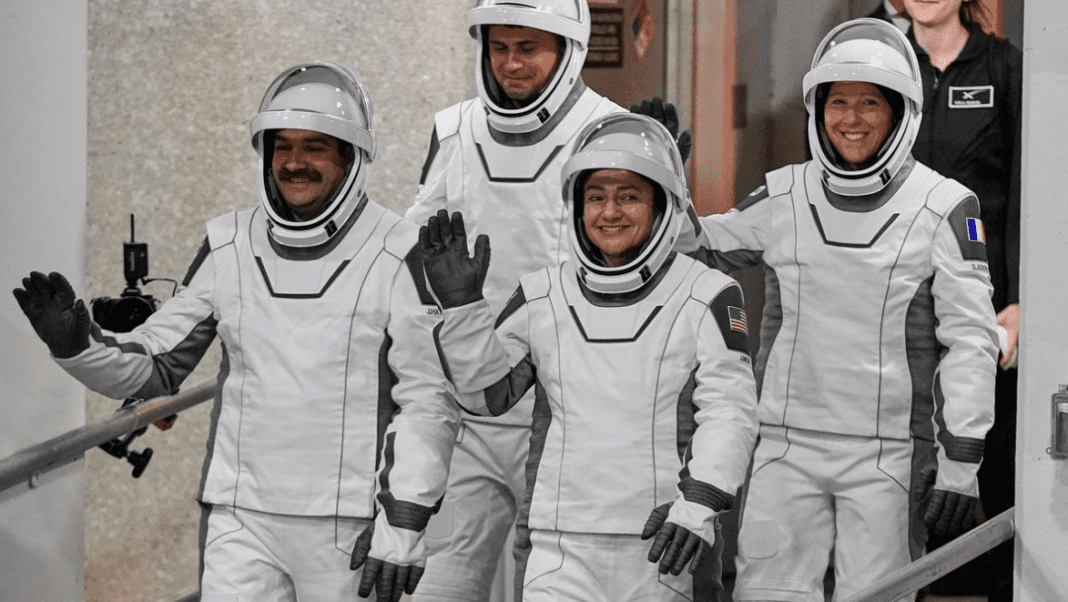

The International Space Station (ISS) welcomed four new astronauts after part of its previous crew returned to Earth due to a spacecraft safety concern, ensuring the station stays fully operational. This rotation keeps experiments, maintenance, and daily operations running smoothly, as astronauts conduct research on human health, microgravity, and Earth’s climate that cannot be done on Earth.
Why New Astronauts Were Introduced
The four new astronauts were sent to fill the gap created when NASA brought part of the previous team back as a precautionary measure. The early return of the earlier crew was prompted by a minor technical issue with their transport spacecraft. While no immediate danger occurred, astronaut safety is always the top priority. By sending replacements promptly, NASA and its international partners ensured that the ISS remained fully staffed and fully functional.
A continuous human presence is essential aboard the ISS. Experiments in microgravity cannot simply be paused indefinitely. Even routine maintenance, equipment checks, and station operations require dedicated hands and attention. Without a complete crew, research could slow down, station efficiency could be affected, and important tasks could be delayed.
NASA fixes dangerous hydrogen leak, clears major hurdle for crewed Artemis II Moon mission
This rotation also reflects the international nature of the ISS. Cooperation between space agencies around the world ensures that the orbiting laboratory runs smoothly, even when unexpected events occur. Swift crew replacement demonstrates the resilience and coordination of global space efforts.
Meet the Four New Astronauts
The new team brings a mix of experience, first-time space travelers, and international collaboration. These astronauts are ready to take on vital tasks aboard the station, including conducting experiments, maintaining systems, and supporting daily life in microgravity.
- Jessica Meir – A seasoned astronaut with prior experience on the ISS. She has taken part in groundbreaking missions, including the first all-female spacewalk, making her a veteran spacefarer ready for more challenging tasks.
- Jack Hathaway – A new astronaut embarking on his first space mission. With a background in the Navy, he brings strong technical and operational expertise to the ISS.
Boeing Starliner: Set to Send NASA Astronauts to Space
- Sophie Adenot – An astronaut from the European Space Agency (ESA) and a former military helicopter pilot. She became only the second woman from her country to travel to space, marking another milestone in international spaceflight.
- Andrei Fedyaev – A cosmonaut from Russia’s space agency and a former military pilot. He brings valuable flight experience and technical skills, supporting both research and station operations.
This diverse team combines experience, technical skill, and fresh perspectives to keep the ISS fully operational. Their work supports critical experiments in multiple fields, including biology, physics, and Earth observation.
What the New Crew Will Do
Once aboard the ISS, the new astronauts will immediately begin scientific work that takes advantage of the unique microgravity environment. This includes experiments on human health, such as studying muscle loss in space, as well as research into fluid behavior, combustion, and plant growth beyond Earth.
In addition to science, the astronauts will maintain station systems and inspect equipment. They may also conduct spacewalks if needed to perform external repairs or upgrades. The ISS also serves as a testing ground for technologies that could be used on future missions to the Moon and beyond.
Observing Earth’s climate from orbit is another critical task for the crew. High above the planet, the astronauts help monitor weather patterns, environmental changes, and other phenomena that provide scientists on Earth with valuable data.
By ensuring a fully staffed ISS, NASA and its international partners maintain the momentum of space research and station operations. The new crew’s arrival marks a seamless transition, allowing experiments and maintenance to continue without interruption.
This rotation underscores the importance of safety, readiness, and international collaboration in human spaceflight. Even after unexpected events, the work aboard the ISS continues at full pace, proving that life and research in orbit go on, nearly 400 kilometers above Earth.