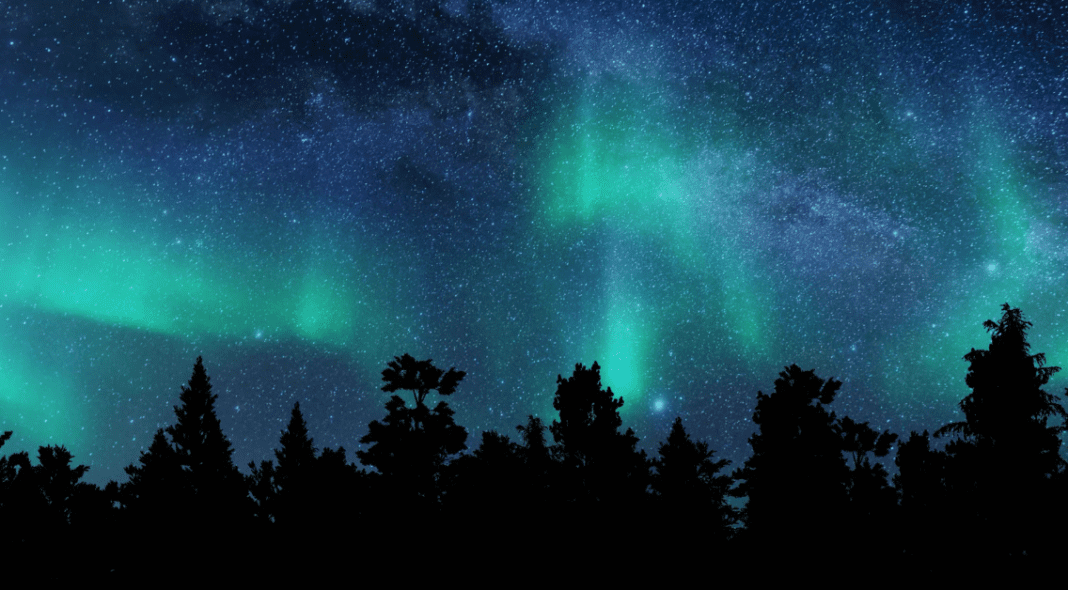



NASA launched two sounding rockets from Alaska. The goal was to study auroras in detail. Scientists focused on rare black auroras. These appear as dark shapes inside glowing northern lights. The rockets carried instruments directly into the auroras. They launched from the Poker Flat Research Range near Fairbanks. This location is ideal for studying auroral activity.
Twin rocket launches target the heart of the northern lights
NASA conducted two separate rocket launches from Alaska to study the northern lights, each addressing a different aspect of these stunning light displays.
The first mission focused on black auroras, which are unlike regular displays. While normal lights glow when charged particles move downward into Earth’s atmosphere, black auroras occur when electrons reverse direction and shoot upward into space. This creates dark shapes within the bright lights, almost like holes in glowing clouds.
To investigate this, a single sounding rocket was launched before sunrise on February 9. It carried instruments that measured electric fields, particle movement, and magnetic activity. The rocket reached about 224 miles high, entering the auroral region before returning to Earth. The instruments worked perfectly, sending back detailed data showing how electron flow reverses and the electrical conditions that create black auroras.
The second mission launched the next day aimed to map the overall flow of electric currents in the northern lights. Two rockets were launched minutes apart, reaching about 198 miles. Working with ground receivers, the mission captured data from multiple angles. This allowed scientists to see how electric currents move, spread, and change throughout the aurora, creating a detailed picture of its electrical activity.
How scientists create a 3D picture of auroral electricity
Auroras are not just light shows. They are part of a giant electrical system that links the Sun, space, and Earth’s atmosphere. Energy from the Sun travels through space as solar wind. When it reaches Earth, some of that energy flows along magnetic field lines toward the poles, lighting up the sky.
The twin-rocket mission was designed to study this electrical flow in detail. By combining data from the rockets with measurements from receivers on the ground, scientists can build a three-dimensional picture of what is happening inside the aurora.
This method is often compared to a medical CT scan. Just as doctors take images from different angles to see inside the human body, scientists use multiple measurements to see inside the aurora. The result is a clearer view of how electric currents move up and down through the upper atmosphere.
NASA Clarifies No Emergency on ISS
The data shows how energy spreads through thin layers of charged gas, also known as plasma. It reveals how some areas glow brightly while others suddenly go dark. This helps explain why auroras can change shape so quickly, sometimes forming waves, streaks, or dark patches that move across the sky.
Understanding these processes is important because auroras are closely linked to geomagnetic storms. These storms happen when strong bursts of solar energy disturb Earth’s magnetic field. When that happens, the same electrical systems that create auroras can also affect modern technology.
Why studying black auroras matters on Earth and in space
Auroras may look peaceful from the ground, but they are signs of powerful forces at work. The electrical activity that creates these colorful skies can also disrupt technology we rely on. In space, geomagnetic storms can damage satellites or affect their orbits, and astronauts can face higher radiation exposure. On Earth, storms can interfere with radio signals, GPS, and even power grids.
Black auroras are especially interesting because they show where energy behaves differently than usual. Instead of moving downward to produce light, electrons shoot upward, changing the balance of the electrical system. Studying this helps scientists understand space weather better.
Sky turns electric: G3 solar storm to paint 24 U.S. states with breathtaking aurora tonight
The Alaska launches offered a rare chance to fly directly through these areas and gather real-time data. Sounding rockets are perfect for this research because they reach the altitudes where auroras form and carry sensitive instruments.
By examining both glowing and black auroras, scientists are mapping how energy from the Sun moves through space and interacts with Earth. These twin missions demonstrate how short, precise launches can reveal hidden secrets of the night sky and advance our understanding of space.