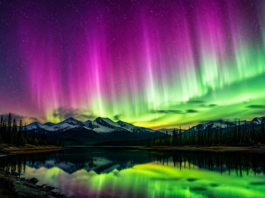

A spectacular celestial display could light up the night sky this Sunday, as the northern lights, also known as the aurora borealis, may be visible from parts of the northern United States. According to the latest forecast from the National Oceanic and Atmospheric Administration (NOAA), periods of minor and moderate geomagnetic storms could make the aurora easier to see, creating a rare opportunity for skywatchers to witness one of nature’s most breathtaking phenomena.
Why the Northern Lights May Appear This Sunday
The northern lights occur when charged particles from the Sun interact with Earth’s magnetic field, producing vibrant glowing colors in the sky. This Sunday, NOAA forecasters are predicting a Kp index of 5 out of 9. The Kp index measures geomagnetic activity, and a higher number indicates that the aurora could appear brighter with more movements and formations.
The elevated activity is mainly due to high-speed solar winds coming from a coronal hole on the Sun. A coronal hole is a cooler, less dense region of the Sun that looks darker in pictures taken by astronomers. These high-speed winds can collide with slower solar winds, forming a compression zone known as a co-rotating interaction region, or CIR. When this zone reaches Earth, it can trigger geomagnetic storms.
NOAA says that moderate geomagnetic storms are expected on Sunday, and even these storms can make the northern lights visible from areas much farther south than usual. Additionally, remnants of a coronal mass ejection that left the Sun last week may also enhance the aurora display, adding to the likelihood of a visible light show.
Where the Aurora Could Be Seen
Skywatchers in 15 northern U.S. states have a chance to see the aurora on Sunday night. The most favorable areas are near the U.S.-Canadian border, where the aurora is often more visible. States included in this forecast are Washington, the Idaho Panhandle, Montana, northeastern Wyoming, North Dakota, and South Dakota.
Boeing Starliner: Set to Send NASA Astronauts to Space
In the upper Midwest, the northern lights could appear over Minnesota, most of Wisconsin, northern Iowa, and northern Michigan. NOAA also includes far northern Upstate New York, as well as the northern parts of Vermont, New Hampshire, and Maine, in the aurora’s reach. Alaska, known for its stunning aurora displays, will also see the lights clearly.
For the best viewing experience, experts suggest moving as far north as possible toward Earth’s magnetic north pole, located in Canada. Observers should find a location with a clear, open view of the sky and minimal light pollution. The ideal time to watch the aurora is typically between 10 p.m. and 2 a.m., when geomagnetic activity tends to peak.
Tips for Experiencing and Photographing the Northern Lights
Even casual observers can enjoy the northern lights without specialized equipment. Modern smartphone cameras can capture quality images if used correctly. For the best photos, turn off the camera flash and set the device on a stable surface like a tripod. Shooting in RAW image format is recommended for higher-quality results.
iPhone users can make the most of Night mode, while Android users should use the Pro mode to adjust settings like shutter speed, ISO, and focus. Observers should also be patient, as the aurora can appear in waves, with colors and shapes shifting over time. Being in a dark area away from city lights and waiting quietly often results in the clearest, most stunning views.
Sun’s surprise sends dazzling northern lights across America — see if you’re in the zone
While the northern lights are often associated with far northern regions like Alaska, solar events can occasionally make the aurora visible from lower latitudes. This Sunday presents one of those opportunities, giving residents in multiple states a rare chance to witness a natural light show that is both magical and scientifically fascinating.
For families, amateur photographers, and astronomy enthusiasts alike, Sunday night could be an unforgettable evening under the shimmering glow of the northern lights.