

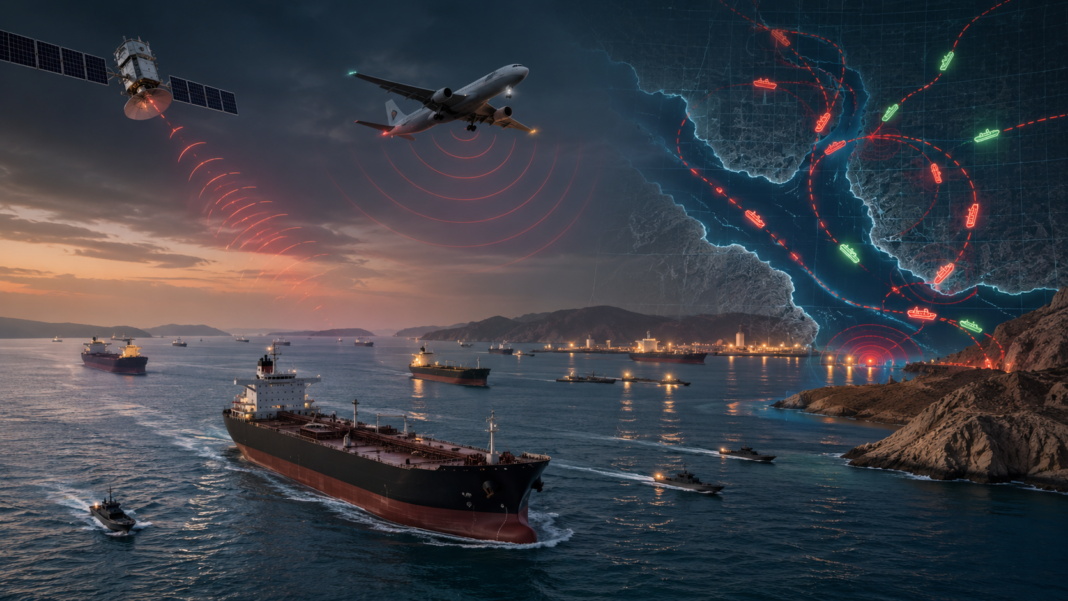

Quick Summary
| Key Fact | Details |
|---|---|
| Conflict | Iran-related military operations in the Middle East |
| Main Issue | GPS jamming and GPS spoofing |
| Key Location | Strait of Hormuz |
| Reported Incidents | More than 1 million GPS disruption events |
| Affected Systems | Ships, aircraft, drones, navigation networks |
| Strategic Impact | Maritime trade, military operations, energy security |
Key Takeaways
- GPS jamming and GPS spoofing have increased significantly around the Strait of Hormuz in 2025.
- According to maritime monitoring organizations, more than one million GPS disruption incidents have been detected since the conflict intensified.
- Commercial ships, oil tankers, aircraft, drones, and military systems have all experienced navigation interference.
- Electronic warfare is increasingly becoming a critical component of modern military operations.
- The disruptions highlight vulnerabilities in global satellite navigation systems.
What Is GPS Jamming?
GPS jamming is an electronic warfare technique that blocks satellite navigation signals by transmitting interference on the same frequencies used by GPS satellites.
When GPS jamming occurs, receivers may lose their ability to determine accurate position, speed, and timing information.
According to the U.S. Department of Homeland Security, GPS interference can affect transportation systems, communications infrastructure, and critical services that depend on satellite navigation.
What Is GPS Spoofing?
GPS spoofing occurs when false navigation signals are transmitted to deceive GPS receivers.
Instead of losing navigation entirely, a spoofed system may calculate an incorrect position and continue operating with false location information.
According to the U.S. Department of Transportation, GPS spoofing can cause vessels, aircraft, and autonomous systems to believe they are somewhere other than their actual location.
Why Is the Strait of Hormuz Important?
The Strait of Hormuz is one of the world’s most important maritime chokepoints.
According to the U.S. Energy Information Administration (EIA), approximately 20% of global petroleum liquids consumption moves through the Strait of Hormuz every year.
Source:
https://www.eia.gov
Because of its strategic importance, military activity in the region can have direct consequences for global shipping, energy markets, and maritime security.
GPS Disruptions Surge During the Iran Conflict
In 2025, the Middle East has experienced an unprecedented rise in GPS interference linked to military operations and regional tensions.
According to multiple maritime intelligence reports, more than one million GPS disruption events have been recorded across the Gulf region since the conflict intensified.
Several commercial vessel tracking platforms have reported unusual navigation anomalies, including:
- Ships appearing to jump large distances.
- Tankers appearing on land.
- Multiple vessels displaying identical positions.
- Navigation tracks showing impossible movements.
These anomalies are commonly associated with GPS spoofing activity.
How Oil Tankers Are Using GPS Gaps
Maritime analysts have reported increasing concerns about “dark fleet” operations.
A vessel is considered “dark” when it disables its Automatic Identification System (AIS), preventing public tracking of its movements.
According to data from maritime intelligence firms, some tankers disappear from tracking systems near the Strait of Hormuz before reappearing days later.
Experts believe GPS spoofing and AIS manipulation make it more difficult for regulators, insurers, and shipping companies to monitor vessel movements accurately.
Impact on Commercial Aviation
The effects are not limited to maritime traffic.
Several aviation monitoring organizations have reported increased GPS interference affecting commercial aircraft operating in Middle Eastern airspace during 2025.
According to aviation safety advisories, pilots may experience degraded navigation accuracy and increased workload when operating in areas affected by electronic interference.
Although modern aircraft have backup navigation systems, persistent GPS disruptions create operational challenges.
Why Militaries Use GPS Jamming
Modern military forces rely heavily on GPS-enabled systems.
Examples include:
| Military Capability | GPS Dependence |
|---|---|
| Drones | High |
| Guided Missiles | High |
| Reconnaissance Systems | High |
| Military Logistics | Medium |
| Battlefield Communications | Medium |
According to defence analysts, disrupting GPS signals can reduce the effectiveness of drones, precision-guided weapons, and surveillance systems without requiring direct military engagement.
What This Means for Future Warfare
The events unfolding around the Strait of Hormuz demonstrate how warfare is increasingly extending into the electromagnetic spectrum.
Military planners now view electronic warfare alongside land, sea, air, cyber, and space operations.
As reliance on satellite navigation continues to grow, GPS jamming and spoofing are likely to remain major features of future conflicts.
Conclusion
The surge in GPS jamming and spoofing during the Iran conflict highlights a growing vulnerability in modern navigation systems. According to maritime, aviation, and defence analysts, electronic warfare is becoming a central element of military strategy because it can disrupt ships, aircraft, drones, and communications without direct physical attacks.
The developments around the Strait of Hormuz in 2025 demonstrate that future conflicts will increasingly involve battles over information, navigation, and satellite-based infrastructure. As nations invest in electronic warfare capabilities, protecting GPS-dependent systems will become a critical component of national security and global trade resilience.