
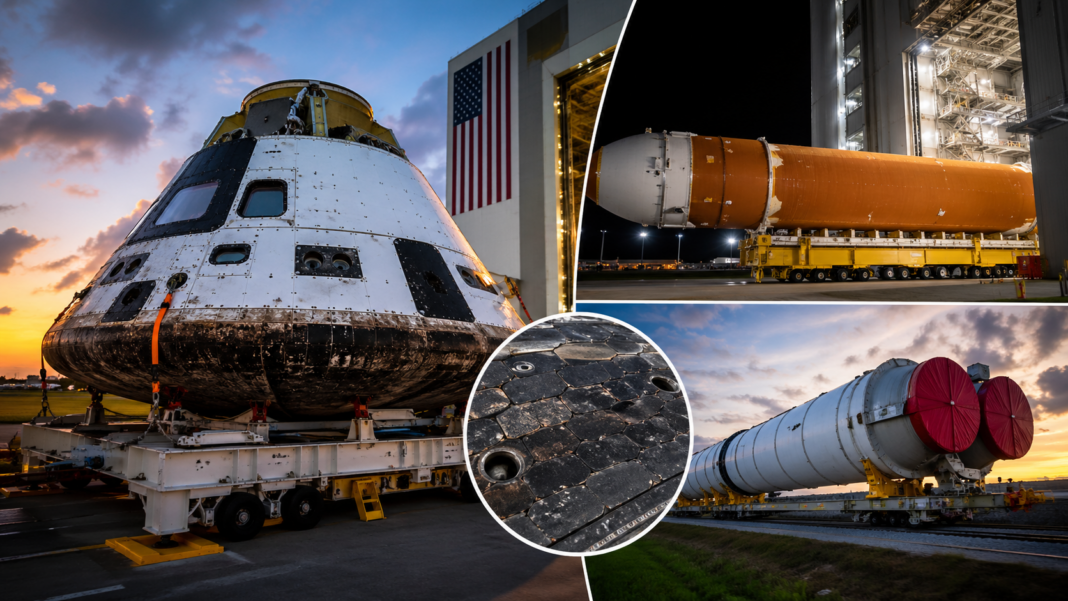

The NASA has brought back its Orion spacecraft from the Artemis II mission to Kennedy Space Center, marking a key step in its Moon program. The mission delivered important data on spacecraft performance, while new updates on the Artemis III mission and its upgraded heat shield show continued progress in future lunar plans.
Artemis II Orion Capsule Returns to Kennedy Space Center
NASA has returned its Orion spacecraft capsule from the Artemis II mission to Kennedy Space Center, nearly a month after completing a historic journey around the Moon. This mission marked the first time in more than 50 years that humans traveled so far into deep space, making it a major milestone for lunar exploration.
The capsule, named Integrity, safely splashed down in the Pacific Ocean on April 10. After recovery near San Diego, it was transported back to Florida. It is now undergoing detailed inspections, where engineers are carefully studying its systems, structure, and onboard equipment.
The nearly 10-day mission tested critical technologies needed for future Moon missions. Engineers are examining avionics, life-support systems, and research tools to understand their performance. The data collected will help improve safety and efficiency for upcoming Artemis missions.
Heat Shield Performance Shows Strong Improvement
One of the most important parts of the Orion spacecraft is its heat shield, which protects the capsule from extreme temperatures during re-entry into Earth’s atmosphere. These temperatures can reach thousands of degrees, making the heat shield essential for astronaut safety.
Early analysis shows that the heat shield used during the Artemis II mission performed even better than the one from the Artemis I mission. Engineers found that “char loss,” or the material that burns away during re-entry, was significantly reduced. Images taken after splashdown and inspections on the recovery ship confirmed that the damage was smaller in both size and amount.
Boeing Starliner: Set to Send NASA Astronauts to Space
The results also matched ground-based arc jet testing, where materials are exposed to extreme heat similar to re-entry conditions. This consistency gives engineers more confidence in the heat shield’s design and materials.
The shield is made of special blocks that absorb and release heat safely, and they showed improved durability during the mission. Apart from a minor toilet issue, the spacecraft performed well, with all major systems working as expected.
Artemis III Hardware and Heat Shield Progress Update
While analysis of the Artemis II mission continues, preparations for the Artemis III mission are already moving forward at full pace.
On April 28, teams transferred the massive core stage of the Space Launch System into the Vehicle Assembly Building at Kennedy Space Center. This is an important milestone, as it marks the first time Artemis III core stage assembly operations are being carried out at this location. The core stage stands 212 feet tall and is designed to store more than 733,000 gallons of super-cooled liquid fuel, which will power four powerful engines during liftoff. It will first be positioned horizontally and later lifted into place for integration with other rocket components.
Artemis II astronauts express high confidence in Moon landing after successful lunar flyby
At the same time, key booster segments have arrived in Florida. Manufactured by Northrop Grumman, these segments were transported by rail across several states. Once assembled, they will form twin solid rocket boosters that provide over 75 percent of the rocket’s total thrust. Each booster will stand nearly 17 stories tall and together generate up to 8.8 million pounds of thrust. Teams are currently inspecting and preparing these segments inside specialized facilities before stacking.
Work is also advancing on the Orion crew module. Its upgraded heat shield, built using 186 Avcoat blocks, has been fully installed, cured, and inspected. Engineers have completed thermal cycle testing and ultrasonic checks to ensure structural strength. The service module has also passed key tests, including solar array deployment. The next phase involves integrating all major systems, including the launch abort system.