

NASA has marked a key milestone in its plan to return humans to the Moon with the rollout of a major rocket component for the Artemis III mission. This step highlights steady progress as preparations continue for one of the agency’s most important upcoming space missions.
A Giant Step Toward the Next Moon Mission
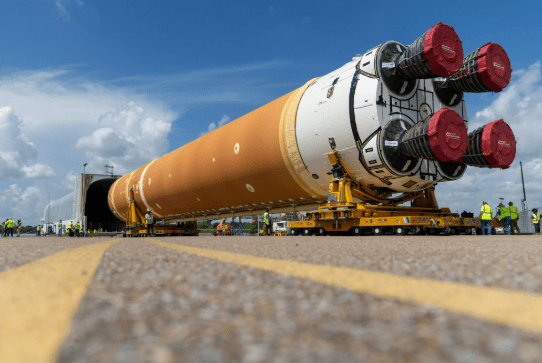
NASA has rolled out the core stage of its powerful Space Launch System rocket, marking an important milestone for the Artemis III mission under the Artemis program. This mission aims to send astronauts toward the Moon and is a key part of NASA’s ongoing efforts in human space exploration.
The massive rocket section was built at the Michoud Assembly Facility, where engineers spent years assembling and testing its complex systems. It has now started its journey aboard a specialized barge heading to the Kennedy Space Center for final preparations, including integration with other rocket components.
Artemis III: NASA’s Pioneering Instruments for Lunar Exploration
As the largest and most powerful section of the rocket, the core stage is responsible for providing the thrust needed during launch. It includes huge fuel tanks, structural sections, and critical systems that support flight. Moving this enormous structure requires advanced transport technology, careful coordination, and precise execution at every step.
What Makes the Core Stage So Powerful
The core stage of the Space Launch System is a remarkable example of advanced engineering and design, playing a central role in the Artemis III mission. Standing about 212 feet tall when fully assembled, it is built to handle enormous amounts of fuel and provide the immense power needed for deep-space missions like the Artemis III mission. Its large tanks can hold more than 733,000 gallons of super-cooled liquid hydrogen and liquid oxygen, which are essential for launch.
These fuels are stored at extremely low temperatures and are carefully managed to ensure safety and performance during the Artemis III mission. The core stage also includes key structural sections that support the rocket during liftoff and flight. Every part is designed to withstand extreme pressure, heat, and vibration as the rocket travels from Earth into space.
NASA Clarifies No Emergency on ISS
At the base of the core stage are four powerful engines built for high performance and reliability. These engines will fire for more than eight minutes, producing over 2 million pounds of thrust. This strong force allows the rocket to break free from Earth’s gravity and carry the Orion spacecraft safely into orbit for the Artemis III mission.
After arriving at the Kennedy Space Center, teams will complete final assembly by stacking all components vertically. This process requires precise alignment, detailed testing, and careful coordination to ensure the rocket is fully prepared for the Artemis III mission.
Preparing for Artemis III Mission Operations
The Artemis III mission is a key part of NASA’s plan to return humans to the Moon under the Artemis program. After launch, astronauts will travel aboard the Orion spacecraft into Earth’s orbit, where critical mission operations will begin. This mission is designed to test advanced technologies and systems that will support future human exploration beyond Earth.
One of the main goals is to demonstrate how spacecraft can meet and connect in space, a process known as docking. This capability is essential for missions where multiple spacecraft must work together. By testing docking and coordination, NASA aims to prepare for more complex missions planned in later phases of the Artemis program. These steps are necessary for building long-term exploration strategies.
NASA prepares to send humans farther from Earth than ever before in Artemis II mission
The Space Launch System plays a central role, as it is currently the only rocket capable of carrying astronauts, spacecraft, and supplies in a single launch. The movement of its core stage from the assembly site to the Kennedy Space Center highlights steady progress and reflects years of detailed planning, engineering, and construction.
As preparations continue, teams will focus on integrating the rocket and testing its systems thoroughly. These steps ensure that all components function correctly before launch, supporting a safe and efficient mission.