
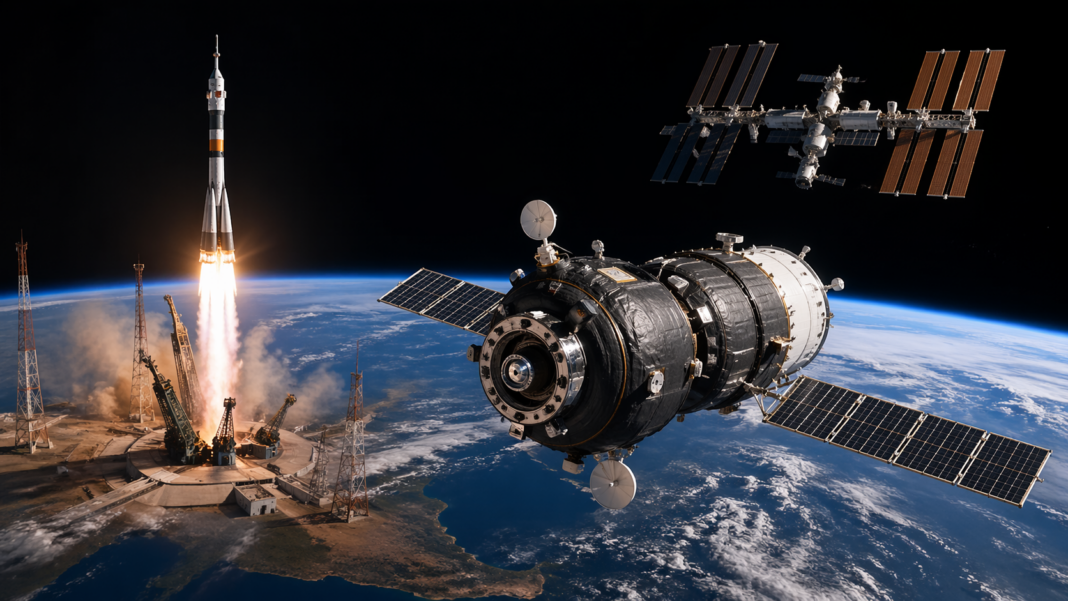

NASA will provide live coverage of the Progress 95 cargo mission to the International Space Station, showcasing a key resupply effort that supports astronauts and research in space. Launching from the Baikonur Cosmodrome aboard a Soyuz rocket, the mission highlights the importance of regular cargo deliveries in keeping the station running smoothly.
Launch of Progress 95 from Baikonur Cosmodrome
NASA has announced live coverage of the launch of the Progress 95 cargo spacecraft, an important mission designed to deliver essential supplies to the International Space Station. These missions help ensure that astronauts living in space have everything they need to safely carry out their daily tasks and research.
Progress 95 is an uncrewed spacecraft that will launch aboard a Soyuz rocket from the Baikonur Cosmodrome. The launch is scheduled for 6:21 p.m. EDT on Saturday, April 25, which will be 3:21 a.m. local time on April 26 in Kazakhstan. This timing allows the spacecraft to follow a precise path to reach the space station.
NASA announces major SpaceX cargo mission for May 12 to support valuable space station experiments
The spacecraft will carry nearly three tons of cargo, including food, fuel, water, and other necessary supplies. These materials are essential for supporting daily life aboard the station, maintaining equipment, and enabling scientific experiments that can only be conducted in microgravity. Regular resupply missions like this are vital because the space station orbits far above Earth, making it impossible to restock without dedicated spacecraft.
Live Coverage and Docking Details
Viewers around the world will be able to watch this cargo mission unfold in real time. NASA’s live broadcast will begin shortly before launch, giving audiences a chance to follow every step of this important cargo mission. Coverage will be available on NASA’s streaming service, NASA+, as well as on platforms like Amazon Prime and YouTube.
After launching into space, Progress 95 will not reach the International Space Station immediately. Instead, it will take about two days to carefully align its orbit with that of the station. This slow and precise approach ensures safety and accuracy during docking for the cargo mission.
NASA Clarifies No Emergency on ISS
The spacecraft is expected to dock at 8 p.m. on Monday, April 27. It will connect to the aft port of the Zvezda module, which is part of the Russian segment of the space station. The docking process is fully automated, meaning the spacecraft will guide itself into position without human control.
NASA will begin its live coverage of the rendezvous and docking at 7:15 p.m., showing the spacecraft carefully approaching and attaching to the station while both travel at extremely high speeds around Earth.
Role of Progress Missions and Space Station Operations
Progress spacecraft play an essential role in keeping the International Space Station running smoothly and efficiently. After docking, the spacecraft remains attached to the station for about seven months. During this period, astronauts unload important supplies such as food, fuel, water, and scientific equipment. These materials are necessary to support daily life in space and to carry out experiments that take advantage of the station’s microgravity environment.
Beyond delivering cargo, Progress spacecraft also help manage waste aboard the station. Once all supplies are removed, astronauts fill the spacecraft with trash, used packaging, and other unwanted materials. At the end of its mission, the spacecraft undocks and heads back toward Earth, where it safely burns up in the atmosphere. This process provides a reliable way to dispose of waste without affecting the space environment.
NASA launches new NASA Force hiring portal to recruit engineers for space exploration
Before Progress 95, the earlier Progress 93 mission completed its journey successfully. It undocked on April 20 and later burned up over the Pacific Ocean. Such regular missions ensure a continuous supply chain and proper station maintenance.
For over 25 years, humans have continuously lived aboard the space station, allowing scientists to conduct important research in space and better understand conditions that cannot be replicated on Earth.