

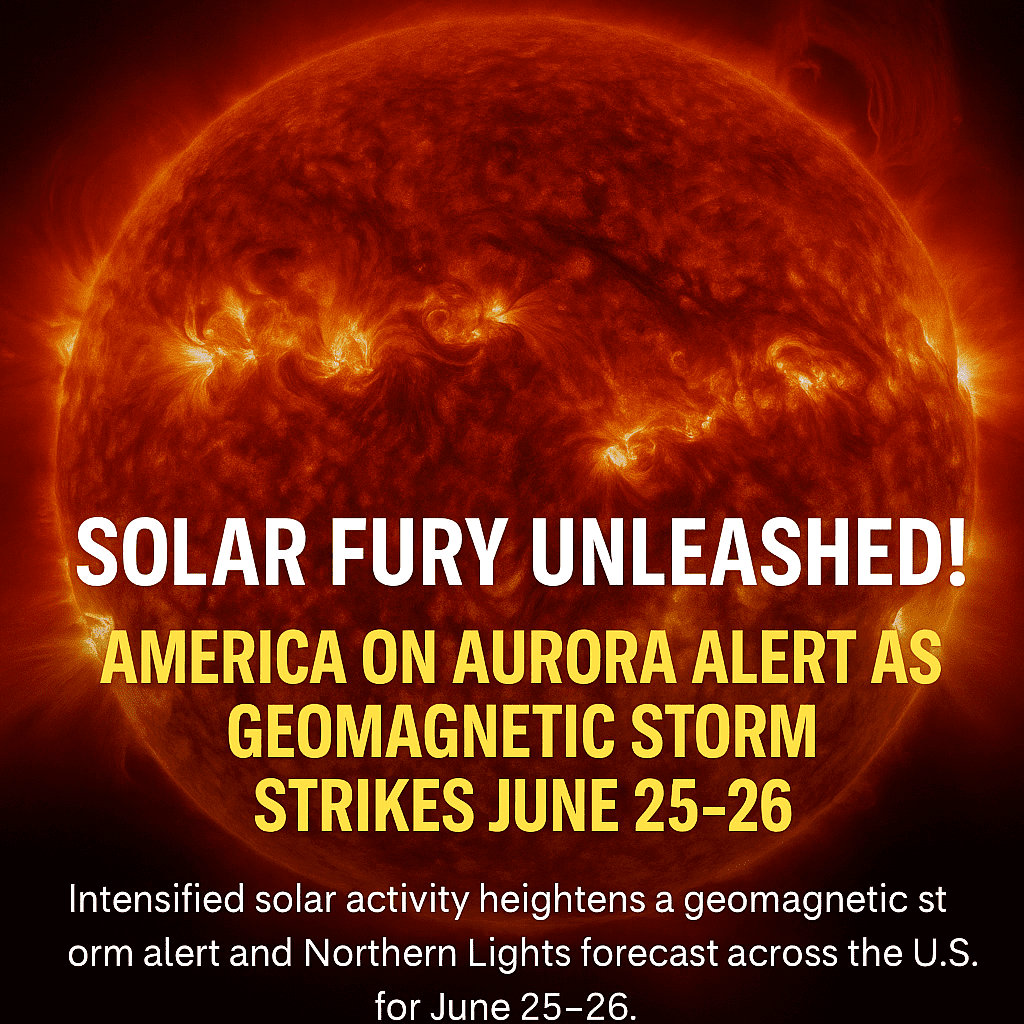

🌌 Aurora Alert! Brace yourselves, skywatchers and tech operators alike — the Sun has fired another warning shot at Earth. With intensified solar activity ramping up, the National Oceanic and Atmospheric Administration (NOAA) has issued a geomagnetic storm alert for June 24–26, placing much of the United States on aurora watch.
This electrifying development comes as a negative polarity coronal hole — a sprawling, dark patch on the solar surface — ejects high-speed solar wind toward our planet at staggering speeds. And the result? A raging geomagnetic storm strong enough to dazzle the skies with Northern Lights — and potentially disrupt GPS, aviation, and satellite communications.
🌬️ What’s Happening Above Us?
According to NOAA, this isn’t your average space weather hiccup. These coronal holes are cooler, less dense regions of the sun, but don’t let their quiet look fool you. They act as open magnetic gateways, unleashing streams of charged solar particles directly into the cosmos — and, unfortunately for us, straight toward Earth’s magnetosphere.
“These high-speed streams can cause significant geomagnetic disturbances,” NOAA warns, “particularly when Earth’s magnetic field lines interact with them.”
As these charged particles slam into our upper atmosphere, they can disrupt satellites, throw off airplane navigation systems, and even interfere with power grids in extreme cases.
Once-in-a-Decade Alert: Rare Northern Lights to Stun the U.S. for 3 Nights Straight
🌌 Northern Lights Forecast: Rare U.S. Show Expected
But it’s not all danger — it’s also beauty beyond belief. NOAA has released its aurora visibility maps for June 24 and 25, and they show something astonishing: Northern Lights may be visible as far south as Illinois, Indiana, and Oregon.
The lights — those ethereal green, red, and purple ribbons dancing across the night sky — result from solar particles colliding with Earth’s atmospheric gases, particularly oxygen and nitrogen. It’s a cosmic light show rarely seen by so many.
🛰️ NASA even calls it a “Sun Burp.” In its words:
“During a coronal mass ejection, the Sun ‘burps’ out massive bubbles of electrified gas that can speed through space. When these particles hit our atmosphere, they create jaw-dropping displays of light.”
⚠️ Should You Worry?
While this geomagnetic storm isn’t expected to cause widespread blackouts, experts are urging caution for pilots, GPS users, and satellite operators. High-frequency radio blackouts or timing errors in GPS systems may occur during peak impact hours.
📱 What to watch for:
-
Cellular or satellite signal drops
-
Unexpected GPS inaccuracy
-
Radio interference, especially in polar regions
🌐 Strait of Hormuz Hijacked by Invisible Signal War— Oil Tanker Crash Triggers Fears of GPS Jamming
🕶️ What You Can Do
If you’re in the aurora viewing zone:
-
Find dark skies, away from city lights.
-
Look north between 10 PM and 2 AM.
-
Use aurora tracking apps or NOAA’s viewline maps.
If you’re in tech operations:
-
Delay sensitive satellite operations
-
Monitor GNSS/GPS drift
-
Prepare aviation crews for possible HF radio disruption
🌍 The Bigger Picture
This storm is just one part of a larger solar cycle upswing. Scientists say we’re moving toward Solar Maximum — the peak of the Sun’s 11-year activity cycle — expected in late 2025 or early 2026. That means more flares, more auroras, and potentially more disruptions.
So while the skies may dazzle this week, experts are keeping a close eye on what the Sun may do next.
📸 Share Your Aurora Photos
Were you lucky enough to catch the auroras? Share your images with us using the hashtag #AuroraWatch2025 and tag @Spacetechtimes on X or Instagram.

