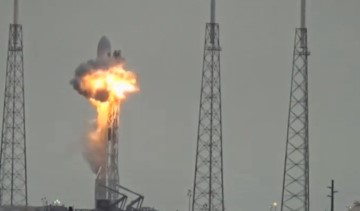

Remember that time, almost nine years ago, when a SpaceX rocket just blew up on the launchpad in Florida? It was a big deal. This was really a pre-launch test, not a launch itself. The rocket, a Falcon 9, was getting ready to carry a satellite named Amos-6 into space. But then, BOOM! A huge explosion ripped through the upper part of the rocket, and the satellite was completely sabotage.
The Sniper Theory
This happened on September 1, 2016, and it really shook things up in the space world. SpaceX was still trying to prove itself as a reliable company that could launch things into orbit. Losing a rocket like that was a major setback. Everyone was scratching their heads, trying to figure out what went wrong. They were aware that a helium gas tank within the rocket had exploded. But the big question was: why? Nothing was moving on the rocket at the time. It was like a car sitting still and then suddenly exploding.
Things got so strange that some SpaceX staff even wondered if the rocket had been taken out by a sniper. Yes — a real, intentional act of sabotage.
This mystery led to some pretty wild ideas. The “sniper” notion was among the most unexpected. Yes, you read that right. Some people at SpaceX, including the boss, thought that maybe someone had actually shot the rocket.
Russia Launches Trio of Satellites—Then a Strange Object Appears From Nowhere
Now, this may sound like a scene from an espionage film. But there were a few things that made them think it could be possible. The explosion started high up on the rocket, on the side facing a building about a mile away. That building belonged to another company that SpaceX was competing with to launch rockets. This company was a big deal back then, launching important stuff for NASA and the military.
Then, someone saw a flash on the roof of that competitor’s building in a video. The timing of that flash seemed to match how long it would take something to travel from the building to the rocket. So, the idea of a sniper taking a shot at the rocket didn’t seem completely impossible to some folks at SpaceX.
Because of this, SpaceX actually spent over a month seriously looking into this “sniper” idea. They even did experiments in Texas, shooting at tanks like the one that exploded to see what would happen. They also sent someone to their competitor’s building in Florida to see if they could check out the roof. Unsurprisingly, the competitor wasn’t too happy about that and told them no.
It turns out that SpaceX didn’t just keep this theory within their own company. They actually went to the government about it.
Alarming: SpaceX Presents the Fed with the “Sniper” Idea
About three weeks after the rocket blew up, SpaceX gave some information to the Federal Aviation Administration (FAA). The FAA is the government group that oversees things like rocket launches.
Switzerland Steps In as Tensions Mount Over Militarization of Space
According to a letter the FAA sent to SpaceX later, SpaceX told the FAA that some of the videos and information they had found could point to “sabotage or criminal activity” causing the explosion. This shows that SpaceX really wanted the government to consider the possibility of someone intentionally blowing up their rocket.
But that’s not all. SpaceX also took this same information to the Federal Bureau of Investigation (FBI) in Florida. The primary federal organization that looks into crimes is the FBI. So, SpaceX wasn’t just thinking about a sniper; they were suggesting to the FBI that a crime might have been committed. The FBI then looked into what SpaceX had presented, along with their main office in Washington, D.C.
The Feds Investigate: No Shooter Found
After looking into everything, the FBI came back with their answer. And what did they find? Nothing. The FBI stated that there were “no indications to suggest that sabotage or any other criminal activity played a role” in the rocket explosion, according to the FAA letter. Because of this, the FAA said they considered the case closed. So, despite SpaceX’s serious push, the federal investigators didn’t find any evidence of a sniper or any other criminal act.
It turned out that the real reason for the explosion was much less dramatic, though still a big problem for SpaceX. After months of figuring things out, engineers realized that they had been fueling the rocket too quickly. In their rush to get the super-cold fuel into the rocket, they had caused a tank inside to get too warm and break.
Terrifying Russian Nuke Threat in Space Alarms NATO, Ignites Global Security Fears
Even though the “sniper” theory didn’t pan out, it shows just how confusing and worrying the rocket explosion was for SpaceX at the time. They were facing a lot of pressure to prove they were a reliable space company, and this failure was a major hurdle. While they might have lost this particular battle with the exploding rocket, they eventually went on to become the dominant force in rocket launches, without any sneaky shooters involved.