

Scientists are raising serious alarms about hidden threats from space that could strike Earth without warning. NASA officials have revealed that thousands of large asteroids, capable of destroying entire cities, are still flying through space completely undetected. This revelation exposes gaps in the current planetary defense systems and shows how challenging it is to track objects that could pose serious regional risks.
Thousands of Dangerous Asteroids Remain Hidden
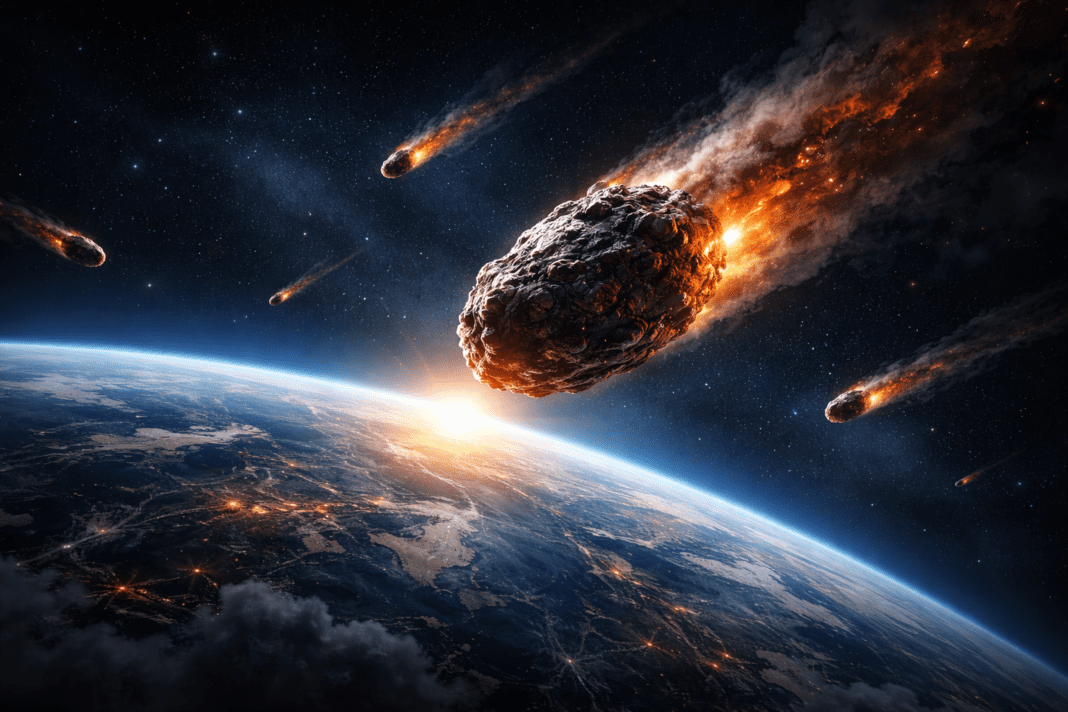
NASA’s planetary defense teams estimate that nearly 15,000 mid-sized near-Earth objects have yet to be discovered. These asteroids are at least 140 meters across—wide enough to flatten a city if they were to collide with Earth. While the largest asteroids have mostly been tracked and catalogued, these mid-sized objects are much harder to detect. Smaller space debris often enters Earth’s atmosphere, but these smaller objects usually burn up or cause only minor damage.
The biggest concern lies in asteroids that fall between these extremes. They are too large to be ignored but too small to be easily spotted. Many of these objects move in unusual orbits around the Sun, making them difficult for telescopes to detect. Experts report that only around 40% of these potentially dangerous asteroids have been catalogued so far. This means that a huge number of city-threatening space rocks could still be quietly drifting through space, invisible to current observation efforts.
Airplane-sized asteroid 2026 BJ8 speeds toward Earth at 50,000 kmph, NASA confirms safe flyby
NASA officials emphasize that these undiscovered asteroids are the real risk. Even the most powerful telescopes cannot easily spot them, especially when they travel along paths that take them far from Earth’s usual observation points. The threat they pose is significant: while they may not trigger global destruction, an impact could devastate entire regions, causing loss of life and massive property damage.
NASA’s Asteroid Defense Efforts and Their Limits
NASA has taken steps to explore ways to defend Earth from asteroid impacts. One notable experiment involved sending a spacecraft to deliberately hit a small asteroid moon at more than 14,000 miles per hour. The mission successfully altered the moon’s orbit, proving that deflection is possible. However, experts warn that no similar spacecraft is currently on standby for a real-world emergency.
NASA’s 5th Biennial Exercise to tackle Asteroid threats
Current planetary defense programs face limitations due to funding and planning. Even if a threatening asteroid were discovered tomorrow, it could take years to mount a response. Powerful telescopes can track many objects in space, but mid-sized asteroids often remain invisible until they are very close to Earth. Past incidents, including close encounters with unknown objects, have highlighted these gaps in detection and monitoring.
Preparedness requires sustained investment and strategic planning, but current budgets and programs may not be sufficient to respond immediately to a sudden threat. The fact that a large portion of these city-killer asteroids remain untracked underscores the urgency of improving both observation capabilities and response readiness.
Close Calls Expose Gaps in Tracking
The risks of undiscovered asteroids became more evident after asteroid YR4 passed close to Earth on December 25, 2024. Early calculations suggested a possible collision in 2032, raising serious concern among scientists. Later analysis confirmed that YR4 posed no immediate threat, but the incident revealed weaknesses in the current tracking system and the need for improved monitoring.
NASA-inspired models show nuclear detonations might deflect doomsday asteroids
To address these challenges, NASA plans to launch the Near-Earth Object Surveyor telescope next year. This new mission aims to detect hidden asteroids faster and track their movements more accurately. Officials emphasize that earlier detection is crucial, as it provides more time to prepare and respond if an asteroid were ever found on a collision course with Earth.
Until this enhanced tracking system is operational, many regional threats could remain unseen. NASA stresses that improving detection and maintaining readiness is key to reducing the risks posed by these mid-sized, city-killer asteroids.