

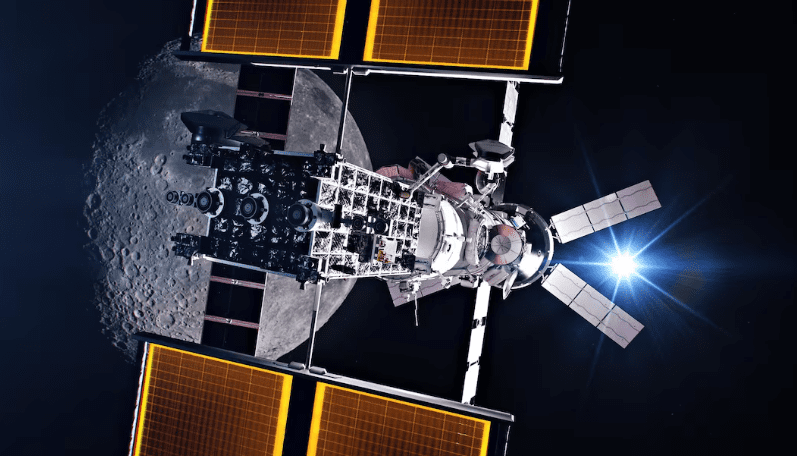

NASA has unveiled a major overhaul of its space exploration strategy, marking a significant shift in how it plans to return humans to the Moon. The new approach moves away from earlier orbital plans, including reliance on the Lunar Gateway, and focuses on building a permanent presence on the lunar surface, while also advancing cutting-edge technologies for future deep space missions.
A Major Change in Lunar Plans
NASA has announced a major shift in its Moon exploration plans. The agency has cancelled its earlier idea of building an orbital station called the Lunar Gateway, which was meant to serve as a stopover for astronauts traveling to and from the lunar surface.
Instead, NASA will repurpose parts of the project to build a permanent base directly on the Moon. This new strategy focuses on living and working on the surface rather than in orbit, reducing reliance on the Lunar Gateway and aiming to establish a long-term human presence.
🏠 Italy builds the Moon’s first home for astronauts— Europe rises as NASA’s most vital ally
The plan is part of the Artemis program, which seeks to return humans to the Moon after more than 50 years. The lunar base, expected to cost around $20 billion, will include robotic landers, drones, and advanced systems designed to support safe and extended stays on the Moon.
Building on the Moon Instead of Orbit
The new plan from NASA focuses on building infrastructure directly on the Moon’s surface. This includes using robotic systems to prepare the ground before humans arrive. Machines will help set up equipment, test resources, and make the environment safer for astronauts, instead of relying on the Lunar Gateway as a staging point.
NASA also plans to explore the use of nuclear power on the Moon. This could provide a steady and reliable energy source, especially during the long lunar nights when sunlight is not available. Nuclear systems may play a key role in running habitats, equipment, and communication systems.
Moon resources in high demand among powerful nations.
Parts of the Lunar Gateway project will still be used, but in a different way. Hardware and designs originally meant for the orbiting station may now support surface operations. This shift has created uncertainty for international partners such as the European Space Agency, Japan Aerospace Exploration Agency, and Canadian Space Agency, which had planned to contribute to the Lunar Gateway.
NASA has stated that it will continue discussions with these partners to find new roles for them in the updated plan. The aim is to keep international cooperation strong while adjusting to the new direction. The timeline for landing astronauts on the Moon remains set for 2028, marking a historic return to lunar exploration and a key step in building the new base.
Nuclear Spacecraft and Race to the Moon
Alongside its Moon plans, NASA has announced a major new mission. The agency is preparing to launch a spacecraft called Space Reactor 1 Freedom before the end of 2028. This mission will test nuclear electric propulsion, a technology that could support future missions beyond the Lunar Gateway.
The spacecraft is expected to travel to Mars and deploy helicopters to explore the planet’s surface. This mission aims to move nuclear technology from research into real-world space operations and could complement future exploration plans that were once linked to the Lunar Gateway.
⏱️NASA rushes nuclear reactor launch as China, Russia aim to dominate moon
At the same time, NASA is working with private companies like SpaceX and Blue Origin to build lunar landers. These vehicles will carry astronauts from space to the Moon’s surface. However, both companies are facing delays and technical challenges, with some projects running up to two years behind schedule, affecting timelines once aligned with the Lunar Gateway.
NASA has said it will use whichever lander is ready first to stay on track for a 2028 Moon landing. The mission will also use the Orion spacecraft, which will transport astronauts before they transfer to landers instead of relying on the Lunar Gateway. Meanwhile, Artemis 2 is set to send astronauts on a lunar fly-by, marking a major step forward as NASA shifts focus away from the Lunar Gateway.