
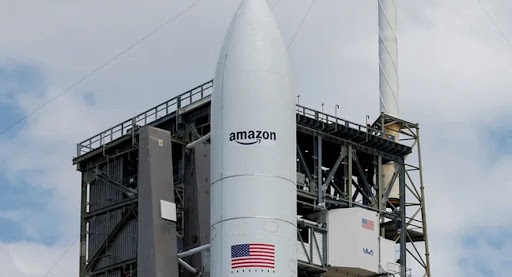

On Monday, Amazon successfully launched the first 27 satellites for its ambitious Project Kuiper, a broadband internet constellation that aims to compete directly with SpaceX’s Starlink.
Introduction to Amazon’s Kuiper Project
The satellites were launched on an Atlas V rocket from the Cape Canaveral Space Force Station in Florida. This marks a major step forward in Amazon’s long-awaited internet-from-space initiative, which has faced numerous delays.
Project Kuiper, Amazon’s $10 billion investment, seeks to provide global broadband coverage through low-Earth orbit satellites. Amazon intends to launch 3,236 satellites in all, so the initial 27-satellites are only the start. These satellites are designed to deliver high-speed internet to users around the world, especially in remote and rural areas where traditional broadband services are unavailable or unreliable.
Bad weather caused the launch to be postponed from its initial April date. Despite the setback, the successful launch on Monday is seen as a critical milestone in Amazon’s efforts to establish a competing network against SpaceX’s Starlink, which has already put thousands of satellites into orbit.
Kuiper’s Ambitious Goals and Challenges
Amazon’s Project Kuiper is a massive undertaking, aiming to rival not only Starlink but also traditional internet service providers like AT&T and T-Mobile. The project’s goal is to provide affordable broadband services to underserved areas globally.
Bandwagon-3 Makes Noise—Literally! SpaceX Sends 3 Payloads into Orbit, Returns Booster with a Boom
Kuiper’s deployment has faced delays, with Amazon originally hoping to launch its first batch of satellites in early 2024. Now, due to these delays, Amazon may need to seek an extension from the U.S. Federal Communications Commission (FCC) to meet its deadline of deploying half the constellation, or 1,618 satellites, by mid-2026.
Despite this slow start, Amazon has been preparing for the long haul. The first satellites will be followed by more launches, with United Launch Alliance (ULA), the company responsible for the launch, potentially conducting up to five more missions this year. Each new batch of satellites will gradually expand the coverage of Kuiper’s broadband network, starting with the northern and southern regions and eventually extending closer to the equator.
This approach will make Kuiper a direct competitor to SpaceX’s Starlink, which has been operational for several years. Amazon is assuming that its well-established consumer and cloud computing services, as well as its mass production skills, would give Kuiper an advantage in the market, even though Starlink already has a sizable user base and has grown quickly.
Airbus Makes History with Kuiper—A Game-Changing Internet Revolution at 35,000 Feet
Kuiper vs. Starlink: The Race for Broadband from Space
SpaceX, led by Elon Musk, has been a leader in satellite internet services for several years through its Starlink network. As of Monday, SpaceX has launched over 8,000 Starlink satellites into space and has amassed over 5 million users worldwide. Its rapid deployment schedule of at least one mission per week, each carrying dozens of satellites, has allowed Starlink to quickly dominate the market.
Starlink’s success has made it an attractive option for various customers, including governments, military agencies, and businesses. The network’s fast and reliable internet services have helped it establish a foothold in areas where traditional broadband providers have struggled to reach. In contrast, Amazon’s Kuiper is still in its early stages, and it will need to accelerate its pace of launches to catch up to SpaceX’s established network.
However, Amazon’s Project Kuiper has significant backing, both financially and strategically. The company’s vast resources and infrastructure, including its experience in building consumer electronics and its cloud computing division, could give Kuiper an advantage as it seeks to build a competitive satellite internet service.
Amazon has also revealed its new Kuiper consumer terminals, which are devices that will allow users to connect to the satellite network. These terminals come in two sizes, one as large as a vinyl record and the other smaller and comparable in size to a Kindle e-reader. These devices are expected to be produced at a cost of under $400 each, making the service accessible to a broad range of consumers.
Alphabet’s High-Stakes Bet on SpaceX Signals Deepening Tech-Military Ties
The competition between Amazon’s Kuiper and SpaceX’s Starlink is expected to reshape the future of global internet connectivity. Both companies have made it clear that there is room for multiple players in the market, as the demand for reliable and affordable broadband internet grows around the world. But because Amazon entered the market late, it will face formidable obstacles in catching up to Starlink’s explosive growth.