

Wednesday, November 25, 2026
2.3 C
Chicago

SpaceX’s IPO Explained: The Numbers, the Structure and What It Means for the Space Industry

Last updated: November 23, 2026. This is an explainer of reported facts, not investment advice.

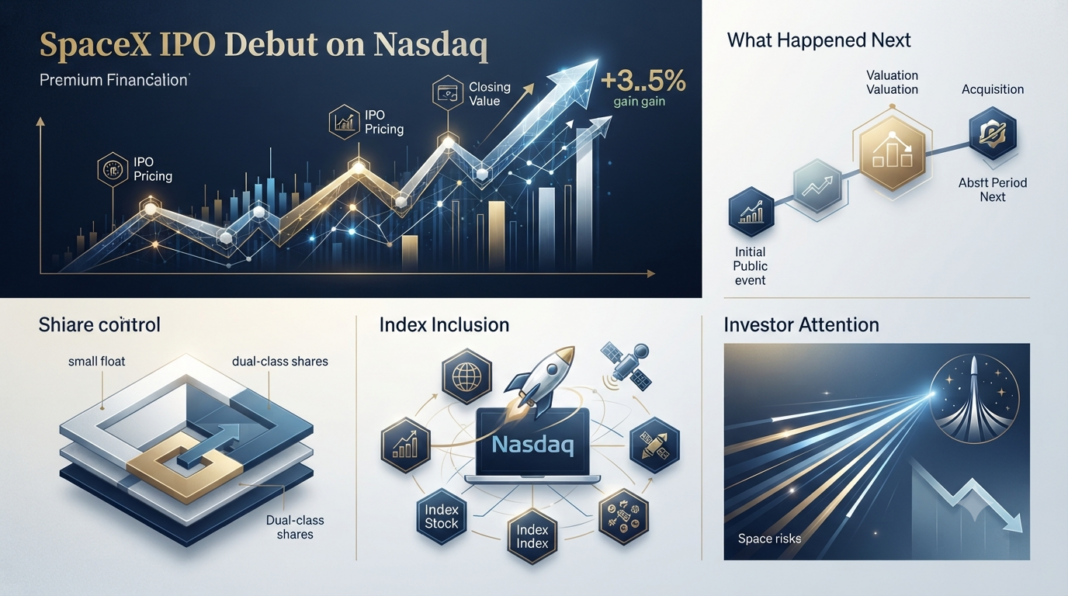
Short answer: SpaceX listed on the Nasdaq under the ticker SPCX on June 12, 2026, after pricing its IPO at $135 a share. It raised about $75 billion, the largest initial public offering in history, and closed its first day at $160.95, up about 19% from the offer price.

The key numbers

Item Figure
— —
Ticker and exchange SPCX, Nasdaq
IPO price $135 per share
Shares sold About 555.6 million
Money raised About $75 billion
Valuation at pricing About $1.77 trillion
First trade $150 (about 11% above the IPO price)
First-day high $176.52
First-day close $160.95 (about 19% above the IPO price)
First-day volume More than 500 million shares

The $75 billion raised surpassed the previous record, a roughly $25 billion listing by Saudi Aramco, according to Euronews. Reports put the market value above $2 trillion during the first day’s trading. Our earlier coverage is in SpaceX hits a $2 trillion valuation.

How the shares are structured

  • Small float: only about 3% to 4% of shares were available for public trading at the start, with early investors and employees holding the rest. A small float can make the price more volatile.
  • Dual-class shares: Elon Musk holds about 49% of the company and retains about 82% of the voting power, according to reports.
  • Index inclusion: the company was expected to qualify for major stock indexes shortly after listing, which could require index funds to buy its shares.

What happened next

SpaceX’s valuation climbed further in the days after the debut. TechCrunch reported it passed Amazon at about $2.7 trillion on June 16 after the stock rose 20% on June 15. The company also announced a deal to acquire Cursor for $60 billion in stock within days of the IPO. Share prices move daily, so check a live source for the current price.

What it means for the space industry

  • A public benchmark. SpaceX is now a listed company whose results, launch cadence and Starlink numbers are reported publicly. That gives investors a reference point for valuing other space companies.
  • Mixed business. SpaceX describes itself as a rocket, satellite and AI company. Its subsidiary xAI is part of the same group, so the listing is about more than launches.
  • Investor attention on space. The listing may increase interest in the rest of the sector, though a Truist analysis cited by CBS found that more than half of 30 large technology IPOs had negative returns after a year, so first-day gains do not predict later performance.

For the satellite business behind much of the valuation, see satellite internet constellations explained and Amazon Leo vs Starlink.

Frequently asked questions

When did SpaceX go public?

June 12, 2026, when it began trading on the Nasdaq under the ticker SPCX.

How much did the SpaceX IPO raise?

About $75 billion at $135 per share, the largest IPO ever.

What was SpaceX’s valuation at IPO?

About $1.77 trillion at pricing, rising above $2 trillion during the first day of trading, according to reports.

How much of SpaceX does Elon Musk control?

Reports say he holds about 49% of the company and about 82% of the voting power through a dual-class share structure.

Is this investment advice?

No. This article summarises reported facts. Consult a licensed adviser before making investment decisions.
Official and primary sources

News reporting and analysis used

Hot this week

Astronauts, Rocket Founders and Agency Chiefs: Meet LinkedIn’s 25 Biggest Space Voices

A curated guide to 15 space leaders, astronauts, founders and investors worth following on LinkedIn, each with a public profile and more than 10,000 followers.

German Startup NeuralSat Raises €2.9 Million for a 72-Satellite Data-Relay Network

NeuralSat GmbH raised €2.9 million in pre-seed funding co-led by Capnamic and Bayern Kapital to build a planned 72-satellite network for data relay and processing in orbit.

CesiumAstro Raises $730 Million at a Valuation Above $4.5 Billion

Austin-based CesiumAstro closed a $730 million Series D led by Janus Henderson on November 5, 2026, and plans a 737-satellite constellation and a large Austin manufacturing campus.

Hyderabad’s Cosmoserve Space Raises $6 Million to Build Satellite-Servicing Spacecraft

Cosmoserve Space, founded by a former ISRO engineer, raised a $6 million seed round led by Japan’s Rebright Partners to develop spacecraft that capture and refuel satellites and clear debris.

NASA’s Swift Observatory Re-enters Earth’s Atmosphere After 22 Years

NASA’s Neil Gehrels Swift Observatory re-entered over Indonesia on November 4, 2026, nearly 22 years after launch, after a private rescue attempt failed to lift it to a higher orbit.

Topics

Astronauts, Rocket Founders and Agency Chiefs: Meet LinkedIn’s 25 Biggest Space Voices

A curated guide to 15 space leaders, astronauts, founders and investors worth following on LinkedIn, each with a public profile and more than 10,000 followers.

German Startup NeuralSat Raises €2.9 Million for a 72-Satellite Data-Relay Network

NeuralSat GmbH raised €2.9 million in pre-seed funding co-led by Capnamic and Bayern Kapital to build a planned 72-satellite network for data relay and processing in orbit.

CesiumAstro Raises $730 Million at a Valuation Above $4.5 Billion

Austin-based CesiumAstro closed a $730 million Series D led by Janus Henderson on November 5, 2026, and plans a 737-satellite constellation and a large Austin manufacturing campus.

Hyderabad’s Cosmoserve Space Raises $6 Million to Build Satellite-Servicing Spacecraft

Cosmoserve Space, founded by a former ISRO engineer, raised a $6 million seed round led by Japan’s Rebright Partners to develop spacecraft that capture and refuel satellites and clear debris.

NASA’s Swift Observatory Re-enters Earth’s Atmosphere After 22 Years

NASA’s Neil Gehrels Swift Observatory re-entered over Indonesia on November 4, 2026, nearly 22 years after launch, after a private rescue attempt failed to lift it to a higher orbit.

NASA’s Twin ESCAPADE Probes Slingshot Past Earth and Head for Mars

NASA’s two ESCAPADE spacecraft completed powered Earth flybys on November 7 and 9, 2026, and are now on a roughly 10-month cruise to Mars, with orbit insertion planned for September 2027.

India’s Spacetech Funding in 2026: How Much Startups Have Raised and Who Leads

Indian spacetech startups have raised about $871 million across 241 rounds through July 2026, with Skyroot, Pixxel, Agnikul and Digantara leading. The numbers and why sources differ.

Space and Sky Events in 2027: The Total Solar Eclipse, Meteor Showers and More

A guide to 2027’s biggest sky events: the August 2 total solar eclipse (6 minutes 23 seconds), the February annular eclipse, lunar eclipses and meteor showers.
spot_img

Related Articles

Popular Categories