Wednesday, November 25, 2026
2.3 C
Chicago

After Artemis II: What NASA’s Moon Programme Does Next

Last updated: November 23, 2026.

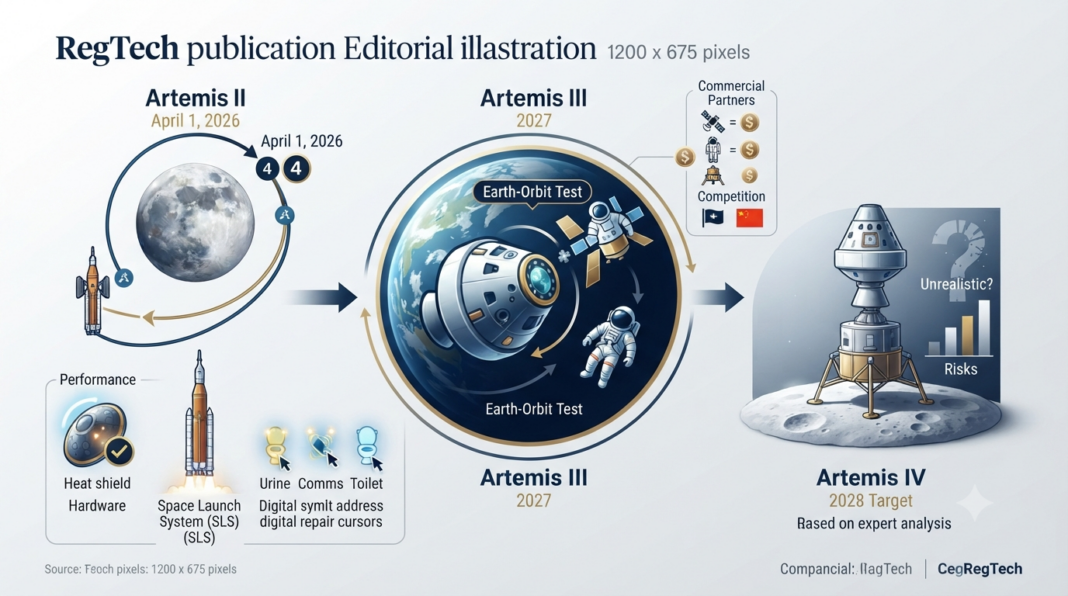
Short answer: Artemis II launched on April 1, 2026, carried four astronauts around the far side of the Moon and returned them safely, the first crewed lunar mission in more than 50 years. NASA now plans Artemis III for 2027 as an Earth-orbit test, with a crewed lunar landing targeted for 2028.

What Artemis II did

The roughly 10-day flight was the first crewed mission of the Artemis programme. The crew travelled about 695,000 miles and looped around the far side of the Moon on a trajectory that returned them to Earth without orbiting the Moon. It followed the uncrewed Artemis I test flight in 2022. For earlier coverage, see our report on America’s powerful Artemis mission.

How the hardware performed

  • Heat shield: results matched predictions made from ground tests in arc jet facilities, a key concern after Artemis I.
  • Rocket and launch pad: NASA said the Space Launch System met its mission goals and pad upgrades limited damage from liftoff.
  • Minor problems: engineers are looking at a urine vent line issue, and crew and reporters noted a communications glitch and trouble with the onboard toilet. NASA said it was gathering data to fix these before Artemis III.

What changed about Artemis III

Artemis III was originally planned as the first crewed landing. In February 2026, NASA Administrator Jared Isaacman said the plan had changed, after an independent safety panel judged the earlier timeline high risk. Artemis III is now scheduled for 2027 and will fly Orion on the Space Launch System into Earth orbit to test rendezvous and docking with a commercial lander. It is also a chance to try new spacesuits from Axiom Space. NASA had not announced the Artemis III crew when we last checked.

The 2028 target

Lessons from Artemis III are meant to feed into Artemis IV in 2028, which NASA hopes will land astronauts on the Moon. A December 2025 executive order called for returning Americans to the Moon by 2028. Some independent analysts consider that schedule unrealistic, citing the readiness of landers, spacesuits and the schedule for the Artemis programme. Treat 2028 as a target, not a promise.

Why it matters for the commercial sector

Artemis depends on commercial partners for landers and suits, and NASA is a major customer for companies in our NASA coverage. The programme also competes with China’s lunar plans. See our guide to the world’s space agencies.

Frequently asked questions

When did Artemis II launch?

April 1, 2026, from Kennedy Space Center in Florida.

Did Artemis II land on the Moon?

No. It was a flyby test mission that carried four astronauts around the far side of the Moon and back.

What is Artemis III now?

A 2027 crewed mission in Earth orbit to test rendezvous and docking between Orion and a commercial lander, rather than a landing.

When will humans land on the Moon again?

NASA is targeting 2028 under the current schedule, but some independent analysts consider that timeline unrealistic.

Who is the NASA Administrator?

Jared Isaacman, who discussed Artemis II and the revised plan in April 2026.
Official and primary sources

News reporting and analysis used

Hot this week

Astronauts, Rocket Founders and Agency Chiefs: Meet LinkedIn’s 25 Biggest Space Voices

A curated guide to 15 space leaders, astronauts, founders and investors worth following on LinkedIn, each with a public profile and more than 10,000 followers.

German Startup NeuralSat Raises €2.9 Million for a 72-Satellite Data-Relay Network

NeuralSat GmbH raised €2.9 million in pre-seed funding co-led by Capnamic and Bayern Kapital to build a planned 72-satellite network for data relay and processing in orbit.

CesiumAstro Raises $730 Million at a Valuation Above $4.5 Billion

Austin-based CesiumAstro closed a $730 million Series D led by Janus Henderson on November 5, 2026, and plans a 737-satellite constellation and a large Austin manufacturing campus.

Hyderabad’s Cosmoserve Space Raises $6 Million to Build Satellite-Servicing Spacecraft

Cosmoserve Space, founded by a former ISRO engineer, raised a $6 million seed round led by Japan’s Rebright Partners to develop spacecraft that capture and refuel satellites and clear debris.

NASA’s Swift Observatory Re-enters Earth’s Atmosphere After 22 Years

NASA’s Neil Gehrels Swift Observatory re-entered over Indonesia on November 4, 2026, nearly 22 years after launch, after a private rescue attempt failed to lift it to a higher orbit.

Topics

Astronauts, Rocket Founders and Agency Chiefs: Meet LinkedIn’s 25 Biggest Space Voices

A curated guide to 15 space leaders, astronauts, founders and investors worth following on LinkedIn, each with a public profile and more than 10,000 followers.

German Startup NeuralSat Raises €2.9 Million for a 72-Satellite Data-Relay Network

NeuralSat GmbH raised €2.9 million in pre-seed funding co-led by Capnamic and Bayern Kapital to build a planned 72-satellite network for data relay and processing in orbit.

CesiumAstro Raises $730 Million at a Valuation Above $4.5 Billion

Austin-based CesiumAstro closed a $730 million Series D led by Janus Henderson on November 5, 2026, and plans a 737-satellite constellation and a large Austin manufacturing campus.

Hyderabad’s Cosmoserve Space Raises $6 Million to Build Satellite-Servicing Spacecraft

Cosmoserve Space, founded by a former ISRO engineer, raised a $6 million seed round led by Japan’s Rebright Partners to develop spacecraft that capture and refuel satellites and clear debris.

NASA’s Swift Observatory Re-enters Earth’s Atmosphere After 22 Years

NASA’s Neil Gehrels Swift Observatory re-entered over Indonesia on November 4, 2026, nearly 22 years after launch, after a private rescue attempt failed to lift it to a higher orbit.

NASA’s Twin ESCAPADE Probes Slingshot Past Earth and Head for Mars

NASA’s two ESCAPADE spacecraft completed powered Earth flybys on November 7 and 9, 2026, and are now on a roughly 10-month cruise to Mars, with orbit insertion planned for September 2027.

SpaceX’s IPO Explained: The Numbers, the Structure and What It Means for the Space Industry

SpaceX listed on Nasdaq on June 12, 2026 in the largest IPO ever. The pricing, first-day trading, share structure and what the listing means for the space sector.

India’s Spacetech Funding in 2026: How Much Startups Have Raised and Who Leads

Indian spacetech startups have raised about $871 million across 241 rounds through July 2026, with Skyroot, Pixxel, Agnikul and Digantara leading. The numbers and why sources differ.
spot_img

Related Articles

Popular Categories