
Last updated: November 23, 2026.
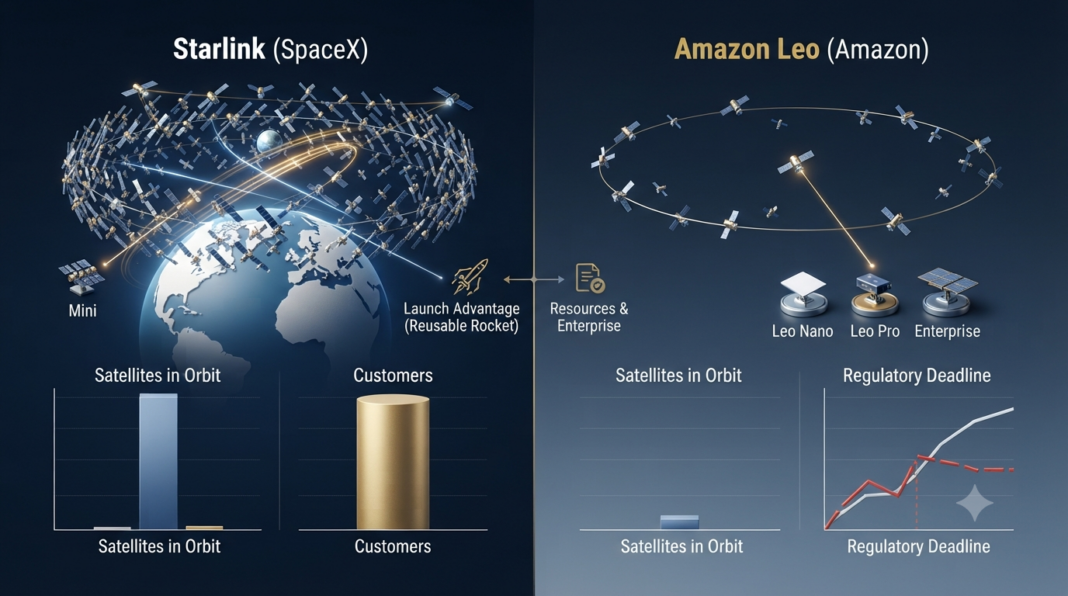
Short answer: Starlink is far ahead. It has more than 11,000 satellites in orbit and a customer base above 10 million. Amazon Leo, the rebranded Project Kuiper, was in enterprise beta from April 2026 with a few hundred satellites and is racing to hit regulatory deployment milestones.
Side by side
| Starlink (SpaceX) | Amazon Leo (Amazon) | |
|---|---|---|
| — | — | — |
| Satellites in orbit | More than 11,000 (October 2026, per trackers) | Roughly 210 to 240 reported in April 2026, with launches continuing |
| Status | Commercial service in many countries | Enterprise beta began April 8, 2026; commercial service was targeted for mid-2026 |
| Customers | More than 10 million reported | Early enterprise customers |
| Typical speeds | About 45 to 280 Mbps download, per Engadget’s summary | Amazon says its largest terminal can reach up to 1 Gbps download |
| Terminals | Several consumer and enterprise dishes | Leo Nano (about 100 Mbps), Leo Pro (about 400 Mbps) and a larger enterprise model |
| Planned size | Tens of thousands of satellites over time | 3,236 satellites under its FCC authorisation |
The regulatory deadline
Amazon’s US licence required it to have half its constellation, 1,618 satellites, in orbit by July 30, 2026, and the full 3,236 by July 30, 2029. Amazon asked the FCC for a two-year extension of the first deadline and contracted more launches to catch up. Check the FCC’s decision before relying on any article that treats the deadline as met or missed. Amazon also had a record month in April 2026, with three launches deploying 90 satellites in 26 days.
The name change
Amazon renamed Project Kuiper as Amazon Leo in November 2025, with “Leo” referring to low Earth orbit. Our earlier coverage uses the Kuiper name, including Amazon’s orbital milestone and our Kuiper and Amazon Leo section.
Where each has an advantage
- Starlink: years of operation, a huge launch advantage through SpaceX’s own reusable rockets, and a large installed base. See Starlink Mini.
- Amazon Leo: Amazon’s resources and enterprise relationships, and higher advertised peak speeds on its largest terminal.
What to watch
Whether Amazon can launch fast enough, when consumer service begins, and how regulators treat deadlines. In India, neither company has started commercial service yet. See Starlink in India. For the basics, read our satellite internet constellations guide.
Frequently asked questions
Is Amazon Leo the same as Project Kuiper?
Yes. Amazon renamed Project Kuiper as Amazon Leo in November 2025.
Is Amazon Leo available to consumers?
As of the latest reports we found, Amazon Leo was in enterprise beta from April 8, 2026, with broader availability expected to grow through 2027. Check Amazon for current availability.
Which is faster, Starlink or Amazon Leo?
Amazon says its largest terminal can reach up to 1 Gbps download. Starlink’s typical download speeds are reported at 45 to 280 Mbps. Real-world speeds depend on location, congestion and terminal.
How many satellites does Amazon Leo need?
Its FCC authorisation requires 1,618 satellites by July 30, 2026 and 3,236 by July 30, 2029. Amazon requested an extension of the first deadline.
How big is Starlink compared with Amazon Leo?
Starlink has more than 11,000 satellites in orbit, while Amazon Leo had a few hundred as of the most recent counts we found.
Official and primary sources
News reporting and analysis used
- Aviation Week: Amazon rebrands Project Kuiper to Amazon Leo
- The Next Web: Amazon Leo targets mid-2026 commercial launch (April 10, 2026)
- Engadget: Amazon’s satellite internet service is scheduled for mid-2026
- IEEE ComSoc Technology Blog: Amazon Leo vs Starlink
- HighSpeedInternet.com: Starlink satellites in orbit (October 2, 2026)