
Last updated: November 23, 2026.
Short answer: Skyroot Aerospace’s Vikram-1 reached low Earth orbit on its first attempt on July 18, 2026, from the Satish Dhawan Space Centre in Sriharikota. It is India’s first privately developed orbital-class rocket, and the mission was called Mission Aagaman, meaning “arrival”.
What happened
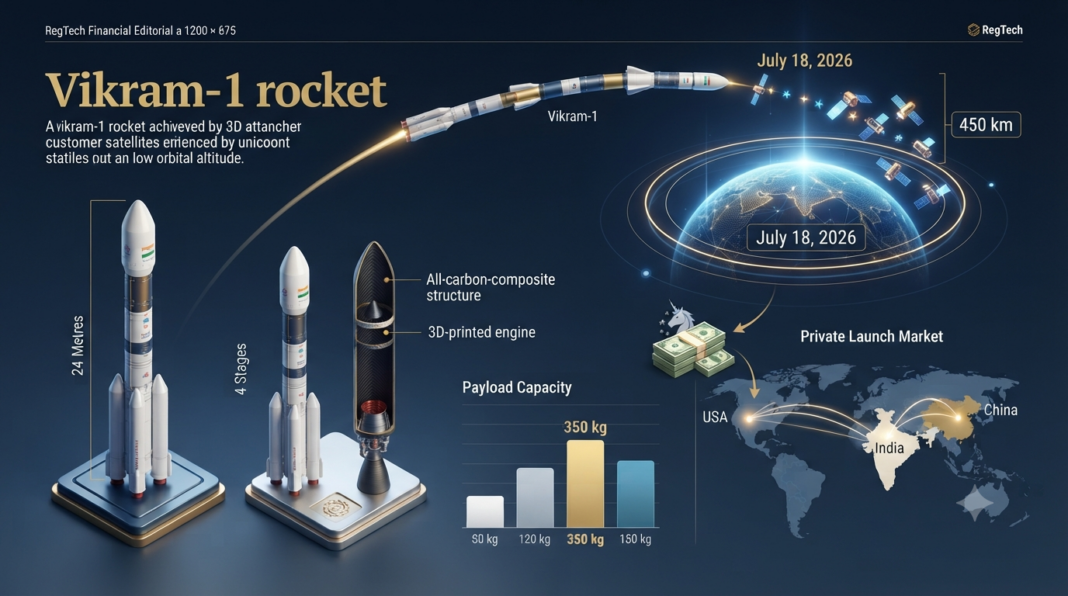
Vikram-1 lifted off on the morning of July 18 and placed multiple customer payloads and technology demonstrations into a roughly 450 km orbit at about 60 degrees inclination. Reports say it completed all planned stages, including stage separations and the firing of its Orbital Adjustment Module. Indian officials and Skyroot described the flight as a success, and the Indian government’s science and technology portal reported that the vehicle reached orbit.
Several outlets reported that this makes India the third country, after the United States and China, to have a private company launch an orbital rocket successfully. That ranking comes from press reports rather than an official registry, so treat it as the media’s framing.
About the rocket
- Size: about 24 metres tall, with four stages.
- Payload: designed to lift about 350 kg to low Earth orbit.
- Technology: an all-carbon-composite structure and in-house propulsion, including 3D-printed engines and solid-fuel motors.
- Role: a small-satellite launcher, aimed at the growing market for dedicated launches of small satellites.
Why this matters
India’s private launch story began with Skyroot’s Vikram-S, a suborbital rocket flown in November 2022. Vikram-1 is the step from that test to orbit. It follows the 2020 reforms and the Indian Space Policy 2023, which opened launch and satellite manufacturing to private companies, with IN-SPACe providing authorisation and ISRO supporting with range and facilities. See our guide to India’s space sector for how those pieces fit together.
It also helped Skyroot’s funding story. The company became India’s first spacetech unicorn in May 2026 after raising $60 million, and Indian coverage tied the launch to rising investor interest. For the funding picture, see India’s spacetech funding in 2026.
What comes next
This was Vikram-1’s first test flight, so the next questions are about repeatability: how quickly Skyroot can fly again, how many launches it can do per year, and how it competes with ISRO’s small launcher and with global rideshare options. Companies such as Agnikul are also working towards orbital flight. See our report on Agnikul’s milestone.
Frequently asked questions
When did Vikram-1 launch?
July 18, 2026, from the Satish Dhawan Space Centre in Sriharikota, India.
What was Mission Aagaman?
The name of Vikram-1’s first orbital test flight. Aagaman means arrival.
Who built Vikram-1?
Skyroot Aerospace, a Hyderabad-based company.
How much can Vikram-1 carry?
It is designed to carry about 350 kg to low Earth orbit.
Is Vikram-1 India’s first private rocket?
It is India’s first privately developed rocket to reach orbit. Skyroot’s earlier Vikram-S was a suborbital rocket flown in 2022.
Official and primary sources
- India Science and Technology portal (Government of India): Vikram-1 reaches orbit
- Indian Space Policy 2023 (ISRO)