

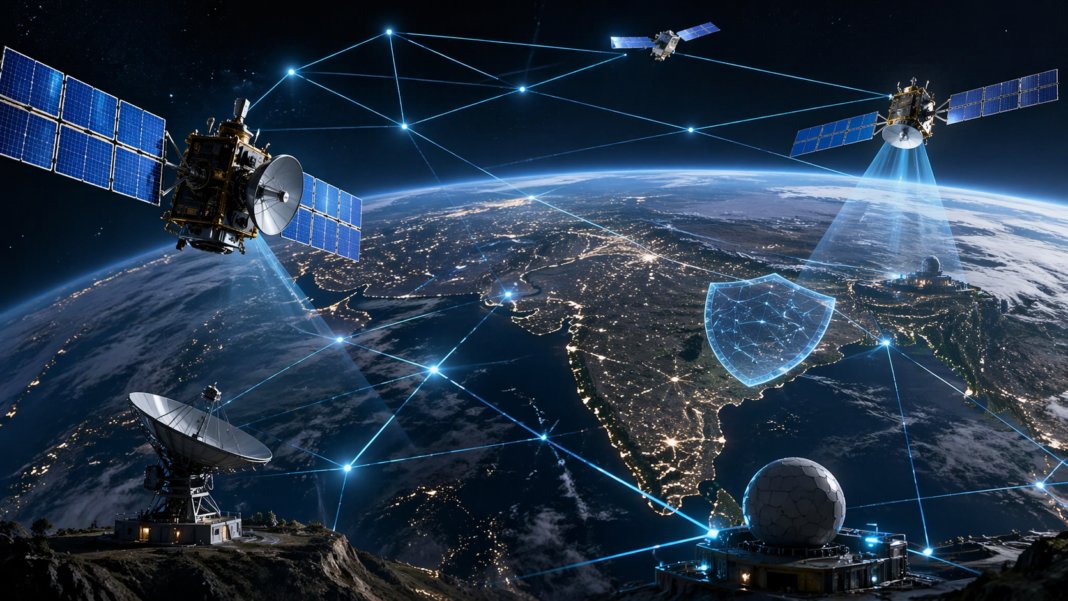

India is facing rising concerns over its space security as experts warn that vulnerabilities could impact future military strength. With modern warfare increasingly relying on satellites and space technologies, the need to strengthen capabilities and reduce dependence on foreign systems is becoming more urgent for ensuring national space security.
Space Becoming a Key Battlefield in Modern Warfare
India’s defence and space leaders have warned that space is no longer limited to communication and satellites—it is now a key part of modern warfare. At a recent defence space event in New Delhi, experts highlighted how countries are increasingly relying on space-based systems for military operations, making space security a critical priority.
Satellites play a major role in communication, navigation, surveillance, and intelligence gathering. They help armed forces track movements, plan missions, and respond quickly. Experts noted that many global conflicts already depend heavily on space technology, making strong and secure space systems essential for national defence and long-term space security.
India’s approach to Starlink reflects a growing focus on sovereign control over satellite networks
They also described space as a “continuous operational domain,” meaning it must be protected at all times, just like land, air, and sea. Any disruption—whether from cyberattacks or physical threats—can have serious consequences and directly impact a country’s military capabilities and overall space security.
India’s Vulnerabilities and Dependence on Critical Technologies
One of the major concerns raised was India’s dependence on advanced technologies from other countries. Although India has made steady progress in space research and satellite development, experts noted that gaps still remain in high-end systems. These include specialised components and technologies that are not yet fully developed within the country.
Experts highlighted that India continues to rely on imports for several critical parts used in space operations. This dependence can become a serious risk during times of conflict, especially if access to these technologies is restricted or disrupted. In such situations, delays in obtaining essential components could directly impact defence readiness and weaken space security.
India advances AI ambitions with L&T-NVIDIA gigawatt data center partnership Mor
Another key issue discussed was the relatively low investment in research and development. Compared to leading global powers, India spends a smaller portion of its national income on developing advanced defence and space technologies. This lower investment may slow down innovation and make it more challenging to keep pace with rapidly evolving global capabilities.
Experts also stressed the importance of building resilient and secure space systems. This includes creating backup satellites, strengthening communication networks, and enabling quick replacement of damaged systems. They also highlighted the growing role of artificial intelligence and cybersecurity in detecting threats early, protecting sensitive data, and supporting faster decision-making during critical operations.
Growing Role of Private Sector and Need for Integration
Another key topic discussed was the growing role of private companies in the space sector. In recent years, startups and private firms have become active contributors to satellite technology, communication systems, and broader space innovation. Their involvement is helping bring fresh ideas, faster development cycles, and more cost-effective solutions. Experts noted that future space capabilities will increasingly rely on strong partnerships between government agencies and private players to strengthen overall space security.
Satellite communication is becoming more critical for both defence and civilian purposes. Secure and reliable communication systems are essential for military operations, especially in remote or challenging terrains where traditional networks may not work effectively. At the same time, there is a strong push to strengthen domestic supply chains so that key components are produced within the country, reducing dependence on imports and improving overall security.
India moves to involve private startups in guardian satellites to protect key space assets
Experts also highlighted the importance of a “whole-of-nation” approach, bringing together the government, military, private sector, and research institutions. Better coordination among these groups can help close capability gaps and speed up development.
Discussions also focused on integrating space capabilities across land, air, and naval forces. Emerging technologies like in-space manufacturing and artificial intelligence-driven data analysis were seen as important tools to enhance space systems and improve military readiness.

