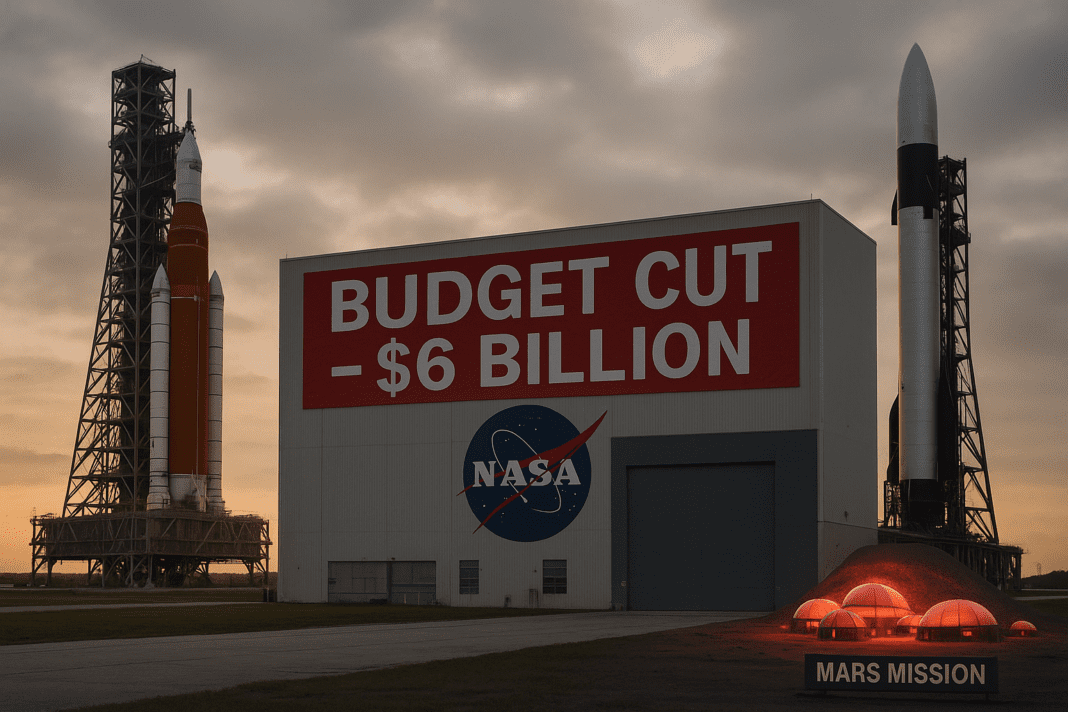

The Trump administration has proposed a major change in NASA’s funding. A new budget proposal seeks to reduce NASA’s overall funding by roughly $6 billion.
Big Budget Cuts Hit NASA
This amounts to about a quarter of NASA’s present budget. At the same time, initiatives aimed at sending people to Mars will receive an additional $1 billion.
A document released on NASA’s official website said that the money would now focus more on two big goals: beating China back to the Moon and putting the first human on Mars. This change in focus comes directly from President Trump’s new budget plan, which reshapes NASA’s priorities. The shift also supports the long-time dream of SpaceX founder Elon Musk, who has aimed to send humans to the red planet.
According to NASA officials, the Trump administration’s decision to cut the agency’s funding means NASA will have to reduce its workforce, shrink its daily operations, and cancel several missions now considered “unaffordable.”
Janet Petro, NASA’s acting administrator, informed staff in an email that these changes would make it a tight and challenging time for the entire agency. She asked employees to stay strong and committed to their work, even though some of NASA’s well-known projects will now be closed under Trump’s budget directive.
Unidentified Drones Breach Russia’s Zvezda Space Intelligence Base
Missions Ending, Focus Shifting
Significant adjustments to NASA’s programs are suggested by the new budget released under President Trump’s administration. One of the most important decisions is to retire the Space Launch System (SLS) rocket. This powerful rocket was originally built to carry astronauts to the Moon and even beyond. Along with the SLS, NASA would also shut down the Orion spacecraft and the Gateway program. These were key parts of NASA’s earlier plan to return humans to the Moon.
The Trump-backed budget also calls for ending the Mars Sample Return (MSR) program. This mission was designed to send robots to Mars to collect samples of rocks and soil and bring them back to Earth. The MSR project was seen as a big step toward learning whether life ever existed on the red planet.
NASA would also stop investing in green aviation, which aimed to create more eco-friendly airplanes. The budget cuts would mostly affect divisions like space science, Earth science, and mission support.
Though Janet Petro, NASA’s acting administrator, didn’t name specific companies, she confirmed that some existing NASA activities will be ending. These changes, however, would allow more money to go to Mars-focused projects. A total of $1 billion will be directed toward Mars missions under Trump’s proposed budget, showing a clear shift in priorities.
China Marks Another Milestone as Shenzhou-19 Crew Lands After Pivotal Space Station Mission
SpaceX and Mars Ambitions
Elon Musk’s space enterprise, SpaceX, will profit from the new emphasis. The corporation is already one of the biggest contractors for NASA and also collaborates with the Department of Defense. SpaceX has been building a massive rocket called Starship, which it says is capable of carrying people and cargo to Earth orbit, the Moon, and Mars.
Musk has often spoken about his belief that humans should live on other planets, especially Mars. He even declared in 2020 that he was “very confident” that SpaceX will put humans on Mars by 2026. However, many experts have said that Musk’s timelines are often too optimistic.
Interestingly, Musk also plays an important role in Trump’s administration. He is helping lead a group called the Department of Government Efficiency (DOGE). This group is working on reducing the size and cost of government departments.
President Trump has nominated a tech businessman, Jared Isaacman, to lead NASA under this new plan. Isaacman’s nomination has already moved forward in the Senate Commerce Committee, but he still needs full approval from the U.S. Senate.
Petro reminded NASA staff members in her email that the agency has encountered difficulties in the past. She praised their ability to adapt and deliver even in hard times.
This new budget shift, if approved, would change NASA’s direction sharply. While many programs will end, others, especially those related to Mars, will see a boost in support. The space agency will now need to adjust its plans and resources to fit this new, leaner vision.