
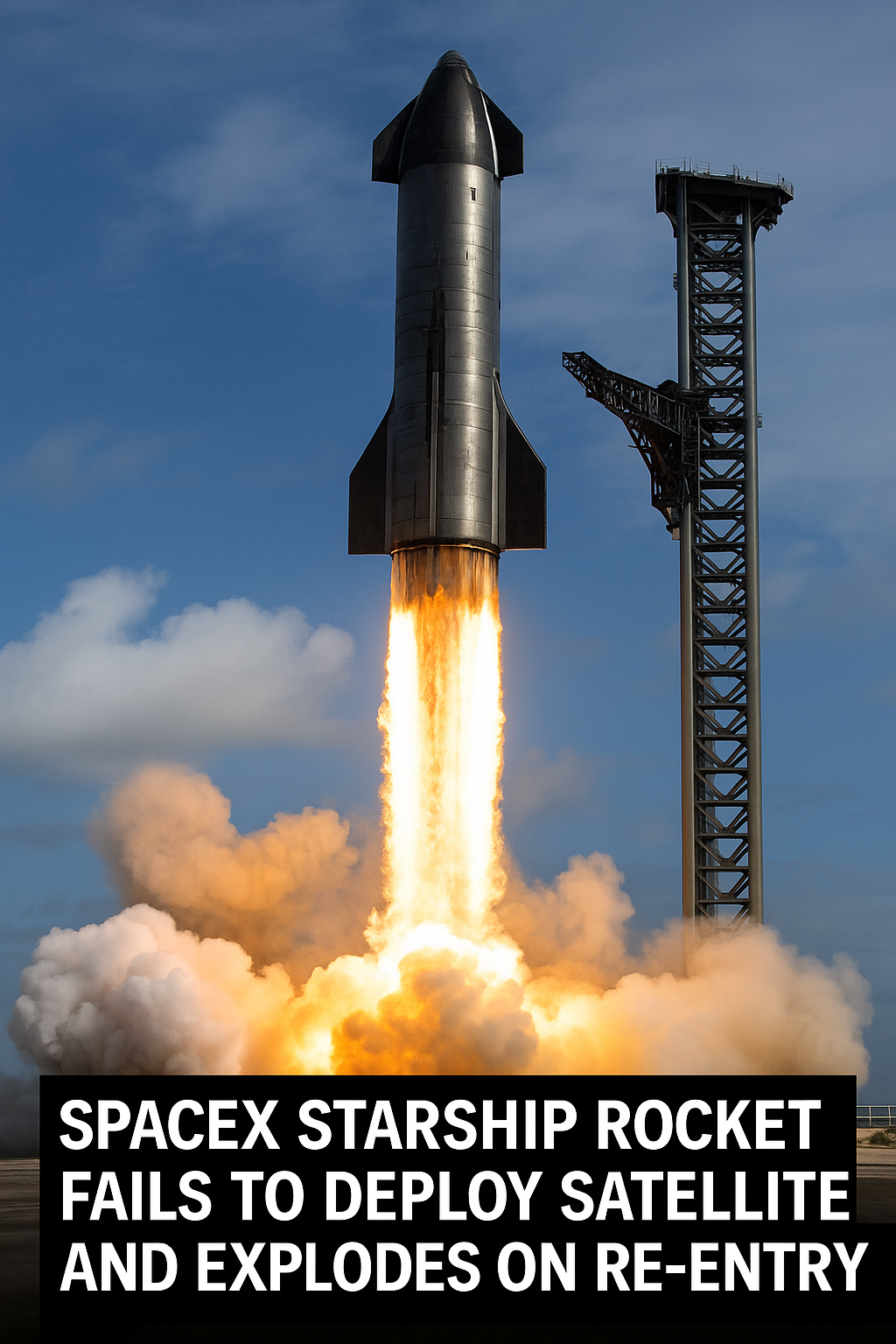

On May 27, 2025, SpaceX’s much-anticipated Starship test mission ended in failure when the spacecraft exploded during re-entry into Earth’s atmosphere. Launched from the company’s Starbase facility in Texas, the rocket did manage to reach space, but it failed to release its intended payload of eight simulated Starlink satellites.
Test Flight Ends in Mid-Air Disintegration
The upper stage of the vehicle was lost above the Indian Ocean, signaling another significant obstacle for SpaceX in its long-term goal of enabling interplanetary travel.
The Starship spacecraft, standing at a towering 400 feet alongside its Super Heavy booster, marked the ninth test in a series of experimental flights aimed at advancing the technology required for missions to the Moon and Mars. While the launch phase succeeded, the upper stage encountered multiple problems during the coast and re-entry phases. SpaceX later confirmed that the mission concluded with what they described as a “rapid unscheduled disassembly,” a term frequently used by the company for in-flight failures.
Technical Challenges and In-Flight Anomalies
SpaceX founder Elon Musk later revealed on the social media platform X that leaks during the coast and re-entry phase had caused a significant loss of pressure in the main tank, contributing to the malfunction.
Starship Shatters, Bahamas Reacts—All Falcon 9 Landings Frozen Indefinitely
The booster stage, which was not intended to be recovered during this test, crashed into the Gulf of Mexico as planned. The focus of this mission was to push the vehicle beyond previous limits, including testing a steeper re-entry angle for the booster. This high-stress scenario was designed to collect valuable data, which Musk described as “a lot of good data to review.”
Although previous tests had shown improvements—such as controlled splashdowns and successful landings of booster stages—this flight’s results indicate that SpaceX still faces major hurdles in refining Starship’s reliability. The company has invested in advanced recovery methods including the use of robotic arms, nicknamed “Mechazilla,” to catch booster stages mid-air. However, that mechanism was not employed during this specific test.
This is not the first time the Starship program has ended with an explosion. Earlier flights in January and March 2025 also ended prematurely. A fire in the “attic” section led to the failure of the January launch, while a fault in the upper-stage engines caused the March mission to fail. In those instances, debris from the disintegrated rockets scattered across parts of the Atlantic, affecting areas near the Bahamas and the Turks and Caicos Islands. The Federal Aviation Administration (FAA) had temporarily halted further launches after those incidents, requiring SpaceX to complete all corrective actions before granting approval for the May 27 launch.
SpaceX Goals and Growing Pressures
The latest test failure adds to the mounting pressure on Musk and SpaceX, especially as expectations grow for the company’s participation in upcoming NASA missions. Under the Artemis program, NASA has selected SpaceX’s Starship as the vehicle for a crewed lunar landing mission slated no earlier than 2027. An uncrewed demonstration is expected to take place before the end of this year.
Alphabet’s High-Stakes Bet on SpaceX Signals Deepening Tech-Military Ties
Musk has long emphasized that the Starship program is central to his vision of making humanity a multiplanetary species. He has stated plans to send the first uncrewed mission to Mars as early as 2026, followed by a human mission by 2029. Long-term goals include building a sustainable city on Mars within the next two decades. According to Musk, diversifying life beyond Earth will help ensure the survival of human consciousness, a goal he considers both scientific and philosophical.
However, the recent test failure comes at a time when Musk is also under public scrutiny. His political engagements, especially his financial support for political campaigns, have led to criticism from some stakeholders, raising concerns about his focus on SpaceX and other business ventures such as Tesla. Despite these distractions, Musk reaffirmed his commitment to the Starship program and has promised to prioritize his business responsibilities.
SpaceX continues to lead the commercial spaceflight industry, having completed over 400 successful rocket launches. The company’s Falcon 9 and Falcon Heavy rockets have demonstrated reliability and reusability, placing it ahead of competitors like Blue Origin. However, the significantly larger and more complex Starship rocket remains a formidable challenge, requiring continued experimentation and refinement before it can be deemed flight-ready for human missions.
As SpaceX reviews telemetry and mission data from the latest test, preparations are already underway for the next trial. The company aims to address the recent anomalies and build on the lessons learned. For now, the path to the Moon and Mars remains marked by trial, error, and technical persistence.