Scientists exploring Mars have found something unusual — a strange rock sitting in a spot where it clearly doesn’t belong. NASA’s Perseverance rover discovered the odd boulder on September 19, 2025, while studying the Jezero Crater region. Early tests suggest the rock may not even be from Mars.
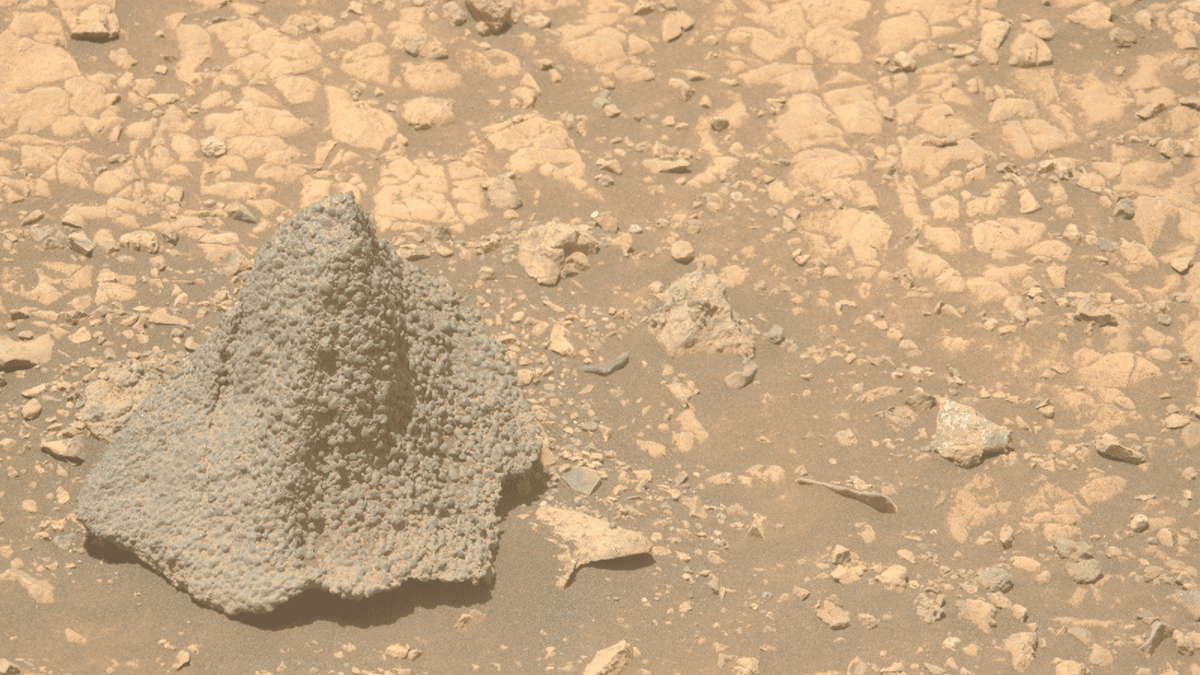
Named Phippsaksla, the rock immediately caught the mission team’s attention. About 80 centimetres long — roughly the size of a small desk — it stands out sharply among the flat, cracked bedrock around it. Mars has many rocks shaped by wind and ancient water, but this one looked completely out of place the moment Perseverance captured its image.
A Strange Rock With an Unusual Makeup
When NASA scientists examined Phippsaksla more closely, they found something surprising. The rover used its SuperCam laser and special spectrometers to study the rock’s composition. These tools can detect the elements inside rocks by firing tiny bursts of laser light and reading the reflected energy.
NASA’s Greatest Mars Discovery Imperiled as Government Scraps Mission to Return Life-Clue Rocks
The results revealed something rare on Mars: very high levels of iron and nickel.
Mars does have iron, which is why the planet looks red, but the combination of iron and nickel together in such high amounts is not normally found in native Martian crust. Instead, this chemical signature closely matches iron-nickel meteorites — rocks that form deep inside the cores of large asteroids.
NASA scientists explained that these types of rocks usually come from space. They are created when huge asteroids break apart, sending fragments flying across the solar system. Eventually, some of these pieces fall onto planets like Earth or Mars. That is why the mission team believes Phippsaksla could be an ancient meteorite that landed on Mars long ago.
The strange shape of the rock also supports this idea. Scientists noticed that the boulder looks nothing like the flatter, more eroded rocks around it. Its size, shine, and edges all suggest that it arrived from elsewhere and somehow survived Mars’ harsh conditions for thousands or even millions of years.
Why This Rock Surprised Scientists
Finding meteorites on Mars is not new. NASA’s Curiosity rover, exploring Gale Crater on another part of the planet, has already found several iron-nickel meteorites over the years. Some of these were large, including the well-known “Lebanon” meteorite, which was almost one metre wide.
But what puzzled the Perseverance team was that no such meteorites had been spotted in Jezero Crater until now. Jezero and Gale are similar in age, and both locations show signs of many past impacts. Scientists had expected Perseverance to find meteorites earlier in the mission, but the rover had gone years without seeing any.
That made Phippsaksla’s discovery even more intriguing. It was found not inside the crater but just outside its rim, on a patch of bedrock believed to have formed from impact processes long ago. This could mean the object was dropped there during a past impact event, or perhaps it landed directly on that spot after travelling through space.
NASA’s 5th Biennial Exercise to tackle Asteroid threats
Another reason the rock stood out is its preservation. Mars has strong winds, dust storms, and temperature swings that can erode surfaces over time. Yet Phippsaksla appears to have kept its iron-nickel signature clearly intact. This suggests it may have landed in a way that protected it or that its strong metallic nature helped it survive.
NASA emphasized that more work is needed to confirm its identity, but early signs point strongly to Phippsaksla being a meteorite — one that may have travelled millions of kilometres before ending up on the Martian surface.
How This Discovery Fits Into Mars Exploration
Perseverance has been exploring the Jezero region to learn about Mars’ ancient environment. This area once had rivers and possibly a lake, making it an important site for searching for past signs of life. While the rover mainly studies sedimentary rocks and dried-up waterways, finding a meteorite adds an unexpected twist to the mission.
Meteorites on Mars can serve as natural time capsules. They carry material from other worlds, and their chemical makeup can help scientists understand how asteroids formed and changed over billions of years. Some meteorites also help researchers study conditions in the early solar system, long before planets like Earth fully formed.
NASA Mars rover uncovers Martian rock that may hold clearest signs of ancient alien life
NASA’s blog post titled “A Stranger in Our Midst?” reflected the team’s excitement. They described the discovery as surprising and noted that Phippsaksla’s unique combination of iron and nickel provides a strong clue that it did not originate from Martian rock.
The scientists also highlighted that discovering this meteorite outside the crater is important because it confirms that meteorites have fallen across many parts of Jezero over time — not just in regions where Curiosity and other rovers have explored before.
As Perseverance continues its mission, the team plans to keep studying Phippsaksla to learn more about its age, origin, and journey. But for now, the unusual rock stands as a reminder that Mars still holds many surprises — some of which arrive not from the planet itself, but from the vastness of space.