
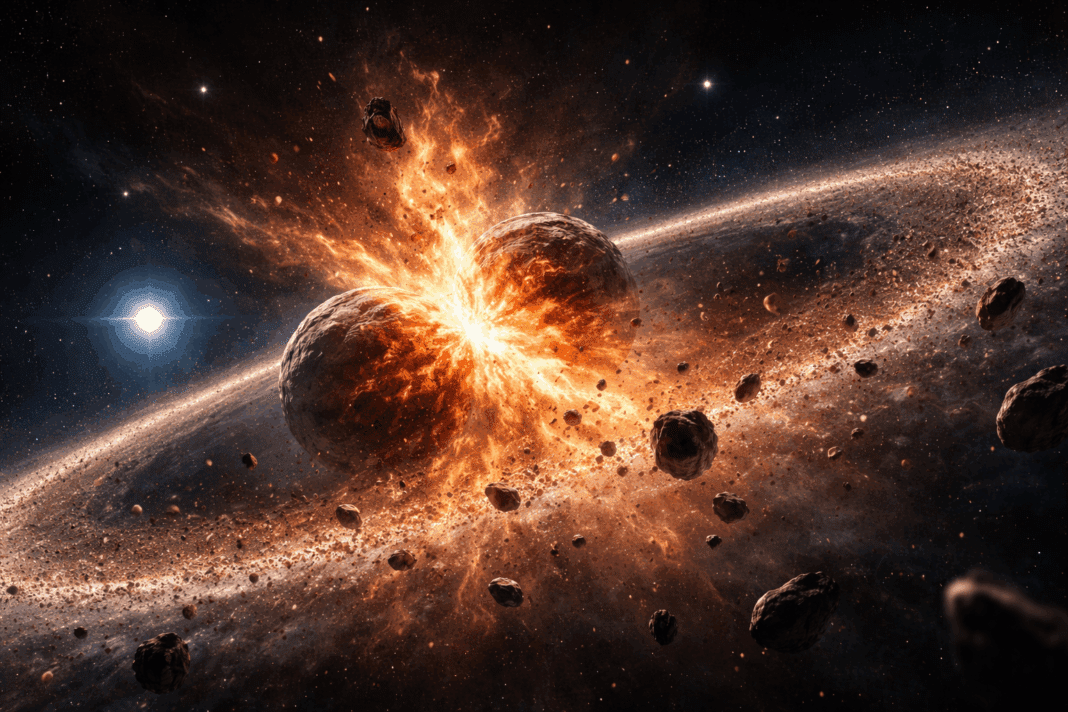

NASA’s Hubble Space Telescope has captured a spectacular scene in a star system not far from Earth, offering the rare chance to witness massive planets colliding. For decades, astronomers have studied a bright star named Fomalhaut, located about 25 light-years away in the Southern Fish constellation, and now new images suggest that objects around it are smashing into each other in dramatic cosmic crashes.
A Stunning Discovery of Planets Colliding
In 2023, astronomers noticed a faint point of light near a broad ring of dust surrounding Fomalhaut. This discovery closely resembled an earlier detection from the mid-2000s that slowly disappeared over time. Scientists now believe that these points of light were not planets at all but debris clouds created by enormous planets colliding or large planetesimals smashing together.
Planetesimals are rocky objects that form in the early stages of a planetary system, and they are the building blocks of planets. When they collide, they release huge amounts of dust that reflect starlight, making them briefly visible to telescopes like Hubble. Over time, sunlight pushes on these tiny dust grains, causing the clouds to spread out and fade. This explains why the first debris cloud vanished and why the second cloud, from another event of planets colliding, may also disappear.
NASA leadership discourse draws attention after political activist Laura Loomer’s comments surface
These collisions are incredibly rare. Experts previously thought that events of this size would occur only once every 100,000 years in a star system like Fomalhaut’s. However, the team observed not just one, but two separate debris clouds in close proximity, suggesting that major planets colliding may happen more often than previously believed—or that this region of the system is unusually active.
How Hubble Captured Planets Colliding
Fomalhaut has long intrigued astronomers because of the dust belts surrounding it, which are similar to our solar system’s Kuiper Belt beyond Neptune. In 2004, Hubble spotted a compact object inside one of these belts, called Fomalhaut b. At the time, scientists debated whether it was a planet or something else.
NASA’s 5th Biennial Exercise to tackle Asteroid threats
Over the years, the object dimmed, stretched outward, and eventually disappeared. Its changing appearance matched predictions for a debris cloud from planets colliding rather than a planet. Nearly 20 years later, Hubble returned to the system and discovered a new object nearby along the same dust ring. This second object is thought to be the result of another massive collision of planets colliding, reinforcing the idea that Fomalhaut is a stage for active cosmic crashes.
The debris clouds are estimated to have formed from objects roughly 37 miles wide—larger than most asteroids involved in known solar system crashes. The impact releases enormous amounts of dust, which briefly shines brightly by reflecting the light of Fomalhaut, allowing astronomers to witness these otherwise invisible events of planets colliding.
Why This Matters
These rare cosmic collisions provide scientists with a unique opportunity to study how planetary systems evolve long after their stars form. By watching debris clouds almost in real time, astronomers can estimate how often such planets colliding occur, how much material is released, and how the surrounding dust disks continue to change over time.
Fomalhaut’s planetary system acts as a natural laboratory. Observing these dust clouds helps researchers understand the behavior and composition of planetesimals when they collide. Each new collision reveals more about the early stages of planet formation and the forces shaping planetary systems across the galaxy.
The discovery also highlights how appearances can be deceiving in space. Objects that look like planets may actually be clouds of dust from catastrophic events of planets colliding. This new understanding helps astronomers interpret past observations more accurately and sheds light on the hidden activity that continues to shape distant star systems.
The observations were made using Hubble’s advanced visible light instruments. Future studies with infrared telescopes like James Webb may provide even more information about the size and makeup of these dust clouds, although the current findings already offer unprecedented insight into the violent and dynamic processes that continue to occur with planets colliding around stars like Fomalhaut.

