
The Space Tech Power List 2026 is SpaceTech Times’ ranking of the 25 most-followed space technology voices on LinkedIn. French ESA astronaut Thomas Pesquet leads with about 545,000 followers, followed by fellow ESA astronaut Sophie Adenot (about 184,000) and Skyroot Aerospace co-founder Pawan Kumar Chandana (about 178,000). Together, the 25 leaders reach roughly 2 million followers across 9 countries, and every one of them is eligible to claim a verified, shareable LinkedIn badge.
Key takeaways
- Astronauts and agency leaders form the largest group: 7 astronauts and 4 space agency leaders, including ESA’s Director General and NASA’s longest-serving Administrator.
- Company founders and executives are close behind with 9 names, from launch and satellite companies to Blue Origin, Planet Labs and ICEYE.
- North America (11) and Europe (8) supply 19 of the 25 names; Asia has 3, and Latin America, the Middle East and Africa, and Oceania have one each.
- The United States has the most entries (11), followed by France (4) and India (3).
- Rankings use LinkedIn follower counts recorded in SpaceTech Times’ research sheet. They measure reach, not influence or achievement, and the counts are not independently verified.
How the Space Tech Power List 2026 was compiled
The list ranks 25 space technology professionals by the number of followers on their public LinkedIn profiles, as recorded in SpaceTech Times’ research sheet at the time of compilation in November 2026. Where two figures were close, the sheet order was kept.
What the ranking means. Followers measure audience size on one platform. They are not a judgement of technical achievement, leadership or commercial success, and many outstanding space professionals are not active on LinkedIn.
Accuracy. Follower counts change daily and have not been independently verified, so figures in this article are rounded. The country shown is the one recorded in the research sheet, which may differ from a person’s nationality. Job titles come from public sources and may change.
Grouping. The categories used in this article (astronaut, agency leader, founder or executive, investor or advisor, industry specialist) are SpaceTech Times’ own editorial grouping.
The Space Tech Power List 2026 at a glance
The table below shows all 25 leaders in rank order. Follower counts are rounded and show approximate LinkedIn followers and come from SpaceTech Times’ research sheet.
| # | Leader and role | Country | Followers |
|---|---|---|---|
| 1 | Thomas Pesquet ESA astronaut, European Space Agency |
France | 545K |
| 2 | Sophie Adenot ESA astronaut, European Space Agency |
Germany | 184K |
| 3 | Pawan Kumar Chandana Co-founder and CEO, Skyroot Aerospace |
India | 178K |
| 4 | Daniel S. Goldin Former NASA Administrator |
USA | 119K |
| 5 | Vanessa E. Wyche Senior NASA executive |
USA | 105K |
| 6 | Josef Aschbacher Director General, European Space Agency |
Austria | 103K |
| 7 | Nik Cooper Senior Director, Build Reliability and Quality Assurance, SpaceX |
USA | 102K |
| 8 | Radha Krishna Kavuluru Space technologist and former ISRO scientist |
India | 77.5K |
| 9 | Jonny Kim NASA astronaut |
USA | 61.6K |
| 10 | Dave Limp Chief Executive Officer, Blue Origin |
USA | 53.3K |
| 11 | Marcos Pontes Astronaut and former Minister of Science, Technology and Innovations |
Brazil | 42.8K |
| 12 | Daniel Metzler Co-founder and CEO, Isar Aerospace |
Germany | 39.8K |
| 13 | Helene Huby Co-founder and CEO, The Exploration Company |
France | 39.4K |
| 14 | Aisha Bowe Founder and CEO, STEMBoard |
USA | 38.2K |
| 15 | Chad Anderson Founder and Managing Partner, Space Capital |
USA | 35K |
| 16 | Dr Somanath Sreedhara Panicker Former Chairman, ISRO |
India | 33.2K |
| 17 | Dylan Taylor Chairman and CEO, Voyager Technologies |
USA | 31.5K |
| 18 | Sara Sabry Astronaut and space advocate |
Egypt | 30.2K |
| 19 | Martin Sion Chief Executive Officer, Alstom |
France | 27.5K |
| 20 | Rafal Modrzewski Co-founder and CEO, ICEYE |
Finland | 26.9K |
| 21 | Katherine Bennell-Pegg Space engineer and astronaut-trained specialist |
Australia | 26.1K |
| 22 | Arnaud Prost ESA reserve astronaut |
France | 26K |
| 23 | Moriba Jah Astrodynamicist and professor, University of Texas at Austin |
USA | 23.5K |
| 24 | Christina Korp Founder, SPACE for a Better World |
USA | 21.2K |
| 25 | Will Marshall Co-founder and CEO, Planet Labs |
USA | 21K |
Get your verified Space Tech Power List badge
Are you one of the 25? Paste your LinkedIn profile URL in the tool below. If it matches your entry, you can download your badge and add it to the Licenses and certifications section of your LinkedIn profile with a verification link that points back to this page. Badges are valid for one year, until November 2027.
Profiles of the 25 leaders
Each profile gives the leader’s rank, country, approximate LinkedIn audience and a short factual summary based on public sources.
Thomas Pesquet
Rank 1 | France | Europe | About 545K LinkedIn followers
Thomas Pesquet is a French European Space Agency (ESA) astronaut and aerospace engineer who has become one of the most recognisable European voices in human spaceflight. He has completed two long-duration missions aboard the International Space Station (ISS), contributing to scientific research, international cooperation and the operation of one of the world’s most advanced orbital laboratories. His career combines engineering expertise with extensive experience in space operations and public science communication.
Pesquet is expected to fly again in 2027 on a mission involving commercial space station developer Vast, under an agreement announced by France in June 2026. His professional updates and public engagement have helped bring space exploration closer to a wider audience. With approximately 545,000 LinkedIn followers, he leads this year’s list by a substantial margin, with an audience nearly three times the size of the second-ranked profile.
Sophie Adenot
Rank 2 | Germany | Europe | About 184K LinkedIn followers
Sophie Adenot is a French ESA astronaut and former military test pilot whose career reflects the combination of aviation, engineering and operational expertise required for human spaceflight. Her selection as an ESA astronaut placed her among the professionals preparing for Europe’s next generation of crewed missions. Her background in military aviation also provides experience in complex technical environments and demanding flight operations.
Adenot launched to the International Space Station aboard SpaceX Crew-12 on 13 February 2026 for her epsilon mission and returned on 8 October 2026 after nearly eight months in orbit, according to the supplied research. The mission marked a major milestone in her astronaut career and included her becoming the first French woman to conduct a spacewalk. Her public profile reflects growing interest in European human spaceflight and the role of women in space exploration.
Pawan Kumar Chandana
Rank 3 | India | Asia | About 178K LinkedIn followers
Pawan Kumar Chandana is the co-founder and chief executive officer of Skyroot Aerospace, a Hyderabad-based private space company working to develop launch vehicles for the commercial space market. An aerospace engineer by training, Chandana has been part of India’s transition towards a more commercially driven space sector, where private companies are developing capabilities traditionally associated with government space agencies.
Skyroot achieved a major milestone in 2022 when its Vikram-S vehicle became India’s first privately developed rocket to be launched into space. The achievement brought greater attention to the country’s emerging private launch industry and demonstrated the growing role of startups in India’s space ambitions. Through his leadership at Skyroot, Chandana is helping position Indian companies within the global commercial space ecosystem.
Daniel S. Goldin
Rank 4 | USA | North America | About 119K LinkedIn followers
Daniel S. Goldin served as NASA Administrator from 1992 to 2001, making him the agency’s longest-serving administrator. During his tenure, NASA operated under three US presidents and pursued major programmes involving scientific research, international cooperation and human spaceflight. His leadership period included important developments in the International Space Station programme and the agency’s wider scientific and exploration activities.
After leaving NASA, Goldin continued working in technology and innovation, including as an entrepreneur in areas such as neural computing and artificial intelligence. His experience across government leadership, aerospace programmes and emerging technologies gives him a distinctive perspective on the relationship between scientific research and technological development. His professional presence continues to attract interest from people following the evolution of the space industry.
Vanessa E. Wyche
Rank 5 | USA | North America | About 105K LinkedIn followers
Vanessa E. Wyche is a veteran NASA executive whose career at the agency began in 1989. Over several decades, she has held leadership and technical management responsibilities connected with NASA’s human spaceflight activities. Her work has involved supporting programmes and operations at Johnson Space Center, one of the agency’s principal facilities for astronaut training, mission planning and crewed spaceflight.
Wyche became director of Johnson Space Center in 2021, becoming the first Black woman to lead a NASA centre. In 2025, she was named NASA’s acting associate administrator. Her career reflects the importance of institutional leadership in managing complex space programmes, coordinating technical teams and supporting the next generation of human exploration missions. She remains an influential professional voice in the US aerospace community.
Josef Aschbacher
Rank 6 | Austria | Europe | About 103K LinkedIn followers
Josef Aschbacher is the Director General of the European Space Agency, a position he has held since March 2021. He has spent much of his professional career working in European space programmes, particularly in Earth observation. Before becoming Director General, he led ESA’s Earth observation programmes, giving him extensive experience in satellite-based monitoring, environmental data and the development of European space capabilities.
Under his leadership, ESA has continued to focus on Europe’s role in the global space sector, including scientific exploration, satellite infrastructure and strategic autonomy. Aschbacher is a prominent advocate for the value of space technology in addressing challenges on Earth, from climate monitoring to security and technological competitiveness. His leadership places him at the centre of important decisions about Europe’s space priorities and long-term programmes.
Nik Cooper
Rank 7 | USA | North America | About 102K LinkedIn followers
Nik Cooper is a manufacturing and quality professional associated with SpaceX, where public professional profiles describe him as Senior Director of Build Reliability and Quality Assurance. His work focuses on manufacturing reliability and hardware quality across production programmes. These responsibilities are particularly important in the commercial space industry, where launch systems and spacecraft must meet demanding engineering and operational requirements.
Before his work at SpaceX, Cooper held roles in the automotive manufacturing sector at BMW Group. This experience connects large-scale industrial production with the quality systems required in aerospace manufacturing. His career illustrates how expertise developed in advanced manufacturing can contribute to the development of commercial launch vehicles and other complex space technologies.
Radha Krishna Kavuluru
Rank 8 | India | Asia | About 77.5K LinkedIn followers
Radha Krishna Kavuluru is a space technologist and former scientist at the Indian Space Research Organisation (ISRO). His professional work has included project management responsibilities for the ground segment of NISAR, the joint NASA-ISRO Synthetic Aperture Radar mission. The mission represents an important collaboration between two major space agencies and is designed to use advanced radar technology for observing changes on Earth’s surface.
Kavuluru’s experience in ground-segment development places him within an important part of satellite mission operations. Ground infrastructure enables spacecraft to communicate with Earth, supports the processing of mission data and helps make satellite observations available for scientific and practical applications. He is also a widely quoted commentator on Indian space missions, contributing to public discussion about the country’s growing space capabilities.
Jonny Kim
Rank 9 | USA | North America | About 61.6K LinkedIn followers
Jonny Kim is a NASA astronaut, physician and former United States Navy SEAL whose career spans military service, medicine and human spaceflight. His professional background is unusual even within the astronaut community, combining operational experience in the armed forces with medical training and the technical preparation required for space missions.
Kim travelled to the International Space Station aboard the Soyuz MS-27 spacecraft in 2025 and returned in December of that year. His mission added spaceflight experience to a career already marked by work in demanding operational environments. His professional journey also highlights the range of disciplines that can contribute to astronaut selection and the growing importance of multidisciplinary expertise in human space exploration.
Dave Limp
Rank 10 | USA | North America | About 53.3K LinkedIn followers
Dave Limp is the chief executive officer of Blue Origin, the aerospace company founded by Jeff Bezos. He joined the company in late 2023 after a long career at Amazon, where he led its devices and services business. His experience in technology product development and large-scale business operations provides a background for leading a company working across launch vehicles, space infrastructure and commercial space services.
Blue Origin is developing and operating systems intended to expand access to space. Its programmes include the New Shepard suborbital vehicle and the New Glenn heavy-lift rocket. Under Limp’s leadership, the company is working to strengthen its position in the commercial space market. His role places him at the intersection of technology management, private investment and the development of new launch capabilities.
Marcos Pontes
Rank 11 | Brazil | Latin America | About 42.8K LinkedIn followers
Marcos Pontes is a Brazilian astronaut, engineer and former government minister who became the first Brazilian to travel into space. He flew to the International Space Station in 2006, marking a historic moment for Brazil’s participation in human spaceflight. His mission brought international attention to the country’s space programme and helped strengthen public interest in science and space exploration.
Following his astronaut career, Pontes entered public service and served as Brazil’s Minister of Science, Technology and Innovations from 2019 to 2022. His work across spaceflight, science policy and government leadership gives him a broad perspective on the role of technology in national development. He remains a prominent figure in Latin America’s space community and an advocate for scientific education and innovation.
Daniel Metzler
Rank 12 | Germany | Europe | About 39.8K LinkedIn followers
Daniel Metzler is the co-founder and chief executive officer of Isar Aerospace, a Munich-based company developing launch vehicles for the commercial satellite market. The company is part of Europe’s growing private launch sector, which aims to strengthen the region’s ability to place satellites into orbit and reduce dependence on launch services from other parts of the world.
Isar Aerospace is developing its Spectrum rocket, designed to serve the needs of commercial and institutional satellite customers. Spectrum made its first orbital launch attempt from Norway in 2025. Metzler’s work reflects the growing role of European startups in launch vehicle development and the effort to establish a more competitive commercial space ecosystem across the continent.
Helene Huby
Rank 13 | France | Europe | About 39.4K LinkedIn followers
Helene Huby is the co-founder and chief executive officer of The Exploration Company, a European aerospace startup developing Nyx, a reusable spacecraft concept for cargo transportation and in-orbit logistics. Her work is connected to the development of commercial space infrastructure and the ambition to create European capabilities for serving future space stations.
The company’s Nyx programme is intended to support cargo missions and provide services to space stations and other orbital destinations. Reusable spacecraft and reliable transportation systems are expected to become increasingly important as commercial activity in low Earth orbit expands. Through her leadership, Huby is contributing to Europe’s efforts to develop a stronger private-sector presence in the emerging space economy.
Aisha Bowe
Rank 14 | USA | North America | About 38.2K LinkedIn followers
Aisha Bowe is an aerospace engineer, entrepreneur and former NASA engineer who founded and leads STEMBoard, a technology and engineering company. Her professional background combines technical work with business leadership, giving her experience in developing engineering solutions and building technology-focused organisations.
Bowe is also known for her work promoting science, technology, engineering and mathematics education through initiatives such as LINGO. Her activities aim to introduce more students to technical subjects and help broaden access to opportunities in engineering and technology. Through her work in aerospace, entrepreneurship and education, she has become a visible voice encouraging greater participation in the space and technology sectors.
Chad Anderson
Rank 15 | USA | North America | About 35K LinkedIn followers
Chad Anderson is the founder and managing partner of Space Capital, an investment firm focused on companies developing technologies connected to the space economy. His work involves identifying businesses and technologies that can benefit from the expansion of satellite infrastructure, launch services, geospatial data and other space-related markets.
Anderson is also known for publishing research and reports examining investment activity across the space industry. These reports provide an overview of capital flows, business developments and emerging opportunities in the sector. His work helps connect the technology and investment communities, offering investors and industry professionals a way to understand the commercial potential of space-based infrastructure.
Dr Somanath Sreedhara Panicker
Rank 16 | India | Asia | About 33.2K LinkedIn followers
Dr Somanath Sreedhara Panicker is an Indian aerospace engineer and former Chairman of the Indian Space Research Organisation (ISRO), serving from 2022 to 2025. He also held the position of Secretary of the Department of Space. His career has been closely associated with launch vehicle engineering and the development of India’s space transportation capabilities.
During his tenure as ISRO chairman, India achieved major milestones, including the successful Chandrayaan-3 landing near the lunar south pole in 2023 and the launch of the Aditya-L1 solar observatory. These missions strengthened India’s position in lunar and solar exploration. His leadership period also coincided with increasing attention to private-sector participation and the expansion of India’s broader space ecosystem.
Dylan Taylor
Rank 17 | USA | North America | About 31.5K LinkedIn followers
Dylan Taylor is the chairman and chief executive officer of Voyager Technologies, a US company operating across space and defence technology. He is also a prominent investor in the space sector, with professional interests spanning commercial space infrastructure, emerging aerospace businesses and the development of the wider space economy.
Voyager Technologies listed on the New York Stock Exchange in 2025, bringing additional attention to the company’s role in the space and defence technology market. Taylor has also experienced human spaceflight personally, travelling aboard a Blue Origin New Shepard mission in 2021. His combination of executive leadership, investment activity and spaceflight experience makes him a notable voice in the commercial space industry.
Sara Sabry
Rank 18 | Egypt | Middle East and Africa | About 30.2K LinkedIn followers
Sara Sabry is an Egyptian astronaut, engineer and space advocate who became the first Egyptian to travel into space. She flew aboard Blue Origin’s New Shepard NS-22 mission in 2022, also becoming the first woman from Africa to travel to space. Her flight represented an important milestone for Egypt and helped bring greater visibility to the region’s participation in commercial human spaceflight.
Beyond her own spaceflight, Sabry is involved in promoting wider access to space and encouraging participation from underrepresented communities. Her public work focuses on making space exploration more accessible and building awareness of opportunities in science, technology and aerospace. She has become an important voice in conversations about the future of space participation across the Middle East and Africa.
Martin Sion
Rank 19 | France | Europe | About 27.5K LinkedIn followers
Martin Sion is a French aerospace executive whose career has included senior leadership roles in Europe’s launcher industry. He served as chief executive officer of ArianeGroup from April 2023 to March 2026, overseeing a company involved in the development and production of launch systems and propulsion technologies. His professional background includes a long association with the European aerospace sector.
A graduate of École Centrale Paris, Sion began his career in rocket propulsion at SEP in 1990. His experience spans engineering and executive management, connecting the technical foundations of launch vehicle development with the strategic demands of the aerospace business. He became chief executive officer of Alstom on 1 April 2026, following his tenure at ArianeGroup.
Rafal Modrzewski
Rank 20 | Finland | Europe | About 26.9K LinkedIn followers
Rafal Modrzewski is the co-founder and chief executive officer of ICEYE, a Finnish space technology company specialising in synthetic aperture radar (SAR) satellites. The company’s technology enables Earth observation using radar, allowing it to collect imagery in conditions where traditional optical satellites may face limitations, including at night or through cloud cover.
ICEYE operates a large constellation of SAR satellites and provides data for applications such as disaster response, environmental monitoring and defence. The company’s work demonstrates how commercial satellite operators are expanding the availability of Earth observation data for governments, businesses and other organisations. Modrzewski’s leadership has helped establish ICEYE as a significant player in the global satellite technology market.
Katherine Bennell-Pegg
Rank 21 | Australia | Oceania | About 26.1K LinkedIn followers
Katherine Bennell-Pegg is an Australian space engineer and astronaut who has worked across the country’s developing space sector. Her professional background includes more than a decade of involvement in space technology and programmes connected with areas such as robotics, human spaceflight, resource utilisation and Earth observation.
Bennell-Pegg completed astronaut training with the European Space Agency, becoming a significant figure in Australia’s efforts to build its human spaceflight capabilities. She has also worked with the Australian Space Agency, contributing to the development of national space programmes and technical expertise. Her career highlights the growing participation of Australia in international space activities and the importance of developing local talent and capabilities.
Arnaud Prost
Rank 22 | France | Europe | About 26K LinkedIn followers
Arnaud Prost is a French military test pilot, engineer and European Space Agency reserve astronaut. Selected as part of ESA’s astronaut reserve in November 2022, he is among the professionals preparing to support Europe’s future human spaceflight activities. His background in military aviation and engineering provides experience relevant to the demanding technical and operational requirements of astronaut missions.
Prost is scheduled to make his first spaceflight in 2027 to Vast’s Haven-1 commercial space station, under an agreement announced by France in June 2026. The planned mission reflects the growing involvement of commercial space station developers in human spaceflight and Europe’s interest in maintaining access to future orbital destinations. His career brings together test aviation, engineering and the next phase of commercial human spaceflight.
Moriba Jah
Rank 23 | USA | North America | About 23.5K LinkedIn followers
Moriba Jah is an astrodynamicist and professor at the University of Texas at Austin, known for his work on space domain awareness, orbital debris and the long-term sustainability of activities in Earth orbit. His research examines the movement of objects in space and the growing challenges associated with the increasing number of satellites and other objects operating around the planet.
As commercial and government space activity expands, understanding the orbital environment has become increasingly important for preventing collisions and supporting responsible operations. Jah is a frequent public advocate for sustainable use of Earth’s orbital space, helping bring technical and policy questions about space traffic and debris into wider discussion. His work connects scientific research with the practical challenges facing the global satellite industry.
Christina Korp
Rank 24 | USA | North America | About 21.2K LinkedIn followers
Christina Korp is an astronaut manager, space advisor and entrepreneur whose work focuses on space advocacy, public engagement and communicating the benefits of space exploration. She founded SPACE for a Better World in 2020 and serves as president of Purpose Entertainment. Her professional activities connect astronauts, companies and organisations with audiences interested in space and its wider applications.
Korp previously managed Apollo 11 astronaut Buzz Aldrin and has worked on projects that promote the value of space technology and exploration for life on Earth. Her work extends beyond traditional aerospace operations into education, communication and advocacy. By helping astronauts and space organisations communicate their work, she contributes to building public awareness and wider engagement with the space sector.
Will Marshall
Rank 25 | USA | North America | About 21K LinkedIn followers
Will Marshall is the co-founder and chief executive officer of Planet Labs, a company that operates one of the world’s largest fleets of Earth-imaging satellites. Its satellite network collects frequent observations of the planet, providing data that can support applications in agriculture, environmental monitoring, infrastructure, disaster response and other fields.
Marshall is a physicist by training and began his career as a scientist at NASA before co-founding Planet. His work has helped advance the use of satellite imagery as a source of regularly updated information about the Earth’s surface. Through Planet’s commercial satellite operations, he has contributed to the growth of the geospatial data industry and the expanding role of space technology in decision-making on Earth.
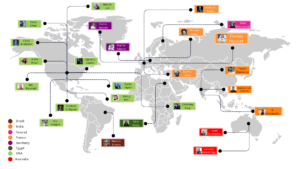
Space tech leaders by region
Of the 25 leaders, the largest groups are in North America and Europe.
North America (11)
Daniel S. Goldin, Vanessa E. Wyche, Nik Cooper, Jonny Kim, Dave Limp, Aisha Bowe, Chad Anderson, Dylan Taylor, Moriba Jah, Christina Korp, Will Marshall.
Europe (8)
Thomas Pesquet, Sophie Adenot, Josef Aschbacher, Daniel Metzler, Helene Huby, Martin Sion, Rafal Modrzewski, Arnaud Prost.
Asia (3)
Pawan Kumar Chandana, Radha Krishna Kavuluru, Dr Somanath Sreedhara Panicker.
Latin America (1)
Marcos Pontes.
Middle East and Africa (1)
Sara Sabry.
Oceania (1)
Katherine Bennell-Pegg.
Frequently asked questions
What is the Space Tech Power List 2026?
The Space Tech Power List 2026 is a ranking by SpaceTech Times of 25 space technology professionals, ordered by their number of LinkedIn followers. It covers astronauts, space agency leaders, company founders and executives, investors and industry specialists across 9 countries.
Who is the most followed space tech leader on LinkedIn in this list?
Thomas Pesquet, the French ESA astronaut, ranks first with about 545,000 followers. Sophie Adenot (about 184,000) and Pawan Kumar Chandana (about 178,000) follow.
How were the 25 leaders ranked?
They were ranked by LinkedIn follower count as recorded in SpaceTech Times’ research sheet in November 2026. The counts are rounded and have not been independently verified, and the ranking measures audience reach rather than influence or achievement.
Which countries and regions are represented?
The list covers 9 countries. North America has 11 entries, Europe 8, Asia 3, and Latin America, the Middle East and Africa, and Oceania one each. The United States, France and India have the most entries.
What types of people are on the list?
SpaceTech Times groups them as 7 astronauts, 4 space agency leaders, 9 company founders or executives, 2 investors or advisors and 3 industry specialists.
How can a listed leader claim the verified LinkedIn badge?
Use the claim tool on this page: paste your LinkedIn profile URL, and if it matches an entry you receive a badge image and a pre-filled “Add to profile” link for the Licenses and certifications section of LinkedIn. SpaceTech Times may also send listed leaders a direct message with their personal link.
How can I verify someone’s Space Tech Power List badge?
Open the Verify tab on this page and paste the credential ID, which looks like ST26-XXXX-XXXX, or click Show credential on the badge in their LinkedIn profile. The page confirms whether the credential matches a listed leader.
How long is the Space Tech Power List badge valid?
The badge is valid for one year from publication, until November 2027, which matches the validity of the Space Tech Power List 2026. The expiry date is added to the credential on LinkedIn, and the verification page shows the credential as expired after that date.
Does the badge prove who owns a LinkedIn profile?
No. The verification confirms that the credential matches a person listed in the Space Tech Power List 2026. Always check that the LinkedIn profile showing the badge is the one listed for that person.
How do I request a correction or an update to an entry?
Contact the SpaceTech Times editorial team through the contact page on this website with the entry name and the change requested. Titles and counts are reviewed and updated when errors are confirmed.
Corrections, sources and disclosures
Profiles are based on public information, including official agency and company websites and press releases, and were last reviewed on 25 November 2026. Titles and affiliations change; if you spot an error or want your entry updated, contact the SpaceTech Times editorial team. Inclusion in the list is based solely on LinkedIn follower counts and does not imply endorsement by, or any commercial relationship with, SpaceTech Times. Follow SpaceTech Times on LinkedIn for new lists and space industry news.