
Last updated: November 23, 2026.
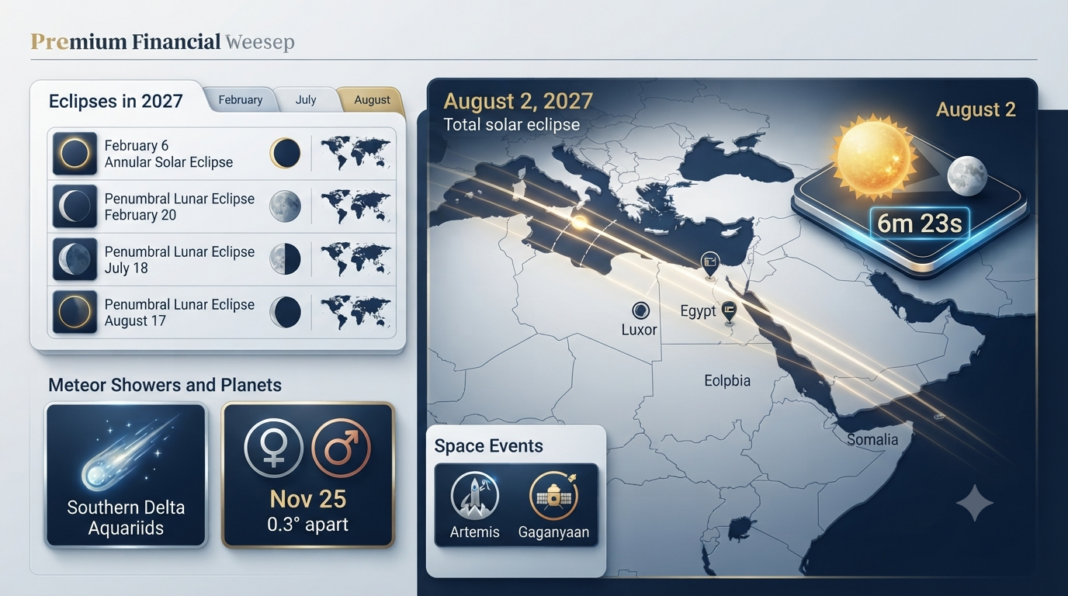
Short answer: The headline event of 2027 is the total solar eclipse on August 2, with totality lasting up to 6 minutes 23 seconds near Luxor, Egypt. The year also has an annular solar eclipse on February 6, three penumbral lunar eclipses and the usual meteor showers.
Eclipses in 2027
| Date | Event | Where |
|---|---|---|
| — | — | — |
| February 6 | Annular solar eclipse | Chile, Argentina, Uruguay and West Africa |
| February 20 | Penumbral lunar eclipse | Visible where the Moon is above the horizon |
| July 18 | Penumbral lunar eclipse | Visible where the Moon is above the horizon |
| August 2 | Total solar eclipse | Southern Europe, North Africa, the Middle East and Somalia |
| August 17 | Penumbral lunar eclipse | Visible where the Moon is above the horizon |
Penumbral lunar eclipses are subtle, because the Moon only dims slightly. They are a smaller event than the solar eclipses.
The August 2 total solar eclipse
The longest totality on the path is 6 minutes 23 seconds, near Luxor in Egypt, according to eclipse calculations. The path crosses Morocco, southern Spain (including Gibraltar), Algeria, Tunisia, Libya, Egypt, Saudi Arabia, Yemen and Somalia. Greatest eclipse occurs at about 10:07 UTC. It is widely described as one of the longest total solar eclipses of the century.
Planning tips:
- Choose your spot early. Hotels and tours along the path in Spain, Morocco and Egypt are likely to book up.
- Check the weather record. Southern Europe and North Africa tend to have clearer skies in early August than many regions, but clouds can still interfere.
- Use proper eye protection. Never look at the Sun without eclipse glasses that meet the ISO 12312-2 standard, except during the brief total phase.
Meteor showers and planets
- Southern Delta Aquariids: peak around July 31, with up to about 25 meteors an hour, and the Moon only about 6% lit, so skies are dark.
- Venus and Mars: a close pairing in the evening sky on November 25, about 0.3 degrees apart, close enough to share a telescope view.
- Planet and meteor shower timings depend on your latitude and local weather, so check a local calendar nearer the date.
Space events to follow on Earth
2027 is also expected to bring the next Artemis flight and, in India, Gaganyaan’s crewed mission. See what NASA does next after Artemis II and where Gaganyaan stands. For terms like penumbral and annular, see our space glossary, and for stargazing basics, our Milky Way stargazing guide.
Frequently asked questions
When is the next total solar eclipse after 2026?
August 2, 2027, crossing southern Europe, North Africa, the Middle East and Somalia.
How long will the August 2, 2027 eclipse last?
Totality lasts up to 6 minutes 23 seconds at the point of greatest duration, near Luxor, Egypt.
What is an annular solar eclipse?
An eclipse in which the Moon is too far from Earth to cover the Sun completely, leaving a bright ring around it. One occurs on February 6, 2027.
Is it safe to look at a solar eclipse?
Only with certified eclipse glasses or solar filters meeting the ISO 12312-2 standard. The brief total phase of a total eclipse is the only time it is safe to look without protection.
Which lunar eclipses happen in 2027?
Penumbral lunar eclipses on February 20, July 18 and August 17, 2027.