
Last updated: November 23, 2026.
Short answer: India has not yet flown the first uncrewed Gaganyaan test, called G1. It is officially targeted for the fourth quarter of 2026, and the first crewed mission has been described as 2027, with a Parliament reply giving 2027 to 2028. No launch date has been confirmed.
What Gaganyaan is
Gaganyaan is ISRO’s human spaceflight programme. The plan is to send a crew of three Indian astronauts to an orbit of about 400 km for a three-day mission and bring them back with a splashdown in the sea. The programme was approved in 2019 and its funding was revised in 2024 to Rs 20,193 crore covering eight missions, according to Indian news reports.
The test flights come first
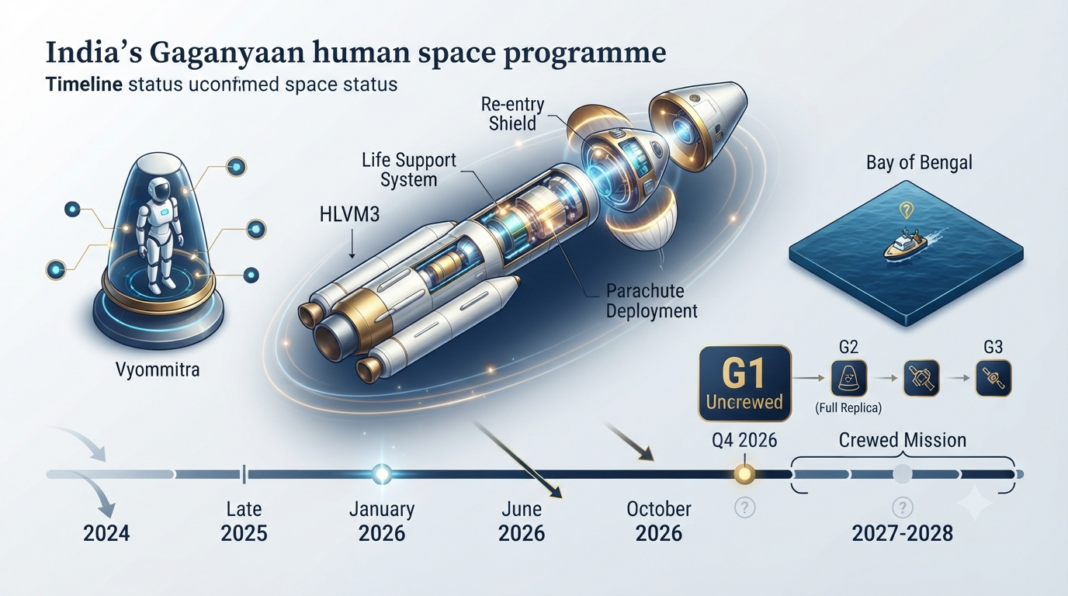
ISRO has said it will complete three uncrewed missions before a crewed flight. G1, the first, will carry a humanoid robot called Vyommitra to test life support, re-entry, parachute deployment and splashdown. G2 and G3 follow, with G2 intended to be an almost exact replica of the final human mission.
How the schedule has moved
- 2024: the crewed flight was pushed to 2026 for safety assurance.
- Late 2025: ISRO said G1 would fly in December.
- January 2026: ISRO’s chairman said G1 was planned for March 2026, with human spaceflight in 2027.
- June 2026: the chairman said engineers were working for an uncrewed launch by the end of 2026, but the schedule depends on safety assessments and could slip.
- October 2026: an official statement placed G1 in the fourth quarter of 2026. A Government of India parliamentary response described the first crewed mission as 2027 to 2028.
That pattern, repeated slips and a safety-first approach, is typical of human spaceflight programmes. ISRO’s chairman has said there is life involved, so the uncrewed tests must succeed first.
Hardware status
Reporting on the government’s programme overview as of late October 2026 says the human-rated LVM3 rocket (HLVM3) has completed development and ground testing of all propulsion stages and structures, and that the crew and service modules have been realised, with assembly and integration nearing completion. That is progress, but it is not a launch date or a human-flight certificate.
What to watch next
- An official G1 launch date and launch window.
- The recovery operation in the Bay of Bengal, which is a key test.
- Whether G2 and G3 follow quickly enough to keep 2027 alive.
For India’s wider space picture, see our Indian space sector guide and the India section.
Frequently asked questions
When will Gaganyaan launch?
The first uncrewed test, G1, is targeted for the fourth quarter of 2026, but no launch date has been confirmed. The first crewed flight has been described as 2027, and a Parliament reply gave 2027 to 2028.
What is Vyommitra?
A half-humanoid robot that will fly on the uncrewed Gaganyaan test missions to collect data in flight.
How many astronauts will fly on Gaganyaan?
The plan is a crew of three Indian astronauts on a mission of about three days in a roughly 400 km orbit.
How many uncrewed tests are planned?
ISRO has said three uncrewed missions will fly before the first crewed one.
Which rocket will carry Gaganyaan?
A human-rated version of the LVM3 launch vehicle, called HLVM3.
Official and primary sources
News reporting and analysis used
- Free Press Journal: Tests underway for uncrewed mission, Gaganyaan slated for 2027 (January 2026)
- The Wire: Gaganyaan could face delays due to safety assessments
- Tech Insider: Gaganyaan HLVM3 readiness (October 2026)
- New Kerala: Gaganyaan G1 uncrewed mission set for 2026 (October 24, 2026)
- Space.com: India delays first Gaganyaan astronaut launch to 2027