

NASA is planning a unique mission called Dragonfly to explore a distant moon using a flying robotic vehicle instead of a rover. It will study an alien world with unusual lakes, rain, and landscapes made of different chemicals. The mission will help scientists understand how complex chemistry may form in extreme environments far from Earth.
NASA’s Dragonfly Mission Heads Toward Titan, Saturn’s Mysterious Moon
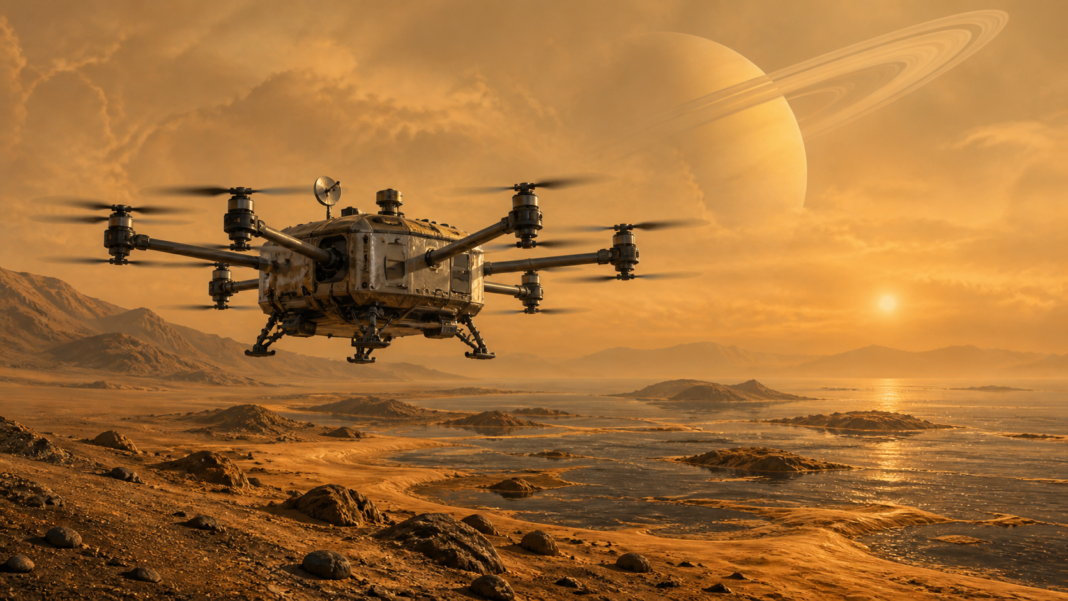
NASA’s Dragonfly mission is set to explore Titan, the largest moon of Saturn and one of the most unusual worlds in the solar system. Instead of wheels like traditional rovers, Dragonfly is designed as a flying robotic aircraft that can move across Titan’s surface by air. This makes it very different from earlier space vehicles that slowly roll across rocky ground.
Titan is about 886 million miles away from Earth and is even larger than Mercury. It has a thick orange atmosphere that hides its surface from direct view. Unlike most moons, it has weather systems, including rain, rivers, and lakes made of methane and ethane instead of water.
NASA builds on the success of the Mars helicopter to launch a powerful drone mission to Titan
After a long journey through space, Dragonfly will explore Titan by flying from place to place. Its design allows it to cover large distances quickly, helping scientists study different regions that may reveal how complex chemistry develops in extreme alien environments.
Titan’s Thick Atmosphere Makes Flight Possible in a Strange Alien World
Titan is one of the rare places in the solar system where a drone-like machine can fly more easily than on Earth. This is mainly because its atmosphere is very thick. The air pressure is about 1.5 times higher than Earth’s surface, and the air itself is much denser. This helps flying vehicles stay in the air with less effort.
At the same time, Titan’s gravity is much weaker. Objects there weigh only about one-seventh of what they would weigh on Earth. Together, thick air and low gravity create ideal conditions for flight, making it easier for a robotic aircraft like Dragonfly to move around.
Titan is also extremely cold. Temperatures are so low that methane behaves like liquid water does on Earth. Instead of rain made of water, Titan experiences methane rain, which slowly reshapes its surface over time.
Its atmosphere contains nitrogen and many organic compounds. These substances drift through the air and settle on the ground, forming dunes and deposits rich in carbon-based material. This makes Titan one of the most chemically active moons in the solar system.
Scientists think Titan may resemble early Earth in some ways. Long ago, Earth may have had similar chemistry before life began. Because Titan has stayed frozen and unchanged for billions of years, it may preserve clues about those early chemical processes.
Dragonfly’s Flying Design and Onboard Laboratory for Alien Chemistry
Dragonfly is an SUV-sized spacecraft designed as an eight-rotor flying machine instead of a traditional wheeled rover. It can take off, land, and fly across Titan’s surface, allowing it to travel long distances much faster than ground-based vehicles. This gives it the ability to explore many different regions in a short time.
The spacecraft carries a built-in scientific laboratory that collects samples from Titan’s icy surface and organic-rich sandy material. These samples are processed inside onboard ovens and instruments that study their chemical composition in detail. The goal is to understand what materials exist on this distant moon.
NASA astronaut Anil Menon prepares for his first mission to the International Space Station
One of the main instruments is a mass spectrometer, which detects very small chemical traces in samples. It can identify molecules like amino acids, nucleobases, and fatty acids, which are considered key building blocks of life. Dragonfly also uses a rotating system to store samples and a laser tool to examine surface materials without always collecting them.
The mission can also drill into Titan’s frozen ground to reach buried materials where ancient chemistry may be preserved. Unlike smaller Mars helicopters, Dragonfly is larger and more powerful, made possible by Titan’s thick atmosphere. It will mainly explore equatorial dune regions rich in organic particles formed by long-term atmospheric reactions.