

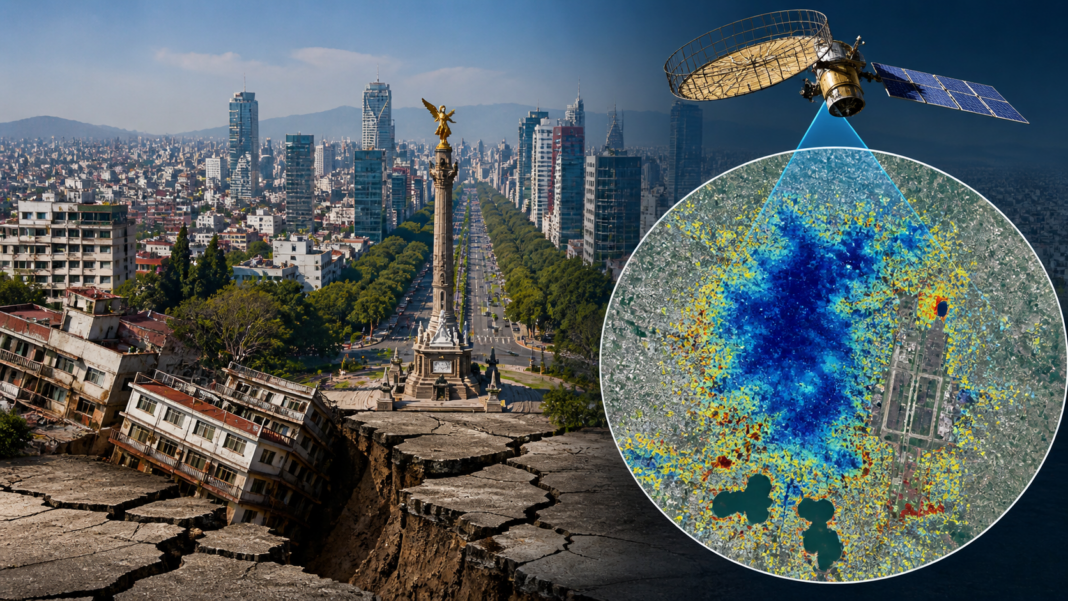

New satellite data has revealed a surprising and serious issue—Mexico City is sinking at a rapid rate. Using advanced space technology, scientists can now track these changes more clearly, showing how the ground beneath the city is gradually collapsing.
A Giant City Slowly Sinking Into the Ground
Mexico City, one of the largest cities in the world, is facing a serious and unusual problem—it is slowly sinking. New satellite data shows that parts of the city are going down by nearly 10 inches (about 25 centimeters) every year. This makes it one of the fastest-sinking big cities on Earth.
The metropolitan area covers about 3,000 square miles (7,800 square kilometers) and is home to nearly 22 million people. That means millions of people are living in a place where the ground beneath them is gradually lowering.
NASA astronaut Anil Menon prepares for his first mission to the International Space Station
This new information comes from advanced satellite imagery that can measure tiny changes in the Earth’s surface. The images show that some areas are sinking faster than others. In certain zones, the land is dropping by more than half an inch (over 2 centimeters) every month.
The data highlights how serious the situation has become. It also shows how modern technology can help scientists closely monitor changes that are difficult to see with the naked eye.
Why Mexico City Is Sinking So Fast
The main reason behind the sinking is how Mexico City was built. The city stands on an ancient lakebed that was once covered with water. Over time, this area was drained and developed, leaving behind soft and unstable soil beneath the surface.
Beneath the city lies an aquifer, a natural underground layer that stores water. For decades, large amounts of water have been pumped out to meet the needs of the growing population. As this water is removed, the soil begins to compact, causing the ground above to slowly sink.
The heavy weight of buildings, roads, and infrastructure adds further pressure on the soft ground. This increases the rate at which the land compresses, making the sinking more noticeable over time.
This process has been ongoing for more than a hundred years, but modern satellite technology now helps track it more accurately. Recent data collected between October 2025 and January 2026 shows faster sinking during the dry season. In the images, rapidly sinking areas appear in dark blue, while other colors may represent minor noise in the data.
Advanced Satellite Technology Reveals Hidden Changes
The new data comes from an advanced Earth-observation satellite that tracks changes on the planet’s surface using synthetic aperture radar. This technology allows it to see through clouds and dense vegetation, making it highly effective in all weather conditions, especially in areas like Mexico City.
The satellite scans Earth every 12 days, providing regular updates on land, ice, and surface changes. Its large radar antenna captures highly detailed measurements, helping scientists monitor even the smallest ground movements in Mexico City.
One of its key strengths is detecting slight sinking or shifting of land. This makes it especially useful for studying cities like Mexico City, where the ground is gradually subsiding. The satellite uses two radar systems at different wavelengths, improving accuracy in complex environments like urban and coastal regions.
New high capacity ViaSat-3 F3 satellite brings faster internet to remote regions in Asia
The images clearly show major landmarks, including the international airport and nearby lakes, allowing scientists to track changes over time in Mexico City. A well-known monument built in 1910 has had steps added over the years as the surrounding ground sank, highlighting visible impacts.
These observations show how continuous monitoring helps scientists understand land changes. The data also highlights the effects of long-term groundwater use and urban development, demonstrating the importance of modern space technology in studying Earth.